Content Navigation

In the realm of legal agreements, the Georgia Hold Harmless Agreement form plays a crucial role in protecting individuals and organizations from liability. This form serves as a mutual understanding between parties, where one party agrees not to hold the other responsible for any potential losses, damages, or legal claims that may arise during a specific activity or event. It is often utilized in various contexts, such as rental agreements, event planning, and construction projects, ensuring that all parties are aware of their responsibilities and the risks involved. By signing this agreement, participants can engage in activities with a clearer understanding of their legal standing, fostering a sense of security and trust. The form typically outlines the scope of the agreement, specifies the parties involved, and may include provisions related to indemnification. Understanding the nuances of this document is essential for anyone looking to navigate potential liabilities effectively and ensure a smooth partnership or event execution.

Georgia Hold Harmless Agreement Example

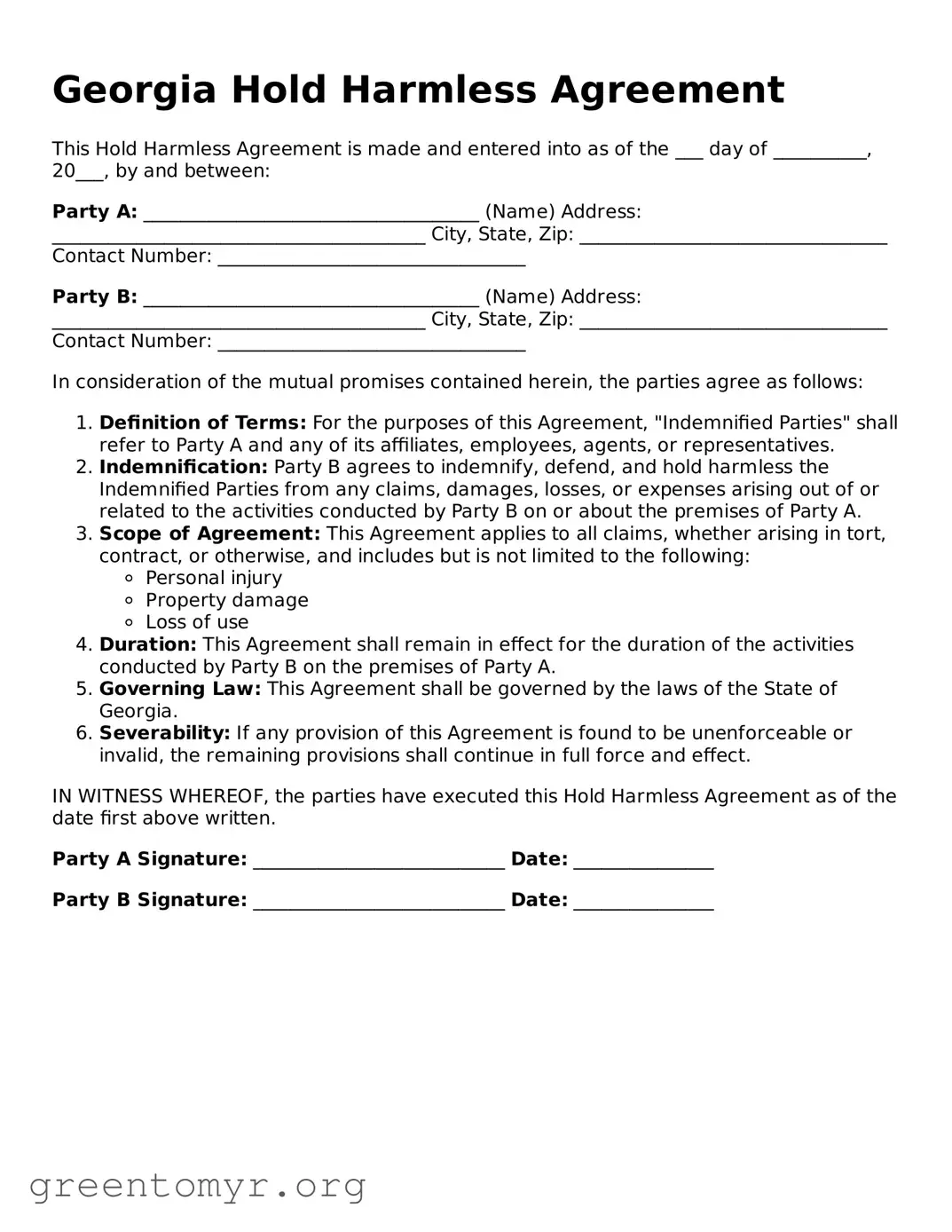
Georgia Hold Harmless Agreement

This Hold Harmless Agreement is made and entered into as of the ___ day of __________, 20___, by and between:

Party A: ____________________________________ (Name) Address: ________________________________________ City, State, Zip: _________________________________ Contact Number: _________________________________

Party B: ____________________________________ (Name) Address: ________________________________________ City, State, Zip: _________________________________ Contact Number: _________________________________

In consideration of the mutual promises contained herein, the parties agree as follows:

  1. Definition of Terms: For the purposes of this Agreement, "Indemnified Parties" shall refer to Party A and any of its affiliates, employees, agents, or representatives.
  2. Indemnification: Party B agrees to indemnify, defend, and hold harmless the Indemnified Parties from any claims, damages, losses, or expenses arising out of or related to the activities conducted by Party B on or about the premises of Party A.
  3. Scope of Agreement: This Agreement applies to all claims, whether arising in tort, contract, or otherwise, and includes but is not limited to the following:
    • Personal injury
    • Property damage
    • Loss of use
  4. Duration: This Agreement shall remain in effect for the duration of the activities conducted by Party B on the premises of Party A.
  5. Governing Law: This Agreement shall be governed by the laws of the State of Georgia.
  6. Severability: If any provision of this Agreement is found to be unenforceable or invalid, the remaining provisions shall continue in full force and effect.

IN WITNESS WHEREOF, the parties have executed this Hold Harmless Agreement as of the date first above written.

Party A Signature: ___________________________ Date: _______________

Party B Signature: ___________________________ Date: _______________

PDF Form Features

Fact Name Description
Purpose The Georgia Hold Harmless Agreement is designed to protect one party from legal liability for injuries or damages incurred by another party.
Governing Law The agreement is governed by the laws of the State of Georgia.
Parties Involved Typically, there are two parties: the indemnitor (the party providing protection) and the indemnitee (the party being protected).
Common Uses This agreement is often used in rental agreements, construction contracts, and event planning.
Enforceability For the agreement to be enforceable, it must be clear, specific, and signed by all parties involved.
Limitations Some limitations may apply. For instance, it may not protect against gross negligence or willful misconduct.
Written Agreement A written document is essential. Verbal agreements may not hold up in court.
Legal Review It is advisable to have the agreement reviewed by a legal professional to ensure compliance with state laws.
Duration The duration of the agreement should be specified, indicating how long the hold harmless provisions remain in effect.
Indemnification Scope The scope of indemnification should be clearly defined, detailing what types of claims and damages are covered.

Guide to Using Georgia Hold Harmless Agreement

Completing the Georgia Hold Harmless Agreement form is a straightforward process. Once you have gathered the necessary information, you will be ready to fill out the form accurately. This will ensure that all parties involved understand their responsibilities and liabilities.

  1. Begin by downloading the Georgia Hold Harmless Agreement form from a reliable source.
  2. Read the form carefully to familiarize yourself with the sections that need to be completed.
  3. In the first section, provide the names and contact information of all parties involved. This includes the individual or organization that will be held harmless and the person or entity that is agreeing to hold them harmless.
  4. Next, specify the location where the activities covered by the agreement will take place. Be as detailed as possible to avoid any confusion.
  5. In the following section, describe the activities that will take place. This should clearly outline what the agreement covers.
  6. Indicate the date of the agreement. Ensure this is accurate, as it may be referenced in the future.
  7. Each party should sign and date the form. If there are multiple signatories, make sure everyone has signed where indicated.
  8. After all signatures are collected, make copies of the completed form for each party involved. This will provide a record for future reference.

Once the form is filled out and signed, it is advisable to keep it in a safe place. Each party should retain their copy for their records. This will help ensure that everyone is aware of their obligations and can refer back to the agreement if necessary.

Get Answers on Georgia Hold Harmless Agreement

What is a Georgia Hold Harmless Agreement?

A Georgia Hold Harmless Agreement is a legal document that protects one party from liability for any damages or injuries that may occur during a specific event or activity. This agreement is often used in situations where one party is providing services or facilities to another party, ensuring that the service provider is not held responsible for unforeseen incidents.

When should I use a Hold Harmless Agreement?

Consider using a Hold Harmless Agreement in various scenarios, including:

  • Hosting events where participants might be injured.
  • Renting out property or facilities for activities.
  • Engaging contractors for construction or maintenance work.
  • Participating in recreational activities that involve risks.

Who should sign the Hold Harmless Agreement?

Typically, both parties involved in the agreement should sign it. This includes the party providing the service or facility and the party receiving it. By signing, both parties acknowledge the terms and conditions outlined in the agreement, ensuring mutual understanding and acceptance of the liability limitations.

What are the key components of a Hold Harmless Agreement?

A comprehensive Hold Harmless Agreement generally includes the following components:

  1. Identification of Parties: Clearly state the names and addresses of the parties involved.
  2. Scope of Activities: Define the activities or events covered by the agreement.
  3. Liability Waiver: Include language that specifies which liabilities are being waived.
  4. Indemnification Clause: Outline the responsibilities of each party in case of a claim.
  5. Governing Law: Specify that Georgia law governs the agreement.

Is a Hold Harmless Agreement legally binding in Georgia?

Yes, a Hold Harmless Agreement can be legally binding in Georgia, provided it meets certain criteria. It must be clear, specific, and voluntarily signed by both parties. However, courts may not enforce agreements that attempt to waive liability for gross negligence or willful misconduct.

Can I modify a Hold Harmless Agreement?

Yes, a Hold Harmless Agreement can be modified as long as both parties agree to the changes. It is important to document any modifications in writing and have both parties sign the revised agreement to ensure clarity and enforceability.

What happens if a claim arises despite the Hold Harmless Agreement?

If a claim arises, the Hold Harmless Agreement should be reviewed to determine its applicability. If the claim falls within the scope of the agreement, the party protected by the agreement may not be held liable. However, if the claim involves gross negligence or is outside the agreement's terms, the party may still face legal responsibility.

Do I need a lawyer to draft a Hold Harmless Agreement?

While it is not strictly necessary to hire a lawyer to draft a Hold Harmless Agreement, it is advisable. A legal professional can ensure that the agreement is comprehensive, enforceable, and tailored to your specific needs. This can help prevent potential disputes and misunderstandings in the future.

How can I obtain a Hold Harmless Agreement template?

Hold Harmless Agreement templates can be found online through various legal resources or document services. However, it is essential to ensure that any template used complies with Georgia law and is suitable for your particular situation. Consulting with a legal professional can provide additional guidance in this regard.

Common mistakes

When filling out the Georgia Hold Harmless Agreement form, many individuals make common mistakes that can lead to confusion or even legal issues. One frequent error is failing to provide complete information. This includes not filling in all required fields, such as names, addresses, and dates. Incomplete forms can delay processing and may even render the agreement invalid.

Another mistake is overlooking the importance of clarity in the agreement. People often use vague language or legal jargon that can be misinterpreted. It is crucial to clearly outline the responsibilities and liabilities being waived. A well-defined agreement helps ensure that all parties understand their rights and obligations.

Additionally, individuals sometimes neglect to read the entire document before signing. Skimming through the terms can lead to misunderstandings about what the agreement entails. Taking the time to review the form thoroughly can prevent surprises later on and foster trust between the parties involved.

Lastly, failing to have the agreement notarized or witnessed, when required, is a common oversight. Some may assume that a signature alone is sufficient. However, having a notary or witness can add an extra layer of validity and protection to the agreement. Ensuring that all formalities are met is essential for the document to hold up in case of a dispute.

Documents used along the form

When entering into a Georgia Hold Harmless Agreement, it's essential to have a clear understanding of other related documents that may be necessary. These forms help clarify responsibilities and ensure that all parties are protected. Here’s a list of documents often used alongside the Hold Harmless Agreement:

  • Liability Waiver: This document releases one party from liability for any injuries or damages that may occur during an event or activity. It emphasizes that participants understand the risks involved.
  • Indemnity Agreement: Similar to a Hold Harmless Agreement, this document requires one party to compensate another for any losses or damages incurred. It often outlines specific scenarios where indemnification applies.
  • Insurance Certificate: This form provides proof of insurance coverage. It typically includes details about the policy, such as the type of coverage and the limits, ensuring that adequate protection is in place.
  • Release of Liability: This document is signed by participants to acknowledge that they are aware of the risks involved in an activity. By signing, they agree not to hold the organizers responsible for any injuries or damages.
  • Contractor Agreement: If a contractor is involved in the project, this document outlines the terms of the working relationship. It includes details about services, payment, and responsibilities, ensuring everyone is on the same page.

Having these documents in place can streamline processes and protect all parties involved. It's crucial to understand each form's purpose to ensure compliance and minimize risks.

Similar forms

A Hold Harmless Agreement is a vital document used to protect one party from liability or claims made by another party. Several other documents serve similar purposes in various contexts. Here’s a list of eight documents that share similarities with the Hold Harmless Agreement:

  • Indemnity Agreement: This document obligates one party to compensate another for certain damages or losses, similar to how a Hold Harmless Agreement protects against liability.
  • Liability Waiver: Often used in recreational activities, this waiver releases an organization from liability for injuries, paralleling the protective intent of a Hold Harmless Agreement.
  • Release of Liability: This document allows individuals to voluntarily relinquish their right to sue for damages, akin to the protections offered in a Hold Harmless Agreement.
  • Non-Disclosure Agreement (NDA): While primarily focused on confidentiality, NDAs can also include clauses that protect against liability for shared information, reflecting a similar protective nature.
  • Service Agreement: Often includes clauses that limit liability for service providers, aligning with the purpose of a Hold Harmless Agreement to safeguard against claims.
  • Contractor Agreement: This document may include indemnification clauses that protect one party from the actions of another, mirroring the essence of a Hold Harmless Agreement.
  • Insurance Policy: While not a contract between two parties, insurance policies can provide similar protections by covering liabilities, much like a Hold Harmless Agreement aims to do.
  • Tenant Lease Agreement: Many lease agreements contain provisions that protect landlords from tenant actions, reflecting the same protective spirit found in Hold Harmless Agreements.

Dos and Don'ts

When filling out the Georgia Hold Harmless Agreement form, it's essential to approach the process with care. Here are some important do's and don'ts to keep in mind:

  • Do read the entire form thoroughly before you start filling it out.
  • Do provide accurate and complete information to avoid any misunderstandings.
  • Do consult with a legal professional if you have any questions about the terms.
  • Do keep a copy of the signed agreement for your records.
  • Don't rush through the form; taking your time can prevent mistakes.
  • Don't leave any sections blank unless specified; incomplete forms can lead to issues.
  • Don't sign the agreement without fully understanding its implications.
  • Don't ignore any specific instructions provided with the form.

Misconceptions

The Georgia Hold Harmless Agreement is often misunderstood, leading to confusion about its purpose and implications. Here are five common misconceptions:

  • 1. A Hold Harmless Agreement Eliminates All Liability: Many believe that signing this agreement completely absolves one party from any responsibility for injuries or damages. In reality, while it can limit liability, it does not eliminate it entirely. Courts may still find liability in certain circumstances, particularly in cases of gross negligence.
  • 2. It Is Only Useful for Businesses: Some think that Hold Harmless Agreements are solely for commercial entities. However, individuals can also benefit from these agreements. For instance, they can be used in personal transactions, such as renting equipment or participating in recreational activities.
  • 3. The Agreement Is Always Enforceable: A common misconception is that all Hold Harmless Agreements are legally binding. While many are enforceable, specific conditions must be met for them to hold up in court. For example, if the language is vague or if it violates public policy, it may not be enforceable.
  • 4. It Must Be Notarized: Some individuals believe that a Hold Harmless Agreement must be notarized to be valid. Notarization is not a requirement in Georgia for these agreements. However, having a notary can add an extra layer of credibility and may be beneficial in certain situations.
  • 5. All Hold Harmless Agreements Are the Same: People often assume that these agreements are standardized. In truth, the terms can vary widely depending on the specific situation and the parties involved. It is essential to tailor the agreement to reflect the unique circumstances of the relationship and the activities involved.

Understanding these misconceptions can help individuals and businesses navigate the complexities of liability and risk management more effectively.

Key takeaways

When filling out and using the Georgia Hold Harmless Agreement form, consider the following key takeaways:

  1. Understand the purpose: This agreement protects one party from legal liability for any injuries or damages that may occur during an activity.
  2. Identify the parties: Clearly state the names and addresses of all parties involved in the agreement.
  3. Be specific: Describe the activity or event that the agreement pertains to. This ensures clarity and avoids confusion.
  4. Include a waiver: The agreement should include a waiver of liability, stating that the signing party agrees not to hold the other party responsible.
  5. Consult legal advice: It is advisable to seek legal counsel before finalizing the agreement to ensure it meets all legal requirements.
  6. Sign and date: All parties must sign and date the agreement for it to be valid and enforceable.
  7. Keep a copy: Ensure that all parties retain a copy of the signed agreement for their records.