In Georgia, families who choose to homeschool their children must navigate certain requirements to ensure compliance with state laws. One of the key components of this process is the Homeschool Letter of Intent form. This document serves as a formal notification to the local school superintendent that a parent or guardian intends to educate their child at home. It includes essential details such as the names and ages of the children being homeschooled, as well as the address of the homeschooling location. Submitting this form is not just a formality; it is a crucial step that establishes the family's commitment to providing a structured educational environment. Timely submission is important, as it must be filed by the first day of the school year or within 30 days of beginning homeschooling. Families should also be aware that this letter needs to be updated if there are any changes, such as a new address or additional children being homeschooled. Understanding the nuances of this form can help streamline the homeschooling process and ensure that families remain in good standing with local education authorities.
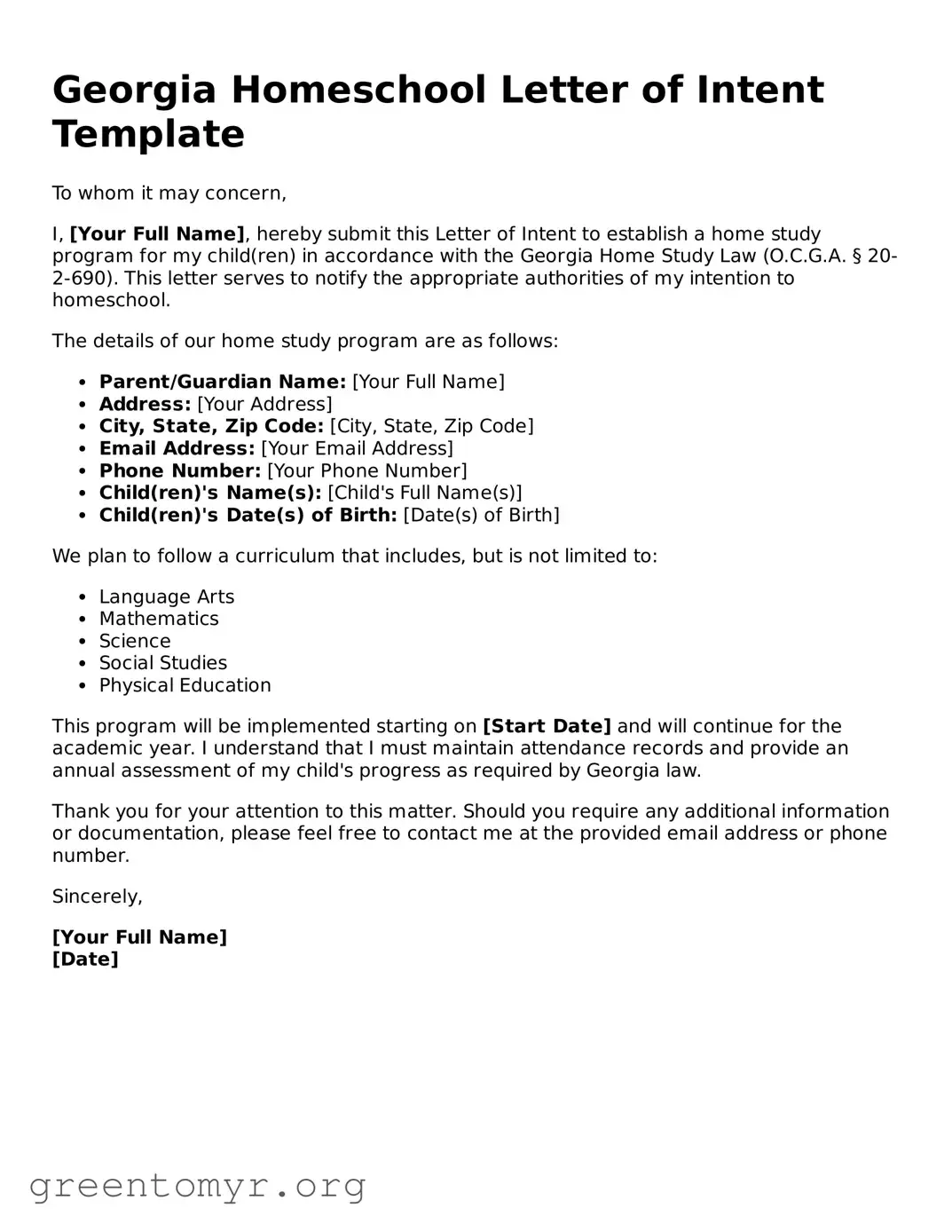
Georgia Homeschool Letter of Intent Template
To whom it may concern,
I, [Your Full Name], hereby submit this Letter of Intent to establish a home study program for my child(ren) in accordance with the Georgia Home Study Law (O.C.G.A. § 20-2-690). This letter serves to notify the appropriate authorities of my intention to homeschool.
The details of our home study program are as follows:
We plan to follow a curriculum that includes, but is not limited to:
This program will be implemented starting on [Start Date] and will continue for the academic year. I understand that I must maintain attendance records and provide an annual assessment of my child's progress as required by Georgia law.
Thank you for your attention to this matter. Should you require any additional information or documentation, please feel free to contact me at the provided email address or phone number.
Sincerely,
[Your Full Name]
[Date]
| Fact Name | Details |
|---|---|
| Purpose | The Georgia Homeschool Letter of Intent form notifies the state of a family's intention to homeschool their child. |
| Governing Law | This form is governed by the Georgia Code, specifically O.C.G.A. § 20-2-690. |
| Submission Deadline | The form must be submitted within 30 days of beginning homeschooling. |
| Required Information | Families must provide their child's name, age, and the address of the homeschooling location. |
| Annual Requirement | Families must submit a new Letter of Intent each year to continue homeschooling. |
| Notification Method | The form can be submitted via mail or email to the local school district. |
| Record Keeping | Families should keep a copy of the submitted form for their records. |
| Educational Plan | While not required at the time of submission, families should develop an educational plan for their child. |
| Contact Information | Families can contact their local school district for assistance with the form. |
Once you have the Georgia Homeschool Letter of Intent form ready, you will need to fill it out accurately. After completing the form, you will submit it to your local school district. This step is crucial to officially notify the district of your intention to homeschool your child.
The Georgia Homeschool Letter of Intent is a formal document that parents or guardians must submit to the local school superintendent to notify them of their intent to homeschool their child. This letter serves as an official declaration that the child will not be attending public or private school and will instead receive education at home.
Any parent or guardian who wishes to homeschool a child in Georgia must submit the Letter of Intent. This includes families with children who are entering kindergarten, as well as those who are withdrawing their children from traditional schools to begin homeschooling.
The Letter of Intent should be submitted within 30 days of beginning the homeschooling process. If a child is withdrawn from a traditional school, the letter must be submitted before the child begins homeschooling. For new homeschoolers, it is recommended to submit the letter before the start of the school year.
The Letter of Intent must include the following information:
It is important to ensure that all information is accurate and complete to avoid any issues with the local school district.
While there is no mandated format for the Letter of Intent, it should be clear and concise. Including all required information in a straightforward manner is essential. Some families choose to use a template, but it is not necessary.
Once the Letter of Intent is submitted, the local school superintendent will acknowledge receipt. There is no further action required from the parent or guardian at this stage. However, it is advisable to keep a copy of the submitted letter for personal records.
Failing to submit the Letter of Intent can lead to complications. The local school district may consider the child truant, which could result in legal consequences. To avoid any issues, it is crucial to submit the letter on time and ensure compliance with Georgia homeschooling laws.
Filling out the Georgia Homeschool Letter of Intent form can be a straightforward process, but many families make common mistakes that can lead to delays or complications. Understanding these pitfalls is essential for a smooth homeschooling experience. Here are nine mistakes to avoid.
First, one frequent error is failing to provide all the required information. The form asks for specific details about the student and the parent or guardian. Omitting any of this information can result in the form being rejected. Double-checking the form before submission can save time and frustration.
Another mistake is not signing the form. It may seem obvious, but some parents forget to include their signature. Without a signature, the document is incomplete. Always ensure that the form is signed before sending it off.
Many people also overlook the importance of submitting the form within the designated timeframe. Georgia law requires that the Letter of Intent be filed within 30 days of beginning homeschooling. Missing this deadline can lead to unnecessary complications and may affect your homeschooling status.
Inaccurate or outdated information can be another stumbling block. For instance, if a family's address changes, they must update the form accordingly. Providing incorrect information can create legal issues down the road.
Some families neglect to keep a copy of the submitted form. It’s crucial to maintain a record for your own reference. This documentation can be vital if questions arise later regarding your homeschooling status.
Another common oversight is not being aware of additional requirements. While the Letter of Intent is a key document, there may be other forms or notifications required by local school districts. Researching these requirements can help ensure compliance with all regulations.
Additionally, some parents fail to include the correct year of the academic calendar. The form should reflect the current school year. This detail is important for clarity and helps local authorities understand your homeschooling timeline.
Rushing through the form can lead to mistakes. Taking the time to carefully read each section and fill it out accurately is essential. A rushed submission can lead to errors that may delay your homeschooling journey.
Finally, not seeking help when needed can be detrimental. If there are any uncertainties about how to fill out the form, reaching out for assistance can prevent mistakes. Local homeschooling groups or educational consultants can provide valuable guidance.
By being aware of these common mistakes, families can ensure a smoother process when submitting the Georgia Homeschool Letter of Intent form. Taking the time to fill it out correctly is crucial for a successful homeschooling experience.
When parents decide to homeschool their children in Georgia, they often need to complete various forms and documents in addition to the Georgia Homeschool Letter of Intent. These documents help ensure compliance with state regulations and support the homeschooling process. Below is a list of common forms and documents that may be required or beneficial for homeschooling families.
These documents, while not all mandatory, can significantly enhance the homeschooling experience. They provide structure, track progress, and ensure that families are meeting educational standards. Keeping organized records will help families navigate the homeschooling journey more smoothly.
Notice of Intent to Homeschool: This document serves a similar purpose as the Homeschool Letter of Intent. It formally notifies the school district of a parent's decision to educate their child at home. Both documents aim to fulfill legal requirements and ensure that the district is aware of the homeschooling arrangement.
Educational Plan: An educational plan outlines the curriculum and educational goals for a homeschooling family. Like the Homeschool Letter of Intent, it provides important information to the school district, demonstrating the family's commitment to a structured educational approach.
Withdrawal Form from Public School: When a child is withdrawn from public school to be homeschooled, a withdrawal form is often required. This form, similar to the Homeschool Letter of Intent, officially communicates the change in educational setting and ensures that the school district updates its records accordingly.
Annual Assessment Report: This document is typically submitted at the end of the school year to report on the child's educational progress. While it serves a different function than the Homeschool Letter of Intent, both documents are essential for maintaining compliance with homeschooling laws and regulations.
When filling out the Georgia Homeschool Letter of Intent form, it is essential to approach the process with care and attention. Here are some key points to consider, both what to do and what to avoid.
Misconception 1: The Letter of Intent is a complex legal document.
Many parents believe that the Letter of Intent requires legal expertise to complete. In reality, the form is straightforward and only requires basic information about the student and the homeschooling plan.
Misconception 2: You must submit the Letter of Intent every year.
Some think that the Letter of Intent needs to be filed annually. However, once you submit it, you only need to update it if there are significant changes in your homeschooling situation.
Misconception 3: You need to provide detailed lesson plans with the Letter of Intent.
Many parents worry that they must include extensive lesson plans. The form only requires basic information; detailed lesson plans are not necessary at this stage.
Misconception 4: The Letter of Intent is only for new homeschoolers.
Some believe that only first-time homeschoolers need to file this document. In fact, returning homeschoolers must also submit the form if they have not done so in the past.
Misconception 5: Submitting the Letter of Intent guarantees approval from the school district.
Parents may think that filing the Letter of Intent ensures their homeschooling program will be approved. Approval is not guaranteed, but filing the form is a necessary step to begin homeschooling.
Misconception 6: You cannot change your homeschooling plan after submitting the Letter of Intent.
Some parents feel locked into their initial plan. However, you can modify your homeschooling approach as needed, even after filing the Letter of Intent.
Misconception 7: The Letter of Intent is only for certain grades.
Many assume that the form is only required for specific grade levels. In truth, it applies to all grades, from kindergarten through high school.
Misconception 8: You need to provide your child's Social Security number.
Some parents think they must include their child's Social Security number on the form. This is not a requirement, and you can leave that section blank if you prefer.
Misconception 9: Filing the Letter of Intent makes you subject to public scrutiny.
Many fear that submitting the Letter of Intent will expose their homeschooling plans to public review. In reality, this information is typically kept private and is not widely shared.
When considering the Georgia Homeschool Letter of Intent form, there are several important aspects to keep in mind. Below are key takeaways that will help ensure a smooth process.
By following these guidelines, you can navigate the process of submitting the Homeschool Letter of Intent with confidence.