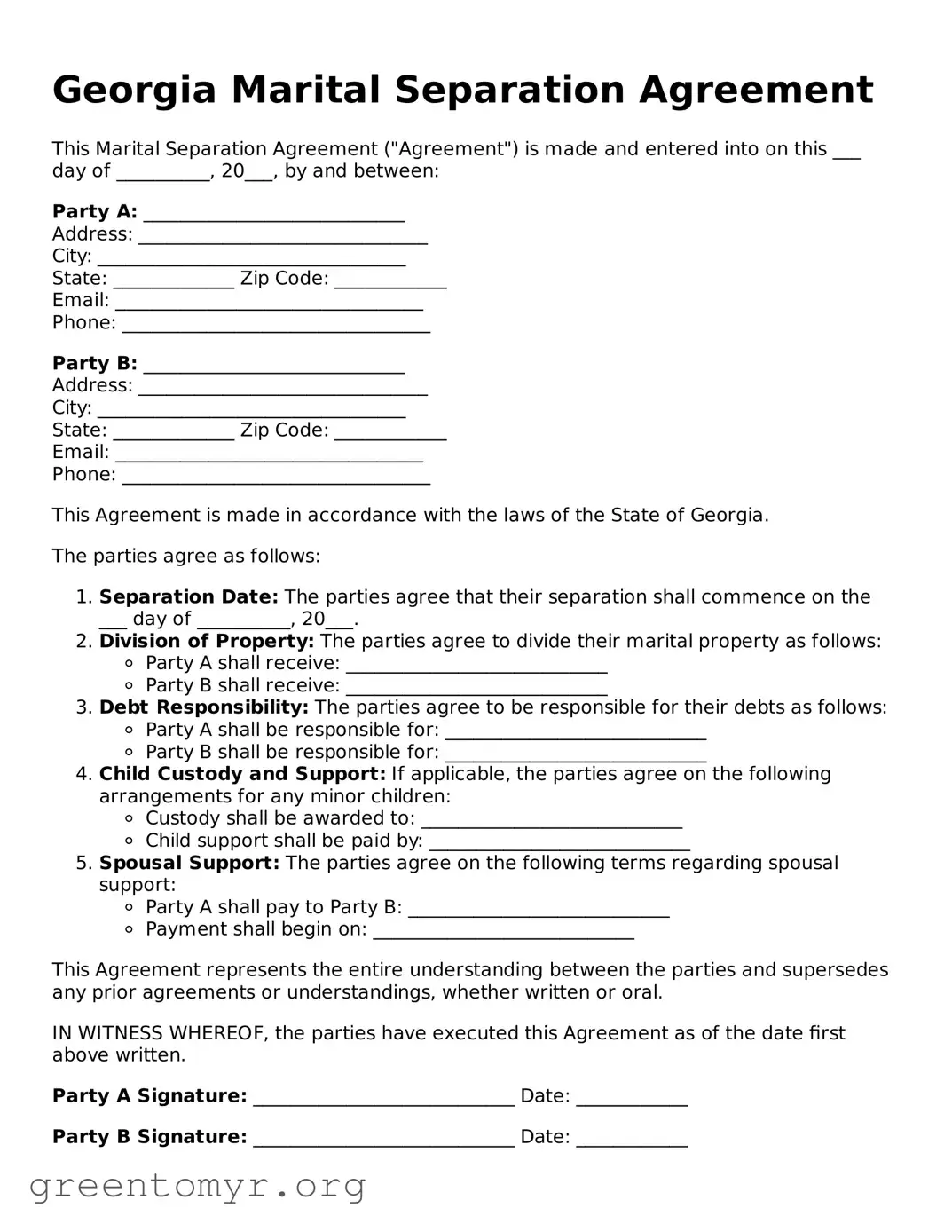
When couples in Georgia decide to separate but wish to remain married, a Marital Separation Agreement can provide clarity and structure during this transitional period. This legally binding document outlines the rights and responsibilities of each spouse while they live apart, addressing essential aspects such as division of property, spousal support, child custody, and visitation rights. By detailing financial obligations and arrangements for any children involved, the agreement helps prevent misunderstandings and disputes down the line. It is important to note that while this form is not a divorce decree, it lays the groundwork for future legal proceedings if the couple ultimately decides to divorce. Understanding the intricacies of the Georgia Marital Separation Agreement is crucial for ensuring that both parties are protected and that their interests are represented fairly during this significant life change.
Georgia Marital Separation Agreement
This Marital Separation Agreement ("Agreement") is made and entered into on this ___ day of __________, 20___, by and between:
Party A: ____________________________
Address: _______________________________
City: _________________________________
State: _____________ Zip Code: ____________
Email: _________________________________
Phone: _________________________________
Party B: ____________________________
Address: _______________________________
City: _________________________________
State: _____________ Zip Code: ____________
Email: _________________________________
Phone: _________________________________
This Agreement is made in accordance with the laws of the State of Georgia.
The parties agree as follows:
This Agreement represents the entire understanding between the parties and supersedes any prior agreements or understandings, whether written or oral.
IN WITNESS WHEREOF, the parties have executed this Agreement as of the date first above written.
Party A Signature: ____________________________ Date: ____________
Party B Signature: ____________________________ Date: ____________
| Fact Name | Description |
|---|---|
| Purpose | The Georgia Marital Separation Agreement form is used by couples who wish to outline the terms of their separation, including asset division, child custody, and support obligations. |
| Governing Law | This form is governed by the laws of the State of Georgia, specifically under Title 19 of the Georgia Code, which addresses domestic relations. |
| Voluntary Agreement | Both parties must voluntarily agree to the terms outlined in the separation agreement. Coercion or undue pressure can render the agreement invalid. |
| Legal Binding | Once signed by both parties, the agreement becomes legally binding and enforceable in court, provided it meets all legal requirements. |
| Child Custody Considerations | The agreement should address child custody and visitation arrangements, prioritizing the best interests of the children involved. |
| Modification Process | Changes to the agreement can be made, but both parties must consent to the modifications and document them properly to maintain enforceability. |
After obtaining the Georgia Marital Separation Agreement form, you will need to provide specific information about your situation. This form is essential for outlining the terms of your separation. Carefully following these steps will ensure that you complete the form accurately.
Once you have completed the form, review it carefully to ensure all information is correct. After that, you can proceed with the next steps in the separation process.
A Georgia Marital Separation Agreement is a legal document that outlines the terms of separation between spouses. This agreement addresses various aspects of the couple's life, including property division, debt responsibility, child custody, and support obligations. It serves as a roadmap for both parties, helping to clarify expectations and responsibilities during the separation period.
Opting for a separation agreement can provide clarity and structure during a challenging time. Here are a few reasons to consider:
While each agreement may vary based on individual circumstances, some common elements to include are:
Yes, both parties must sign the Marital Separation Agreement for it to be legally binding. This mutual consent is crucial, as it demonstrates that both individuals agree to the terms laid out in the document. It’s advisable to have the agreement notarized to further validate its authenticity.
Absolutely. Life circumstances can change, and it’s common for separation agreements to be modified. However, both parties must agree to any changes, and it’s best to document the modifications in writing. Consulting a legal professional during this process can ensure that all modifications are legally sound.
No, a separation agreement is not the same as a divorce. A separation agreement allows couples to live apart while still legally married. It addresses how they will manage their responsibilities during this time. Divorce, on the other hand, is the legal dissolution of the marriage. A separation agreement can be a step toward divorce, but it does not end the marriage.
You can find a Georgia Marital Separation Agreement form through various sources, including:
When choosing a source, ensure that the form complies with Georgia laws and is tailored to your specific situation.
Filling out the Georgia Marital Separation Agreement form can be a daunting task. Many people make common mistakes that can complicate the process. Understanding these errors can help ensure that your agreement is valid and enforceable.
One frequent mistake is failing to provide complete information. Each section of the form must be filled out accurately. Incomplete forms can lead to delays or even rejection. Ensure that you include all necessary details about assets, debts, and responsibilities.
Another error is not being clear about the terms of the agreement. Ambiguous language can create confusion and disputes later on. Use straightforward language and be specific about what each party is agreeing to. This clarity will help prevent misunderstandings.
Some individuals overlook the importance of including all relevant assets and debts. It’s crucial to list everything, from bank accounts to real estate. Failing to disclose an asset can lead to legal issues down the road. Transparency is key in these agreements.
People also often forget to consider future needs. The agreement should address potential changes in circumstances, such as job loss or changes in income. Planning for these possibilities can save both parties from future conflicts.
Another common mistake is neglecting to have the agreement reviewed by a professional. While it may seem straightforward, legal documents can be complex. A lawyer can help ensure that your agreement complies with Georgia law and protects your interests.
Some individuals make the mistake of not signing the document in front of a notary. A notary public adds an extra layer of validation to the agreement. Without notarization, the document may not hold up in court.
Additionally, failing to keep copies of the signed agreement can lead to problems later. Both parties should retain a copy for their records. This ensures that each person has access to the terms agreed upon.
Lastly, people sometimes forget to update the agreement if circumstances change. Life events such as remarriage or the birth of a child can affect the terms of the separation. Regularly reviewing and updating the agreement is essential to keep it relevant.
The Georgia Marital Separation Agreement is a vital document for couples who wish to formalize the terms of their separation. Alongside this agreement, several other forms and documents may be necessary to ensure a comprehensive understanding of the separation process. Below is a list of commonly used documents that complement the Marital Separation Agreement.
Each of these documents plays a significant role in the separation process, helping to clarify the rights and responsibilities of each party. It is essential to approach this process with care and consideration for all involved, particularly when children are part of the equation.
The Marital Separation Agreement is a crucial document for couples who are separating but not yet divorced. It outlines the terms of the separation, including property division, child custody, and support obligations. Several other legal documents serve similar purposes, each addressing specific aspects of separation or divorce. Below is a list of seven documents that share similarities with the Marital Separation Agreement:
Each of these documents plays a vital role in the separation and divorce process, helping individuals navigate complex emotional and legal landscapes. Understanding their similarities can aid in making informed decisions during this challenging time.
When filling out the Georgia Marital Separation Agreement form, it is essential to approach the process with care and attention to detail. Here are eight important dos and don'ts to consider:
When it comes to the Georgia Marital Separation Agreement form, many people hold misconceptions that can lead to confusion. Here are ten common misunderstandings:
A separation agreement is not the same as a divorce decree. A separation agreement allows couples to live apart while remaining legally married. A divorce decree, on the other hand, legally ends the marriage.
Many believe that separation agreements are informal and not enforceable. In reality, once both parties sign the agreement, it becomes a legally binding contract that can be enforced in court.
Some think that a separation agreement requires immediate division of all assets. However, the agreement can outline how assets will be divided over time, allowing for flexibility.
It is a common belief that once child custody arrangements are set in a separation agreement, they cannot be modified. In fact, these arrangements can be revisited and changed if circumstances warrant it.
Many assume that only couples with children need a separation agreement. In truth, any couple considering separation can benefit from having a formal agreement, regardless of whether children are involved.
Some individuals believe they can draft a separation agreement without legal assistance. While it is possible, having a lawyer ensures that the agreement complies with state laws and adequately protects both parties’ interests.
There is a misconception that separation agreements are permanent and cannot be altered. In reality, these agreements can be renegotiated and amended as circumstances change.
Many think that signing a separation agreement is an admission that the marriage is over. However, couples can reconcile at any time, even after signing the agreement.
Some believe that separation agreements are only necessary for wealthy couples. In truth, any couple facing separation can benefit from having a clear agreement, regardless of their financial situation.
Lastly, many think there is a one-size-fits-all template for separation agreements. Each agreement should be tailored to the specific needs and circumstances of the couple involved.
Understanding these misconceptions can help individuals make informed decisions when considering a Georgia Marital Separation Agreement. Clarity about the purpose and implications of such an agreement is crucial for all parties involved.
When filling out and using the Georgia Marital Separation Agreement form, it's essential to understand several key points to ensure the process goes smoothly. Here are some important takeaways:
By keeping these key takeaways in mind, individuals can navigate the process of creating and using a Marital Separation Agreement more effectively.