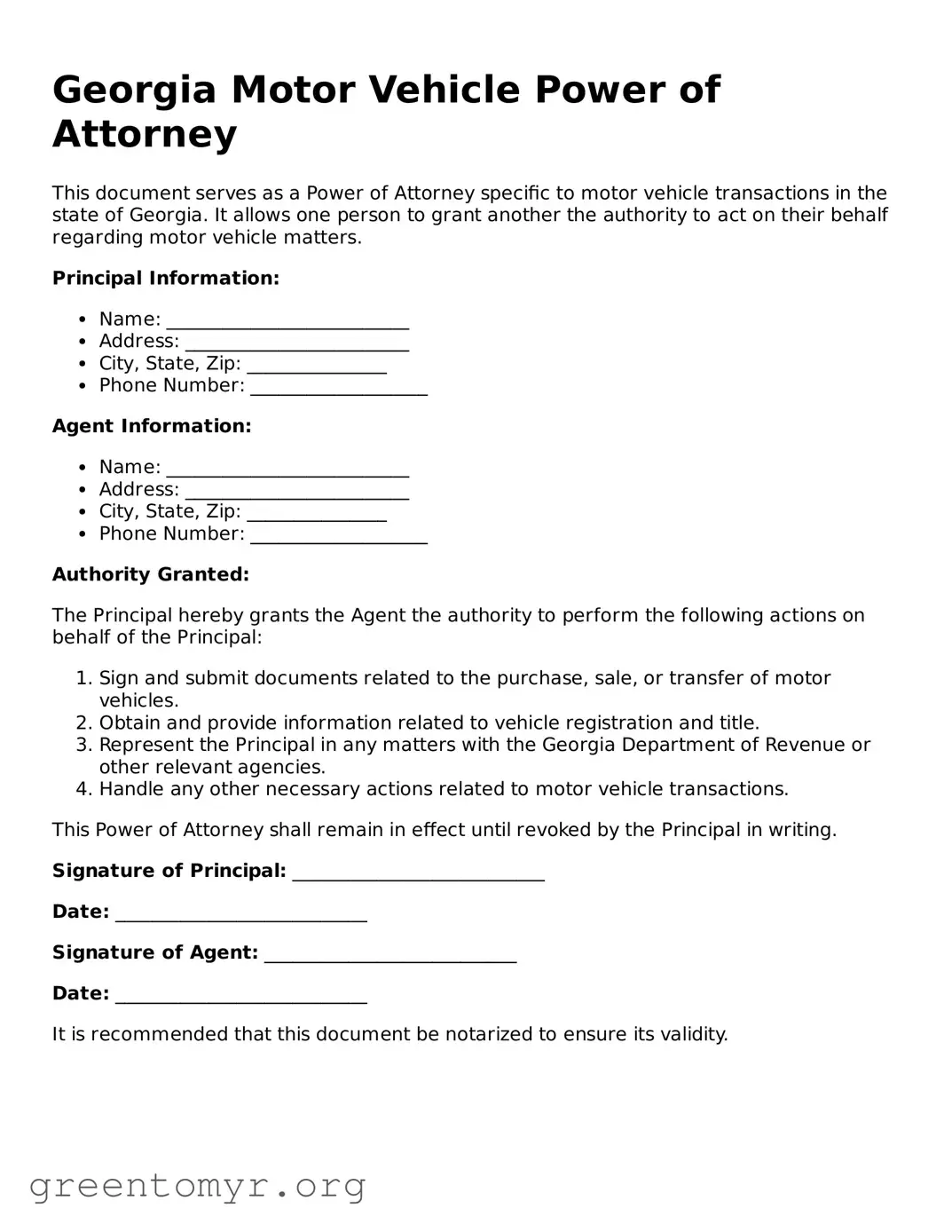
In Georgia, the Motor Vehicle Power of Attorney form serves as a crucial document that allows one individual to grant another the authority to manage specific tasks related to their motor vehicle. This form is particularly useful when the vehicle owner is unable to be present for transactions such as title transfers, registration renewals, or the sale of a vehicle. By designating an agent, the vehicle owner can ensure that their interests are represented effectively, even in their absence. The form outlines the powers granted to the agent, which may include signing documents, obtaining necessary paperwork, and handling various administrative duties associated with the vehicle. It is essential for individuals to understand the importance of this form, as it not only streamlines the process of vehicle management but also safeguards the owner's rights and interests. Properly completing and notarizing the Motor Vehicle Power of Attorney form can prevent potential complications and ensure that the designated agent can act on behalf of the vehicle owner with the necessary authority.
Georgia Motor Vehicle Power of Attorney
This document serves as a Power of Attorney specific to motor vehicle transactions in the state of Georgia. It allows one person to grant another the authority to act on their behalf regarding motor vehicle matters.
Principal Information:
Agent Information:
Authority Granted:
The Principal hereby grants the Agent the authority to perform the following actions on behalf of the Principal:
This Power of Attorney shall remain in effect until revoked by the Principal in writing.
Signature of Principal: ___________________________
Date: ___________________________
Signature of Agent: ___________________________
Date: ___________________________
It is recommended that this document be notarized to ensure its validity.
| Fact Name | Description |
|---|---|
| Purpose | The Georgia Motor Vehicle Power of Attorney form allows an individual to designate another person to act on their behalf in matters related to motor vehicles. |
| Governing Law | This form is governed by Georgia state law, specifically under the Official Code of Georgia Annotated (O.C.G.A.) § 10-6-1 et seq. |
| Authorized Actions | The designated agent can perform various tasks, including signing documents, transferring titles, and handling registrations. |
| Duration | The power of attorney remains effective until revoked by the principal or until the specified expiration date, if applicable. |
| Signature Requirement | The principal must sign the document for it to be valid. Notarization is also recommended to enhance its legality. |
| Revocation | The principal can revoke the power of attorney at any time, provided that the revocation is communicated in writing. |
| Agent's Responsibilities | The agent must act in the best interest of the principal and cannot use the power for personal gain. |
| Usage | This form is commonly used for vehicle sales, transfers, and other transactions that require the owner's signature. |
After obtaining the Georgia Motor Vehicle Power of Attorney form, you will need to complete it accurately to ensure it serves its purpose. Follow the steps below to fill out the form correctly.
A Motor Vehicle Power of Attorney (POA) in Georgia is a legal document that allows one person to authorize another person to act on their behalf in matters related to motor vehicles. This can include tasks such as transferring ownership, registering a vehicle, or obtaining a title. It is particularly useful when the vehicle owner cannot be present to complete these tasks personally.
Any competent adult can be designated as an agent in a Motor Vehicle Power of Attorney. This could be a family member, friend, or trusted individual. The key is that the person you choose must be someone you trust to handle your affairs responsibly.
An agent can perform a variety of tasks related to motor vehicles, including:
Yes, in Georgia, the Motor Vehicle Power of Attorney must be notarized to be legally valid. This means that you need to sign the document in the presence of a notary public, who will then affix their seal to confirm the authenticity of the signatures.
While there is no official state form mandated by Georgia law, it is advisable to use a standard Motor Vehicle Power of Attorney form that meets the state's requirements. These forms can typically be found online or at legal stationery stores. Ensure that the form includes all necessary details and is properly notarized.
A Motor Vehicle Power of Attorney in Georgia remains valid until it is revoked by the principal (the person who granted the power) or until the specific tasks outlined in the document are completed. It's a good practice to specify an expiration date if you want the authority to be limited in time.
Yes, you can revoke a Motor Vehicle Power of Attorney at any time, as long as you are competent to do so. To revoke the POA, you should create a written notice of revocation and provide it to the agent as well as any relevant parties, such as the Department of Motor Vehicles (DMV).
If the vehicle owner becomes incapacitated and has not previously established a Power of Attorney, it may be necessary to go through a legal process to appoint a guardian or conservator. This can be a complex situation, so consulting with a legal professional is highly recommended.
There may be fees associated with notarization and any transactions completed through the Power of Attorney, such as title transfers or registrations. The specific fees can vary based on the services rendered and the local DMV policies. It's wise to check with the DMV for any specific costs involved.
For more information, you can visit the Georgia Department of Revenue's website or contact your local DMV office. They can provide guidance on the process, necessary forms, and any updates to the laws regarding Power of Attorney for motor vehicles.
Filling out the Georgia Motor Vehicle Power of Attorney form can be a straightforward process, but many individuals make common mistakes that can lead to delays or complications. Understanding these pitfalls is crucial for ensuring that the document is completed correctly and serves its intended purpose.
One frequent mistake is failing to provide accurate information about the vehicle. The form requires details such as the Vehicle Identification Number (VIN), make, model, and year. Omitting or incorrectly entering this information can render the document invalid.
Another error involves the lack of signatures. Both the principal and the agent must sign the form. If either signature is missing, the Power of Attorney may not be recognized by the Department of Motor Vehicles (DMV).
Individuals often overlook the importance of having the form notarized. In Georgia, notarization is a requirement for the Power of Attorney to be legally binding. Without a notary's signature and seal, the document may not be accepted.
Some people neglect to specify the powers granted to the agent. The form should clearly outline what actions the agent can take on behalf of the principal. Ambiguity in this section can lead to misunderstandings and potential legal issues.
Incorrect dates can also pose a problem. The date of execution should be filled out accurately. If the date is missing or incorrect, it may cause confusion regarding the validity of the Power of Attorney.
Another common mistake is not providing a clear revocation clause. If the principal wishes to revoke the Power of Attorney at any point, the document should state how this can be done. Failing to include this information can complicate future transactions.
People sometimes forget to keep copies of the completed form. It is essential to retain a copy for personal records and to provide one to the agent. This ensures that all parties are aware of the authority granted.
Inadequate understanding of the agent's responsibilities can lead to issues. The agent should be someone trustworthy and capable of handling the tasks outlined in the Power of Attorney. Choosing the wrong person can result in misuse of authority.
Lastly, individuals may not review the form thoroughly before submission. Errors can easily be overlooked, leading to delays or rejections by the DMV. Taking the time to double-check all entries is vital for a smooth process.
By being aware of these common mistakes, individuals can take proactive steps to ensure that their Georgia Motor Vehicle Power of Attorney form is filled out correctly. This attention to detail can save time and prevent complications down the line.
The Georgia Motor Vehicle Power of Attorney form allows an individual to authorize another person to act on their behalf regarding motor vehicle transactions. Along with this form, several other documents may be needed to ensure a smooth process. Here’s a list of related forms and documents that are often used in conjunction with the Power of Attorney.
Having these documents ready can facilitate the process of handling motor vehicle transactions. Each form plays a specific role in ensuring that all legal requirements are met and that ownership is transferred smoothly.
When filling out the Georgia Motor Vehicle Power of Attorney form, it’s important to ensure that everything is completed accurately. Here are some helpful dos and don’ts to guide you through the process:
Understanding the Georgia Motor Vehicle Power of Attorney form can be tricky. Many people have misconceptions about what it is and how it works. Here’s a list of ten common misunderstandings, along with clarifications to help you navigate this important document.
While many people associate this form with transactions, it can also be used for registering a vehicle, obtaining title transfers, and handling other motor vehicle-related tasks.
In Georgia, you can complete this form without a lawyer, as long as you follow the proper guidelines. However, consulting a legal expert can provide peace of mind.
While notarization is recommended for added authenticity, it is not strictly required for the Power of Attorney to be effective in Georgia.
This is not true. You can revoke a Power of Attorney at any time, as long as you follow the proper procedures to do so.
The duration of a Power of Attorney depends on the terms specified within the document. It can be set for a specific period or remain in effect until revoked.
Organizations and businesses can also use a Power of Attorney to designate someone to act on their behalf in motor vehicle matters.
The Motor Vehicle Power of Attorney is specific to vehicle-related tasks, while a general Power of Attorney covers a broader range of legal and financial matters.
Each state has its own rules and regulations regarding Power of Attorney forms. What applies in Georgia may not be valid in another state.
This form can also be used for commercial vehicles. If you need to manage a fleet or business-related vehicles, this document applies.
The authority granted to the agent is limited to what you specify in the Power of Attorney. You can outline exactly what powers they have.
By understanding these misconceptions, you can better navigate the Georgia Motor Vehicle Power of Attorney form and use it effectively for your needs. Always consider seeking guidance if you have specific questions or concerns.
When filling out and using the Georgia Motor Vehicle Power of Attorney form, keep the following key takeaways in mind: