In the competitive landscape of Georgia's job market, the Non-compete Agreement form serves as a crucial tool for employers and employees alike. This legal document outlines the terms under which an employee agrees not to engage in business activities that directly compete with their employer after leaving the company. Typically, the agreement specifies the duration of the non-compete period, the geographic area it covers, and the types of activities that are restricted. By establishing clear boundaries, this form aims to protect an employer's trade secrets and customer relationships while providing employees with an understanding of their rights and obligations post-employment. Understanding the nuances of the Georgia Non-compete Agreement is essential for both parties to navigate potential disputes and ensure compliance with state laws. As the workforce continues to evolve, the implications of these agreements can significantly impact career trajectories and business strategies.
Georgia Non-Compete Agreement
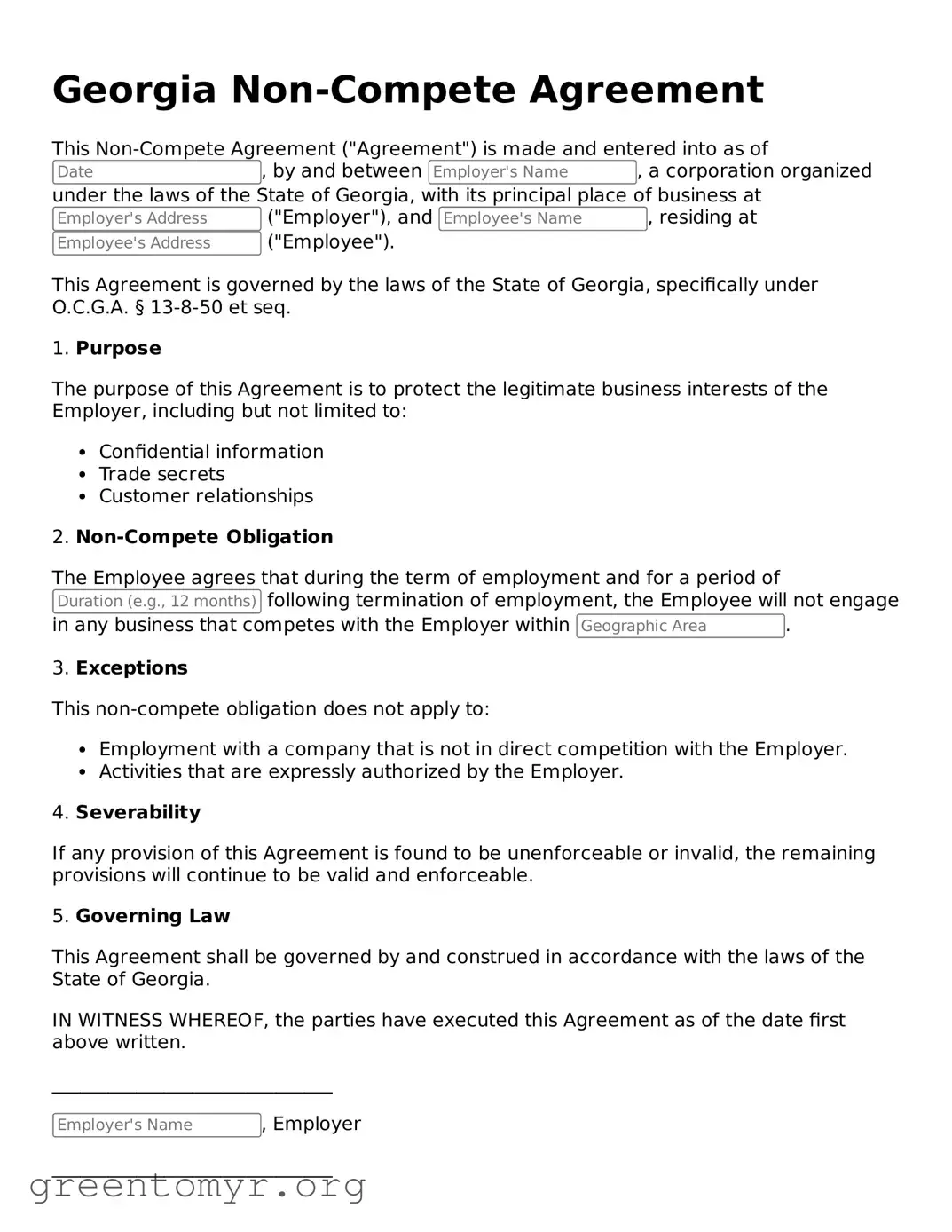
This Non-Compete Agreement ("Agreement") is made and entered into as of , by and between , a corporation organized under the laws of the State of Georgia, with its principal place of business at ("Employer"), and , residing at ("Employee").
This Agreement is governed by the laws of the State of Georgia, specifically under O.C.G.A. § 13-8-50 et seq.
1. Purpose
The purpose of this Agreement is to protect the legitimate business interests of the Employer, including but not limited to:
2. Non-Compete Obligation
The Employee agrees that during the term of employment and for a period of following termination of employment, the Employee will not engage in any business that competes with the Employer within .
3. Exceptions
This non-compete obligation does not apply to:
4. Severability
If any provision of this Agreement is found to be unenforceable or invalid, the remaining provisions will continue to be valid and enforceable.
5. Governing Law
This Agreement shall be governed by and construed in accordance with the laws of the State of Georgia.
IN WITNESS WHEREOF, the parties have executed this Agreement as of the date first above written.
______________________________
, Employer
______________________________
, Employee
| Fact Name | Description |
|---|---|
| Governing Law | The Georgia Non-compete Agreement is governed by Georgia state law, specifically O.C.G.A. § 13-8-50 et seq. |
| Enforceability | In Georgia, non-compete agreements are enforceable if they are reasonable in time, geographic area, and scope of activity. |
| Duration | Typically, non-compete agreements in Georgia can last for up to two years after the employment ends. |
| Geographic Limitations | The agreement must specify a reasonable geographic area where the restrictions apply, which should be related to the business interests. |
| Consideration | For a non-compete agreement to be valid, there must be consideration, such as a job offer or a promotion. |
| Modification | Georgia law allows courts to modify overly broad non-compete agreements to make them enforceable. |
After obtaining the Georgia Non-compete Agreement form, you are ready to begin filling it out. This process involves providing specific information about the parties involved and the terms of the agreement. Follow these steps carefully to ensure all necessary details are included.
Once you have completed these steps, review the form for accuracy. Make sure all information is correct and clearly stated before finalizing the agreement.
A Non-compete Agreement is a legal contract between an employer and an employee that restricts the employee from engaging in activities that compete with the employer's business after leaving the company. In Georgia, these agreements are enforceable under certain conditions. They are designed to protect the employer's business interests, trade secrets, and proprietary information. However, the agreement must be reasonable in scope, duration, and geographic area to be considered valid.
For a Non-compete Agreement to be enforceable in Georgia, it must meet specific criteria:
The duration of a Non-compete Agreement in Georgia can vary based on the specifics of the agreement and the nature of the business. Typically, courts have found that durations ranging from six months to two years are reasonable. However, longer durations may be acceptable if justified by the employer's business interests. It's essential to keep in mind that overly restrictive timeframes may lead to the agreement being deemed unenforceable.
Yes, negotiating the terms of a Non-compete Agreement is not only possible but often advisable. Employees should feel empowered to discuss the restrictions and seek modifications that better align with their career goals and personal circumstances. Common points of negotiation include:
Engaging in open dialogue can lead to a more balanced agreement that protects the employer's interests while allowing the employee to pursue future opportunities.
When filling out the Georgia Non-compete Agreement form, many individuals make critical mistakes that can undermine the effectiveness of the document. One common error is failing to clearly define the scope of the non-compete clause. If the geographical area or the type of work is not specified, the agreement may be deemed too vague and unenforceable. This lack of precision can lead to disputes down the line, making it essential to articulate these details clearly.
Another frequent mistake involves not considering the duration of the non-compete period. Georgia law requires that the duration be reasonable. If the time frame is excessively long, it may not hold up in court. A well-thought-out duration can protect both the employer's interests and the employee's ability to find new work.
People also often overlook the importance of mutual consideration in the agreement. A non-compete clause must provide something of value to both parties. If only one party benefits, the agreement may be challenged. Ensure that the terms are fair and beneficial to both sides to strengthen the enforceability of the agreement.
Another mistake is neglecting to review the agreement with legal counsel. Many individuals assume they can handle the form without professional guidance. However, legal advice can provide insights into state laws and help avoid pitfalls. Consulting an attorney can save time and money in the long run.
Lastly, individuals sometimes forget to keep a copy of the signed agreement. After all parties have signed, it is crucial to retain a copy for personal records. Without a copy, proving the existence and terms of the agreement can become complicated, leading to potential misunderstandings or disputes in the future.
When dealing with a Georgia Non-compete Agreement, several other documents may accompany it to ensure clarity and enforceability. These forms help define the relationship between the employer and employee, outlining expectations and responsibilities. Below are some commonly used documents that often go hand in hand with the Non-compete Agreement.
Using these documents in conjunction with the Georgia Non-compete Agreement can help protect both the employer's interests and the employee's rights. It is essential to ensure that all agreements are clear and comprehensive to avoid misunderstandings in the future.
A Non-compete Agreement is a vital document in the business world, often used to protect trade secrets and maintain competitive advantage. However, several other agreements share similarities with it. Here’s a look at seven documents that have comparable features:
Understanding these documents can help individuals and businesses navigate their rights and responsibilities effectively. Each serves a unique purpose while sharing the common goal of protecting business interests.
When filling out the Georgia Non-compete Agreement form, it's essential to approach the process with care. Here are some important dos and don'ts to consider:
Following these guidelines can help ensure that the agreement is enforceable and fair for both parties involved.
Misconceptions about the Georgia Non-compete Agreement form can lead to confusion and missteps. Here are nine common misconceptions, along with clarifications for each.
This is not true. While Georgia allows non-compete agreements, they must meet specific criteria to be enforceable. If they are overly broad or unreasonable, a court may reject them.
Not every employee is required to sign a non-compete agreement. These agreements are typically used for employees who have access to sensitive information or trade secrets.
In Georgia, the duration of a non-compete agreement must be reasonable. Courts often look for time frames that do not exceed two years, depending on the industry.
This is misleading. A non-compete agreement restricts specific activities for a set time, but it does not prevent you from working in your field entirely.
These are different legal documents. A non-compete agreement restricts where and how you can work, while a non-disclosure agreement protects confidential information.
This is incorrect. Many employers are open to negotiation, especially if you present valid concerns about the terms.
This is false. If the agreement is overly restrictive or unfair, it may be possible to challenge it in court.
This is not always the case. The enforceability of non-compete agreements can differ for independent contractors, depending on the specific circumstances.
This is misleading. Non-compete agreements can vary significantly depending on the industry, the nature of the job, and the specific terms negotiated.
Understanding these misconceptions can help individuals navigate their rights and responsibilities regarding non-compete agreements in Georgia.
When filling out and using the Georgia Non-compete Agreement form, there are several important points to consider. Here are key takeaways to keep in mind:
By keeping these points in mind, individuals and businesses can better navigate the complexities of non-compete agreements in Georgia.