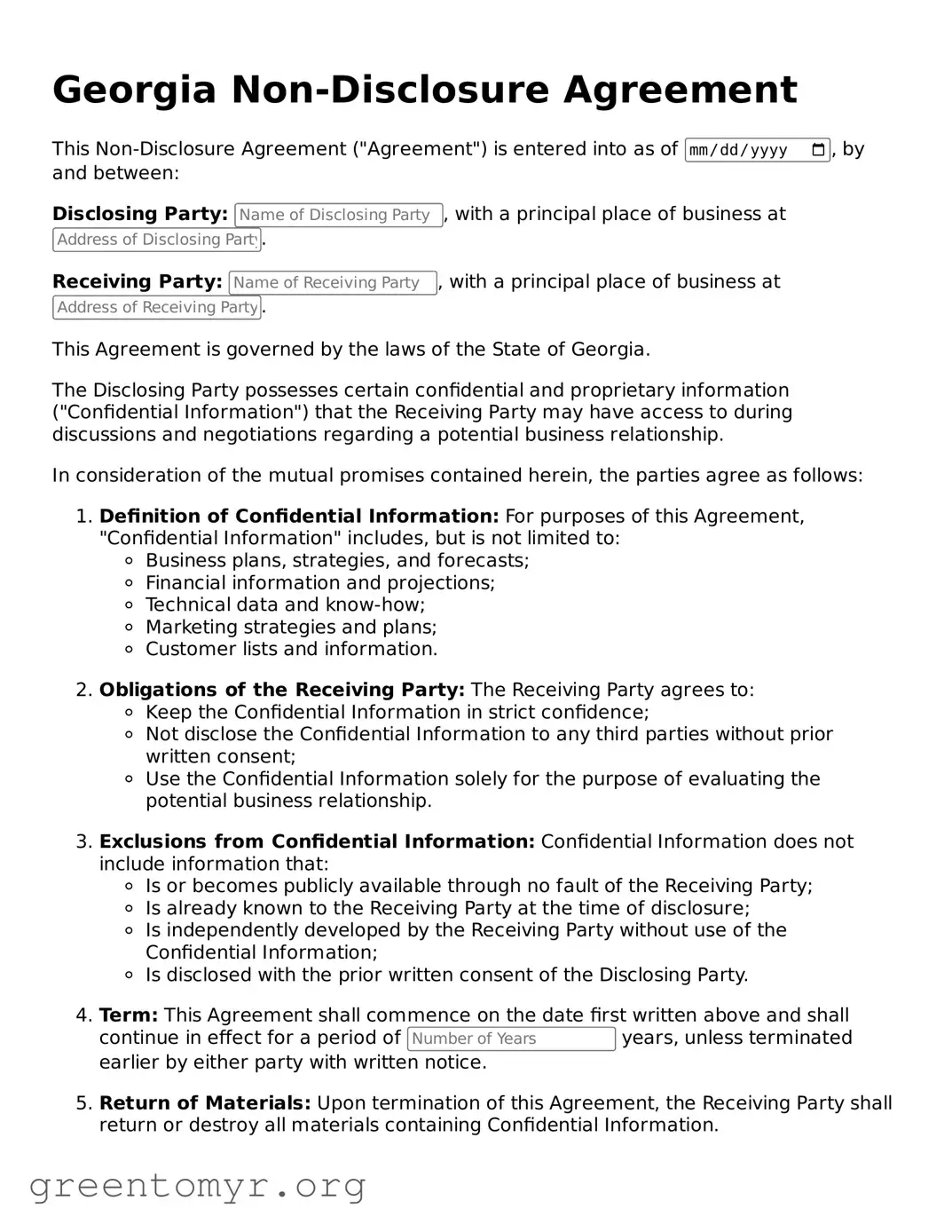
In Georgia, the Non-disclosure Agreement (NDA) form plays a crucial role in protecting sensitive information shared between parties. This legal document establishes a confidential relationship, ensuring that proprietary data, trade secrets, and other private information remain secure. It outlines the obligations of the parties involved, specifying what constitutes confidential information and the duration of the confidentiality obligation. By signing the NDA, individuals and businesses can safeguard their intellectual property and prevent unauthorized disclosure. The form also includes provisions for remedies in case of a breach, reinforcing the importance of compliance. Understanding the key elements of the Georgia NDA is essential for anyone looking to engage in business relationships while maintaining the integrity of their confidential information.
Georgia Non-Disclosure Agreement
This Non-Disclosure Agreement ("Agreement") is entered into as of , by and between:
Disclosing Party: , with a principal place of business at .
Receiving Party: , with a principal place of business at .
This Agreement is governed by the laws of the State of Georgia.
The Disclosing Party possesses certain confidential and proprietary information ("Confidential Information") that the Receiving Party may have access to during discussions and negotiations regarding a potential business relationship.
In consideration of the mutual promises contained herein, the parties agree as follows:
This Agreement constitutes the entire understanding between the parties regarding the subject matter hereof and supersedes all prior agreements, understandings, and negotiations, whether written or oral.
IN WITNESS WHEREOF, the parties have executed this Non-Disclosure Agreement as of the date first above written.
Disclosing Party:
Signature: ___________________________
Name:
Title:
Receiving Party:
Signature: ___________________________
Name:
Title:
| Fact Name | Description |
|---|---|
| Purpose | The Georgia Non-disclosure Agreement (NDA) is used to protect confidential information shared between parties. |
| Governing Law | This NDA is governed by the laws of the State of Georgia. |
| Parties Involved | The agreement typically involves a disclosing party and a receiving party, each defined within the document. |
| Duration of Confidentiality | The NDA specifies the duration for which the information must remain confidential, often ranging from 1 to 5 years. |
| Exclusions | Common exclusions include information that is public knowledge or independently developed by the receiving party. |
Completing the Georgia Non-disclosure Agreement form is a straightforward process. Following these steps will help ensure that all necessary information is accurately provided. Once the form is filled out, it will be ready for signatures and further processing.
After completing these steps, the form will be ready for any necessary distribution or filing as required by the involved parties.
A Non-disclosure Agreement, or NDA, is a legal contract designed to protect confidential information shared between parties. In Georgia, this agreement ensures that sensitive information remains private and is not disclosed to unauthorized individuals or entities.
You should consider using an NDA when discussing or sharing sensitive information, such as business plans, trade secrets, or proprietary information. This is especially important in situations involving potential partnerships, employment, or investment discussions.
Any individual or organization can enter into an NDA. This includes businesses, employees, contractors, and even potential investors. Each party must agree to the terms outlined in the agreement to ensure protection of the confidential information.
Generally, an NDA can protect a wide range of information, including:
However, the information must be clearly defined in the agreement to ensure it is adequately protected.
The duration of the confidentiality obligation can vary based on the terms set in the NDA. Typically, it lasts for a specified period, which can range from a few years to indefinitely, depending on the nature of the information and the agreement between the parties.
If a party breaches the NDA, they may face legal consequences. This can include monetary damages, injunctions to prevent further disclosures, or other remedies as specified in the agreement. It is essential to take breaches seriously, as they can harm the business or individual whose information was disclosed.
Yes, an NDA can be modified, but both parties must agree to the changes. It is advisable to document any amendments in writing to avoid confusion or disputes in the future.
Yes, NDAs are generally enforceable in Georgia as long as they meet certain legal criteria. The agreement must be clear, reasonable in scope, and not overly restrictive. If challenged in court, the enforceability will depend on the specific circumstances and the language used in the NDA.
While it is not mandatory to hire a lawyer to draft an NDA, it is highly recommended. A legal professional can ensure that the agreement is comprehensive, tailored to your specific needs, and compliant with Georgia laws. This can help prevent potential issues down the line.
Templates for NDAs can be found online through various legal websites or resources. However, it is crucial to review any template carefully and consider consulting a lawyer to make sure it meets your specific requirements and complies with Georgia law.
Filling out the Georgia Non-disclosure Agreement (NDA) form can be a straightforward process, but several common mistakes can lead to complications. One of the primary errors is failing to clearly define confidential information. Without a precise definition, parties may have different interpretations of what information is protected, which can create disputes later on.
Another mistake often made is not specifying the duration of confidentiality. The NDA should clearly state how long the information must remain confidential. If this is left vague or omitted entirely, the agreement may become unenforceable, leaving sensitive information exposed.
Many individuals also overlook the importance of including all parties involved. It is crucial to ensure that all relevant parties sign the NDA. If someone is inadvertently left out, they may later disclose information without facing any legal repercussions, undermining the purpose of the agreement.
Inaccurate or incomplete signatures can also pose a problem. Failing to provide proper signatures or including incorrect names can invalidate the agreement. Each party must sign the document in the correct manner, ensuring that all names match their legal identities.
Lastly, individuals sometimes neglect to review the entire document before signing. Skimming through the NDA can lead to misunderstandings about the terms and obligations. Taking the time to read and comprehend the entire agreement can prevent future legal issues and ensure that all parties are on the same page.
A Non-disclosure Agreement (NDA) is an important legal document that helps protect confidential information. In Georgia, several other forms and documents are often used alongside an NDA to ensure comprehensive protection and clarity in business relationships. Below is a list of some commonly associated documents.
Using these documents in conjunction with a Non-disclosure Agreement can help ensure that sensitive information remains protected and that all parties understand their rights and responsibilities. Properly executed agreements foster trust and collaboration in business relationships.
A Non-disclosure Agreement (NDA) is a legal document designed to protect confidential information shared between parties. Several other documents serve similar purposes in safeguarding sensitive information. Here are four documents that share similarities with an NDA:
When filling out the Georgia Non-disclosure Agreement form, it is important to approach the task carefully. Here are five things you should and shouldn't do:
By following these guidelines, you can help ensure that your Non-disclosure Agreement is filled out correctly and effectively protects your interests.
Non-disclosure agreements (NDAs) are important tools for protecting sensitive information in business relationships. However, there are several misconceptions about the Georgia Non-disclosure Agreement form that can lead to confusion. Here are four common myths:
Many people assume that all NDAs function identically, but this isn't true. Each NDA can be tailored to fit specific needs and circumstances. The Georgia Non-disclosure Agreement form can include particular clauses that address unique situations, making it distinct from other agreements.
This is a common misconception. In reality, businesses of all sizes can benefit from NDAs. Whether you're a startup or an established corporation, protecting your proprietary information is crucial. Small businesses, in particular, often need NDAs to safeguard their ideas and trade secrets.
While NDAs do restrict the sharing of confidential information, they don't completely silence individuals. Most agreements specify what can and cannot be shared. For example, information that is already public or independently developed may not be covered by the NDA.
This is not necessarily the case. The duration of confidentiality obligations can vary. The Georgia Non-disclosure Agreement form typically outlines a specific time frame during which the information must remain confidential. After this period, the obligations may no longer apply.
Understanding these misconceptions can help individuals and businesses navigate the complexities of NDAs more effectively. Proper use of these agreements can provide peace of mind and protection for valuable information.
When filling out and using the Georgia Non-disclosure Agreement (NDA) form, consider the following key takeaways: