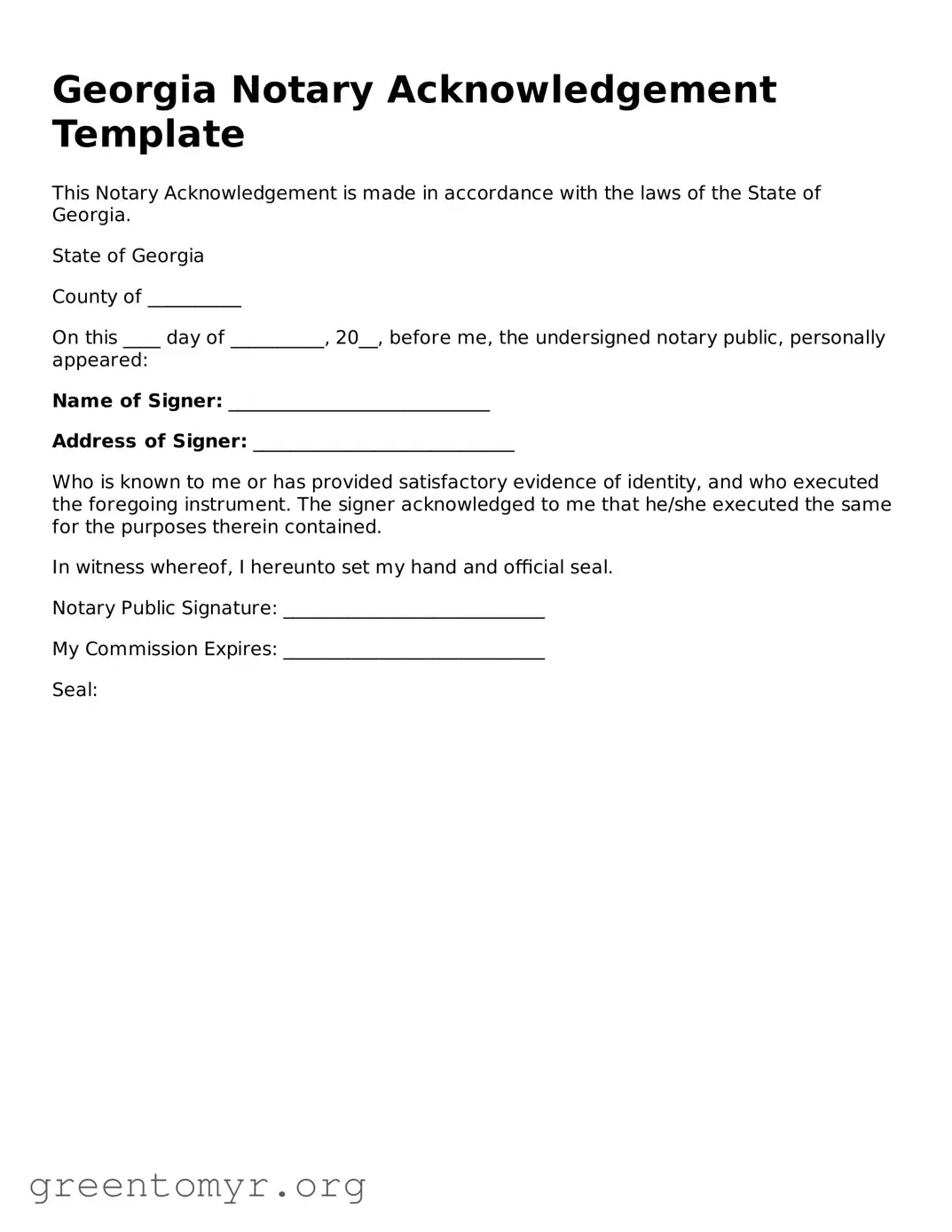
In the state of Georgia, the Notary Acknowledgement form plays a crucial role in the notarization process, ensuring that documents are executed with authenticity and integrity. This form is typically used when a signer wishes to confirm their identity and their willingness to sign a document voluntarily. It serves as a safeguard against fraud and misrepresentation. The form requires the notary public to verify the identity of the signer through proper identification, often including a driver's license or passport. Additionally, it includes specific details such as the date of the acknowledgment, the location where the signing took place, and the notary's official seal. By providing a clear record of the transaction, the Notary Acknowledgement form not only protects the interests of all parties involved but also upholds the legal standards set forth by Georgia law. Understanding the significance and requirements of this form is essential for anyone looking to navigate the complexities of legal documentation in Georgia.
Georgia Notary Acknowledgement Template
This Notary Acknowledgement is made in accordance with the laws of the State of Georgia.
State of Georgia
County of __________
On this ____ day of __________, 20__, before me, the undersigned notary public, personally appeared:
Name of Signer: ____________________________
Address of Signer: ____________________________
Who is known to me or has provided satisfactory evidence of identity, and who executed the foregoing instrument. The signer acknowledged to me that he/she executed the same for the purposes therein contained.
In witness whereof, I hereunto set my hand and official seal.
Notary Public Signature: ____________________________
My Commission Expires: ____________________________
Seal:
| Fact Name | Description |
|---|---|
| Definition | A Georgia Notary Acknowledgment form is a legal document that verifies the identity of a signer and confirms their willingness to sign a document. |
| Governing Law | The use of the Notary Acknowledgment form in Georgia is governed by the Official Code of Georgia Annotated (O.C.G.A.) § 45-17-1 et seq. |
| Purpose | This form is commonly used in real estate transactions, legal documents, and contracts to ensure that signatures are authentic and voluntary. |
| Required Information | The form must include the name of the signer, the date of acknowledgment, and the notary's signature and seal. |
| Signer's Presence | The signer must be present before the notary at the time of acknowledgment to confirm their identity. |
| Validity | A properly completed Notary Acknowledgment form remains valid as long as the document it pertains to is in effect. |
| Notary Requirements | Notaries in Georgia must be commissioned by the state and adhere to specific regulations regarding their duties and responsibilities. |
Once you have the Georgia Notary Acknowledgement form ready, it’s important to fill it out accurately to ensure that all necessary information is provided. After completing the form, it will be used to verify the identity of the signer in a legal context.
The Georgia Notary Acknowledgement form is a legal document used to verify that a signer has willingly signed a document in the presence of a notary public. This form is essential for ensuring the authenticity of the signature and the identity of the signer.
A Notary Acknowledgement is crucial for various legal documents, such as deeds, contracts, and affidavits. It provides proof that the signer is who they claim to be and that they signed the document voluntarily. This can help prevent fraud and disputes regarding the authenticity of the signature.
To complete a Notary Acknowledgement form, follow these steps:
In Georgia, a notary public must be at least 18 years old, a resident of the state, and possess a high school diploma or equivalent. They must also complete the application process and be appointed by the Superior Court in their county.
Yes, notaries in Georgia are allowed to charge a fee for their services. The maximum fee for notarization is typically set by state law, but it can vary. Always check with the notary beforehand to confirm their fees.
Not all documents require a Notary Acknowledgement. However, it is commonly used for documents that will be filed with a court or government agency, or those that require a higher level of verification. Always consult with a legal professional if you are unsure whether your document needs notarization.
If your Notary Acknowledgement is rejected, review the reasons provided. Common issues include missing information, incorrect signatures, or lack of a notary seal. Address these issues promptly and, if necessary, consult with a legal expert to ensure compliance with the requirements.
Filling out the Georgia Notary Acknowledgment form can be straightforward, but many people make common mistakes that can lead to delays or complications. One frequent error is not including the correct date. It is essential to write the date clearly and accurately. If the date is missing or incorrect, the acknowledgment may be deemed invalid.
Another mistake is failing to provide the signer’s name as it appears on their identification. The form requires the name to be precise. If there are discrepancies between the name on the form and the ID, the notarization could be challenged.
People often overlook the importance of the signer’s signature. The signer must sign the document in the presence of the notary. If the notary is not present when the document is signed, the acknowledgment cannot be completed properly.
Additionally, some individuals forget to include their own name and title as the notary. This information is crucial for the validity of the acknowledgment. Without it, the document may not be recognized as legitimate.
Another common error involves the notary’s seal. Notaries must use their official seal on the acknowledgment. Failing to affix the seal or using an outdated seal can invalidate the notarization.
People sometimes neglect to check the required witness signatures. If the document requires witnesses, their signatures must also be included. Omitting this step can lead to legal challenges later on.
Improper formatting is another issue. The acknowledgment must be filled out in a clear and legible manner. Illegible handwriting or crossed-out sections can create confusion and may render the document ineffective.
Many also forget to review the entire document before submission. It’s easy to miss small details, but a thorough review can catch mistakes that might otherwise go unnoticed.
Finally, notaries should be cautious about notarizing documents that they have a personal interest in. This can lead to conflicts of interest and may compromise the integrity of the notarization process.
When working with the Georgia Notary Acknowledgment form, several other documents often accompany it to ensure a smooth and legally compliant process. Each of these documents serves a specific purpose and can help clarify the intentions of the parties involved. Below is a list of common forms that you may encounter.
Each of these forms plays a vital role in various legal transactions. Understanding their purposes can help individuals navigate the complexities of legal documentation more effectively. Always consider consulting a legal professional for guidance tailored to your specific situation.
When filling out the Georgia Notary Acknowledgement form, it’s important to follow certain guidelines to ensure the document is valid and properly executed. Here’s a helpful list of things you should and shouldn’t do:
By following these guidelines, you can help ensure that your notarization process goes smoothly and that the document holds up legally. Remember, a little attention to detail goes a long way!
Notary acknowledgments are important for many legal documents in Georgia, but there are some common misconceptions about the Georgia Notary Acknowledgment form. Here’s a list of seven misconceptions and the truths behind them.
Understanding these misconceptions can help you navigate the notary process more effectively. Always check the specific requirements and practices in Georgia to ensure you’re on the right track.
When filling out and using the Georgia Notary Acknowledgement form, it's important to keep several key points in mind. Here are some essential takeaways: