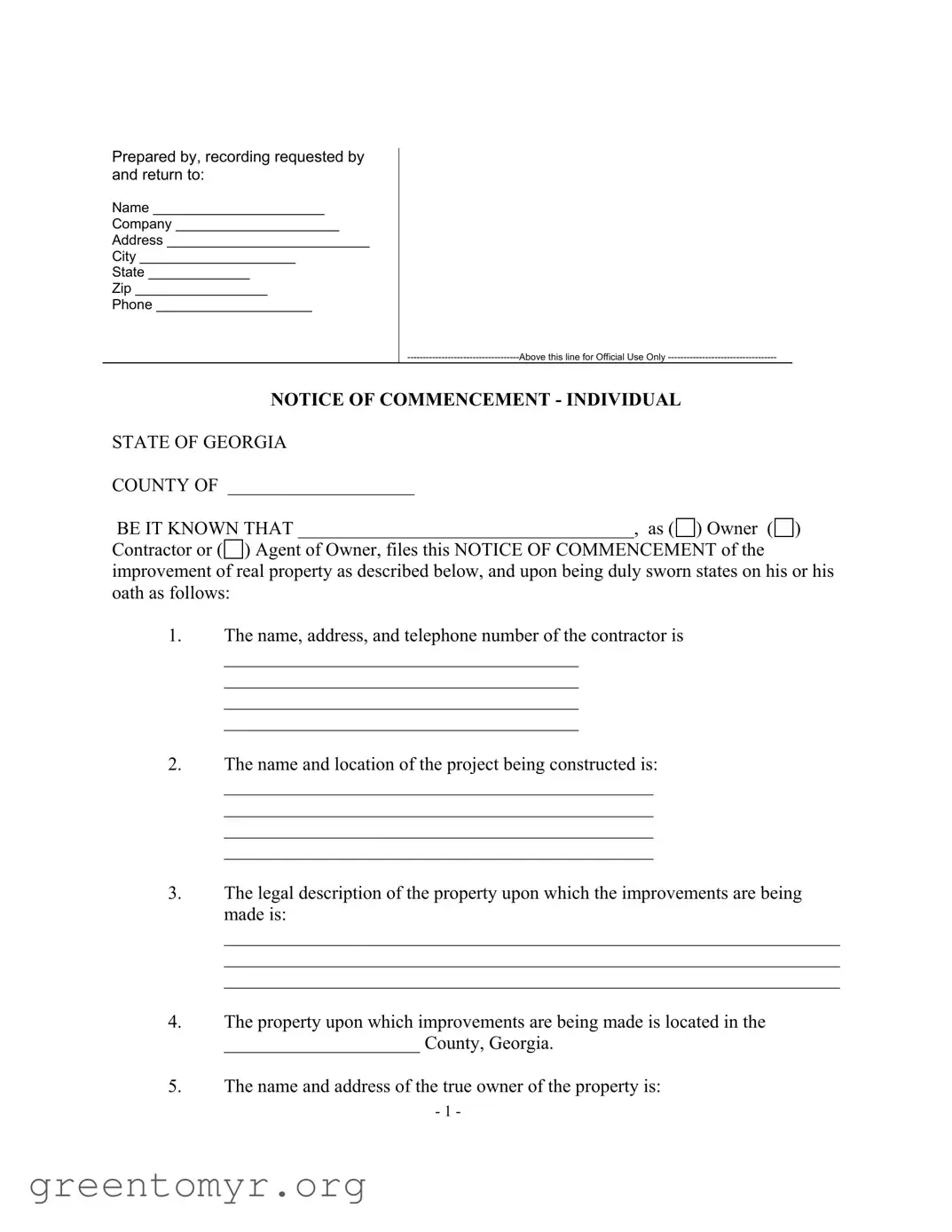
The Georgia Notice form serves as a crucial document in the construction process, ensuring transparency and legal compliance for all parties involved. This form must be filed by the owner, contractor, or their agent to officially announce the commencement of construction on a specific property. It requires detailed information about the project, including the contractor's contact details, the project's location, and the legal description of the property. Additionally, the form mandates the disclosure of the true owner of the property and any other parties involved, such as the construction lender or surety for performance bonds. Timeliness is essential; the Notice must be filed within fifteen days of the contractor starting work. This form not only protects the rights of contractors and subcontractors but also serves as a public record, fostering accountability and clarity in the construction industry. Failure to provide a copy of the Notice to requesting subcontractors or materialmen can lead to significant legal ramifications, emphasizing the importance of compliance with this requirement.
Prepared by, recording requested by and return to:
Name ______________________
Company _____________________
Address __________________________
City ____________________
State _____________
Zip _________________
Phone ____________________
NOTICE OF COMMENCEMENT - INDIVIDUAL
STATE OF GEORGIA
COUNTY OF ____________________
BE IT KNOWN THAT ____________________________________, as () Owner ()
Contractor or () Agent of Owner, files this NOTICE OF COMMENCEMENT of the improvement of real property as described below, and upon being duly sworn states on his or his oath as follows:
1.The name, address, and telephone number of the contractor is
______________________________________
______________________________________
______________________________________
______________________________________
2.The name and location of the project being constructed is:
______________________________________________
______________________________________________
______________________________________________
______________________________________________
3.The legal description of the property upon which the improvements are being made is:
__________________________________________________________________
__________________________________________________________________
__________________________________________________________________
4.The property upon which improvements are being made is located in the
_____________________ County, Georgia.
5.The name and address of the true owner of the property is:
-1 -
__________________________________________________________________
__________________________________________________________________
_________________________________________________________________.
6.The name and address of the person other than the owner at whose instance the improvements are being made, if not the true owner of the property is:
_________________________________________________________________.
7.The name and the address of the surety for the performance and payment bonds, if any are:
__________________________________________________________________
__________________________________________________________________
8.The name and address of the construction lender, if any, is:
__________________________________________________________________
_________________________________________________________________.
9.This Notice is filed within fifteen 15 days after the contractor physically commenced work on the property.
WITNESS my signature on this the _____ day of ____________________, 20_____.
____________________________________
Signature
Print Name: _________________________
Sworn to and executed in the presence of:
__________________________
Witness
Sworn to (or affirmed) and subscribed before me this ____ day of __________ (month),
__________ (year), by _______________________ (name of person making statement).
_______ Personally Known
_______ Produced Identification
Type and # of ID __________________________
____________________________
(Signature of Notary) - 2 -
(Seal) |
_____________________________ |
|
(Name of Notary Typed, Stamped or Printed) |
|
Notary Public, State of Georgia |
|
My Commission Expires: ______________ |
Reference
Notes:
The contractor shall be required to give a copy of the Notice of Commencement to any subcontractor, materialman, or person who makes a written request of the contractor. Failure to give a copy of the Notice of Commencement within ten calendar days of receipt of the written request from the subcontractor, materialman, or person shall render the provision of this Code section inapplicable to the subcontractor, materialman, or person making the request.
- 3 -
| Fact Name | Details |
|---|---|
| Purpose of the Notice | The Georgia Notice of Commencement is a document that officially notifies relevant parties about the beginning of construction on a property. |
| Governing Law | This form is governed by Georgia Code § 44-14-361.5, which outlines the requirements for filing and distributing the notice. |
| Filing Timeline | The notice must be filed within 15 days after the contractor physically begins work on the property. |
| Distribution Requirement | Contractors are required to provide a copy of the Notice of Commencement to any subcontractor, materialman, or person who requests it in writing. |
| Consequences of Non-Compliance | If the contractor fails to provide the notice within 10 days of a written request, the provisions of the law may not apply to the requesting party. |
After completing the Georgia Notice form, you will need to file it with the appropriate county office. Ensure that all information is accurate and that you meet the filing deadline of 15 days after work begins. Having a properly filled form is crucial for protecting your rights and interests in the construction project.
The Georgia Notice form serves as an official document that informs relevant parties about the commencement of construction or improvement on a specific piece of real property. It establishes a legal record of the project and identifies key stakeholders involved, such as the owner, contractor, and any agents. This notice is crucial for ensuring that all parties are aware of the construction activities and can protect their interests.
The Notice of Commencement must be filed by the owner of the property, the contractor, or an agent acting on behalf of the owner. This ensures that the party responsible for the project is officially recognized and that the necessary parties are informed about the construction activities.
The form requires several key pieces of information, including:
The Notice must be filed within fifteen days after the contractor physically begins work on the property. This timeline is important to maintain compliance with Georgia's construction laws and to ensure that all parties are notified promptly.
If the Notice of Commencement is not filed within the required fifteen days, it may affect the legal rights of the contractor and other parties involved. Specifically, it could impact the ability to claim certain liens or protections under Georgia law. Timely filing helps safeguard the interests of all stakeholders.
Yes, the contractor is required to provide a copy of the Notice of Commencement to any subcontractor, materialman, or person who requests it in writing. Failure to provide this copy within ten calendar days can result in the provisions of the notice becoming inapplicable to those requesting parties.
Notarization is essential as it adds a layer of authenticity to the document. It verifies that the individual filing the Notice has done so under oath, confirming the accuracy of the information provided. This can be crucial in legal disputes or when proving the validity of the Notice in court.
Yes, if there are changes to the project or any of the information contained in the Notice, an amendment may be necessary. It is important to keep all records accurate and up to date to ensure compliance with Georgia law and to inform all relevant parties appropriately.
If a project is canceled after the Notice of Commencement has been filed, it is advisable to notify all parties involved. While there is no specific requirement to file a cancellation notice, communicating the cancellation helps prevent confusion and protects the interests of all stakeholders.
The Notice of Commencement should be filed with the appropriate county office in Georgia where the property is located. This ensures that the notice becomes part of the public record, making it accessible to all interested parties.
Filling out the Georgia Notice form correctly is crucial to ensure that all parties involved in a construction project are protected. However, there are common mistakes that people often make when completing this form. Understanding these pitfalls can help avoid delays and legal complications.
One frequent error is failing to provide complete information. Each section of the form must be filled out thoroughly. For instance, the name and address of the contractor should not be left blank. Omitting details can lead to confusion and may invalidate the notice.
Another common mistake is not including the correct legal description of the property. This description is essential for identifying the location of the project. Ensure that it matches the information on the property deed. Inaccuracies here can create issues with future claims or disputes.
People often forget to indicate the correct role in the project. Whether you are the owner, contractor, or agent of the owner, this designation must be checked accurately. Misrepresenting your role can lead to complications in accountability and responsibility.
Additionally, missing the filing deadline is a significant error. The Notice of Commencement must be filed within 15 days after work begins. Delaying this can jeopardize your rights under Georgia law. Keeping track of project timelines is essential.
Another mistake is neglecting to provide information about the surety for performance and payment bonds. If applicable, this information must be included. Failure to do so may result in complications regarding financial protections for subcontractors and suppliers.
Some individuals also overlook the importance of notarization. The signature on the form must be witnessed and notarized. Skipping this step can render the document ineffective, leading to potential disputes down the line.
Moreover, failing to provide a copy of the Notice to subcontractors or materialmen can create problems. The contractor is required to distribute copies upon request. Not adhering to this requirement can affect the rights of those involved in the project.
People sometimes also forget to include contact information for the construction lender, if applicable. This information is crucial for financial transparency and ensuring that all parties are informed about funding sources.
Lastly, not reviewing the completed form before submission can lead to overlooked mistakes. Double-checking all entries for accuracy is vital. A thorough review can save time and prevent issues that might arise from incorrect information.
By being aware of these common mistakes, individuals can ensure that their Georgia Notice form is filled out correctly, helping to protect their interests and streamline the construction process.
When dealing with construction projects in Georgia, various forms and documents complement the Georgia Notice form. Understanding these documents can help streamline the process and ensure compliance with state regulations. Below is a list of commonly used forms that are often associated with the Notice of Commencement.
By familiarizing yourself with these documents, you can better navigate the complexities of construction projects in Georgia. Each form plays a vital role in protecting the rights and responsibilities of all parties involved, ensuring a smoother process from start to finish.
The Georgia Notice form is important for construction projects, but it shares similarities with several other documents. Here are seven documents that are comparable and how they relate to the Georgia Notice form:
When filling out the Georgia Notice form, it is important to follow certain guidelines to ensure accuracy and compliance. Below is a list of things you should and shouldn’t do.
Understanding the Georgia Notice form is crucial for anyone involved in construction projects. However, several misconceptions can lead to confusion. Here are nine common misunderstandings:
Being aware of these misconceptions can help ensure compliance with Georgia's construction laws and protect the rights of all parties involved.