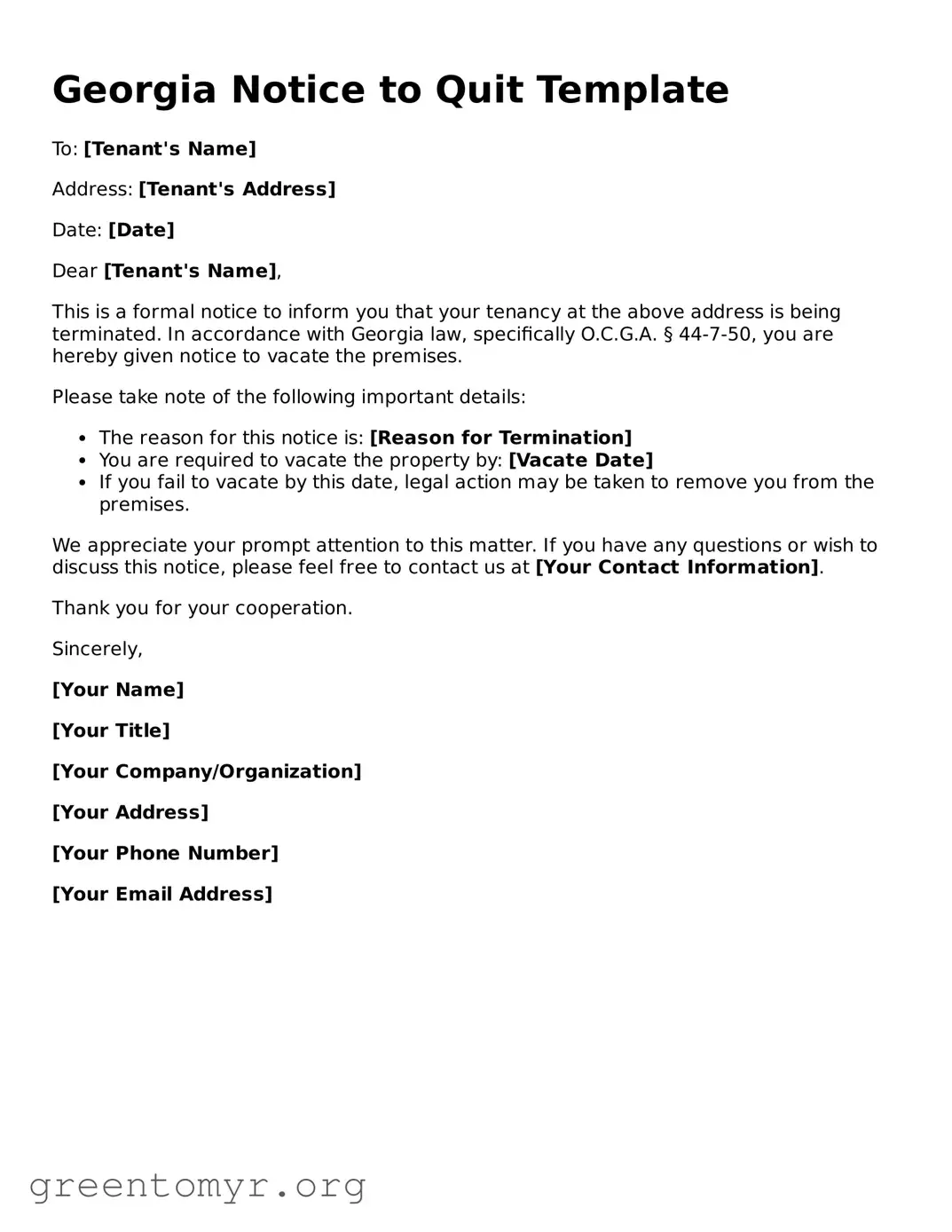
The Georgia Notice to Quit form plays a crucial role in the landlord-tenant relationship, serving as a formal communication tool when a landlord seeks to terminate a rental agreement. This form outlines the specific reasons for the notice, which may include non-payment of rent, lease violations, or the expiration of the lease term. It provides essential information such as the tenant's name, the property address, and the date by which the tenant must vacate the premises. By clearly stating the grounds for eviction, the Notice to Quit ensures that tenants understand the situation and can take appropriate action. Moreover, it is important for landlords to follow the correct procedures outlined in Georgia law to avoid potential legal complications. Understanding the nuances of this form can help both parties navigate the eviction process more smoothly, fostering a clearer understanding of their rights and responsibilities.
Georgia Notice to Quit Template
To: [Tenant's Name]
Address: [Tenant's Address]
Date: [Date]
Dear [Tenant's Name],
This is a formal notice to inform you that your tenancy at the above address is being terminated. In accordance with Georgia law, specifically O.C.G.A. § 44-7-50, you are hereby given notice to vacate the premises.
Please take note of the following important details:
We appreciate your prompt attention to this matter. If you have any questions or wish to discuss this notice, please feel free to contact us at [Your Contact Information].
Thank you for your cooperation.
Sincerely,
[Your Name]
[Your Title]
[Your Company/Organization]
[Your Address]
[Your Phone Number]
[Your Email Address]
| Fact Name | Description |
|---|---|
| Purpose | The Georgia Notice to Quit form is used by landlords to formally notify tenants to vacate the rental property. |
| Governing Law | This form is governed by the Georgia Residential Landlord-Tenant Act, O.C.G.A. § 44-7-50 et seq. |
| Notice Period | Typically, landlords must provide a 60-day notice for lease termination in Georgia, unless otherwise specified in the lease agreement. |
| Delivery Methods | The notice can be delivered in person, via certified mail, or by posting it on the tenant's door. |
Once you have the Georgia Notice to Quit form ready, you will need to fill it out accurately to ensure it serves its purpose. This form is essential for notifying a tenant about the need to vacate the premises. After completing the form, it must be delivered to the tenant in accordance with state laws.
The Georgia Notice to Quit form is a legal document used by landlords to inform tenants that they must vacate the rental property. This notice is typically issued when a tenant has violated the terms of the lease agreement or has failed to pay rent.
A landlord may use a Notice to Quit when:
It is essential for landlords to follow the proper legal procedures when issuing this notice.
In Georgia, the notice period can vary based on the reason for eviction:
Yes, a tenant has the right to contest a Notice to Quit. If a tenant believes the notice is unjustified, they can respond or seek legal advice. It is advisable for tenants to document any communication with the landlord regarding the notice.
If a tenant does not vacate the property by the deadline specified in the Notice to Quit, the landlord may initiate eviction proceedings. This process typically involves filing a complaint in court and obtaining a judgment for eviction.
No, the Notice to Quit does not need to be notarized in Georgia. However, it must be properly filled out and delivered to the tenant according to state law.
A Notice to Quit can be delivered to the tenant in several ways, including:
Proper delivery is important to ensure the notice is legally valid.
Yes, a landlord can issue a Notice to Quit for various reasons, including lease violations, illegal activity on the premises, or simply for terminating a lease agreement. Each reason may have different notice requirements.
A Notice to Quit should include:
Providing clear and concise information helps avoid misunderstandings.
Templates for a Georgia Notice to Quit can be found online through legal websites, local court websites, or by consulting with an attorney. It is important to ensure that any template used complies with Georgia law.
Filling out the Georgia Notice to Quit form can be a straightforward process, yet many individuals make common mistakes that can complicate matters. One frequent error is failing to include the correct address of the tenant. This information is crucial, as it ensures that the notice reaches the intended recipient. Without a proper address, the tenant may not receive the notice, which can lead to delays in the eviction process.
Another mistake often seen is neglecting to specify the reason for the eviction. The form requires a clear statement regarding why the notice is being issued. Whether it’s for non-payment of rent or violation of lease terms, a vague or missing explanation can render the notice ineffective. This lack of clarity can lead to confusion and may ultimately hinder the landlord's ability to proceed with legal action.
Additionally, many people forget to sign and date the form. A Notice to Quit without a signature is not legally binding. This oversight can invalidate the notice, causing further complications down the line. It’s essential to ensure that the form is properly executed to avoid unnecessary setbacks.
Inaccurate dates are another common pitfall. The form should clearly indicate the date by which the tenant must vacate the premises. If this date is incorrect or not properly formatted, it could lead to disputes over the timeline of the eviction. Clarity in this aspect is vital to ensure compliance with Georgia law.
Finally, some individuals fail to provide the appropriate method of delivery for the notice. Georgia law requires that the Notice to Quit be delivered in a specific manner, such as through certified mail or personal delivery. Ignoring these requirements can result in the notice being deemed insufficient, thus prolonging the eviction process. Adhering to the legal guidelines for delivery is crucial for the notice to be effective.
When dealing with tenant-landlord relationships in Georgia, various forms and documents are often utilized alongside the Georgia Notice to Quit form. Each of these documents serves a specific purpose in the eviction process or in managing rental agreements. Understanding these forms can help both landlords and tenants navigate their rights and responsibilities more effectively.
Familiarity with these documents can empower both landlords and tenants to communicate effectively and uphold their rights. By understanding the purpose and use of each form, parties involved can foster a more harmonious rental experience.
The Notice to Quit form is similar to several other documents in the realm of tenancy and lease agreements. Each serves a specific purpose in the landlord-tenant relationship. Here are six documents that share similarities with the Notice to Quit:
When filling out the Georgia Notice to Quit form, it is crucial to follow specific guidelines to ensure that the process goes smoothly. Below is a list of dos and don'ts to keep in mind.
When it comes to the Georgia Notice to Quit form, several misconceptions can lead to confusion for both landlords and tenants. Understanding the facts can help clarify the process and ensure that everyone is on the same page. Here are eight common misconceptions:
Being informed about these misconceptions can empower both landlords and tenants to navigate their rights and responsibilities effectively. Clear communication and understanding of the legal process can prevent misunderstandings and foster better landlord-tenant relationships.
Filling out and using the Georgia Notice to Quit form is an important step for landlords seeking to regain possession of their rental property. Here are some key takeaways to keep in mind:
Understanding these points can help ensure a smoother process when dealing with tenant issues in Georgia.