In the state of Georgia, the Operating Agreement serves as a crucial document for limited liability companies (LLCs), outlining the internal operations and management structure of the business. This agreement not only delineates the roles and responsibilities of the members but also sets forth guidelines for decision-making processes, profit distribution, and dispute resolution. By establishing clear protocols, the Operating Agreement helps to prevent misunderstandings among members and provides a roadmap for the company's governance. Additionally, it addresses important aspects such as the admission of new members, the procedure for member withdrawal, and the dissolution of the company. Having a well-crafted Operating Agreement is essential for ensuring that all members are aligned and that the LLC operates smoothly and effectively, thus safeguarding the interests of all involved parties.
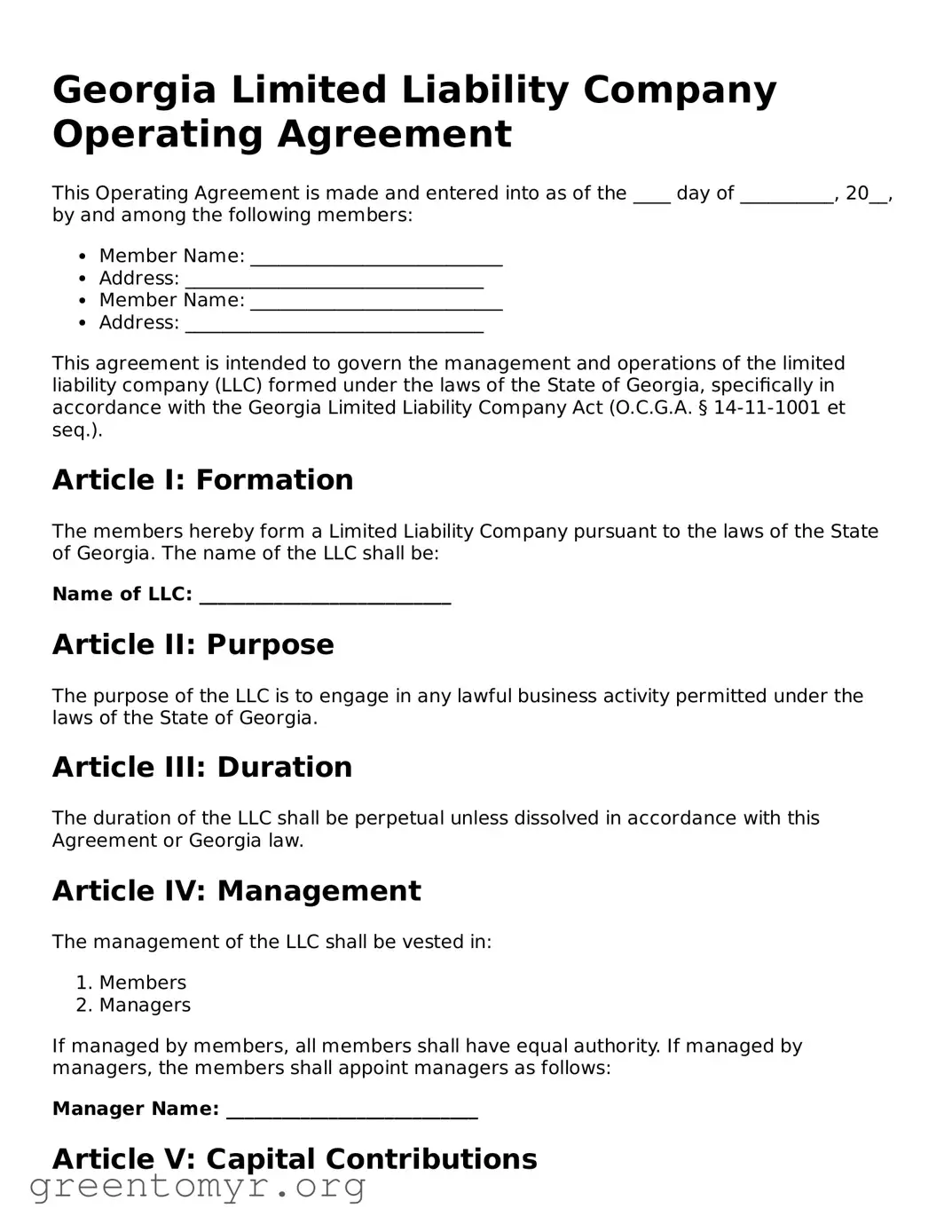
Georgia Limited Liability Company Operating Agreement
This Operating Agreement is made and entered into as of the ____ day of __________, 20__, by and among the following members:
This agreement is intended to govern the management and operations of the limited liability company (LLC) formed under the laws of the State of Georgia, specifically in accordance with the Georgia Limited Liability Company Act (O.C.G.A. § 14-11-1001 et seq.).
Article I: Formation
The members hereby form a Limited Liability Company pursuant to the laws of the State of Georgia. The name of the LLC shall be:
Name of LLC: ___________________________
Article II: Purpose
The purpose of the LLC is to engage in any lawful business activity permitted under the laws of the State of Georgia.
Article III: Duration
The duration of the LLC shall be perpetual unless dissolved in accordance with this Agreement or Georgia law.
Article IV: Management
The management of the LLC shall be vested in:
If managed by members, all members shall have equal authority. If managed by managers, the members shall appoint managers as follows:
Manager Name: ___________________________
Article V: Capital Contributions
Each member agrees to make the following capital contributions:
Article VI: Distributions
Distributions of profits and losses shall be made to the members in proportion to their respective capital contributions unless otherwise agreed in writing.
Article VII: Meetings
Meetings of the members shall be held at least once per year. Notice of the meeting shall be given at least ____ days in advance.
Article VIII: Amendments
This Operating Agreement may be amended only by a written agreement signed by all members.
Article IX: Miscellaneous
This Agreement shall be governed by and construed in accordance with the laws of the State of Georgia.
IN WITNESS WHEREOF, the undersigned members have executed this Operating Agreement as of the date first above written.
______________________________
Member Signature
______________________________
Member Signature
| Fact Name | Description |
|---|---|
| Purpose | The Georgia Operating Agreement outlines the management structure and operating procedures for an LLC. |
| Governing Law | The agreement is governed by the Georgia Limited Liability Company Act. |
| Members | It identifies the members of the LLC and their respective ownership interests. |
| Management Structure | The document specifies whether the LLC is member-managed or manager-managed. |
| Capital Contributions | It details the initial capital contributions made by each member. |
| Profit Distribution | The agreement outlines how profits and losses will be distributed among members. |
| Decision-Making | It describes the voting rights and decision-making processes for the LLC. |
| Amendments | The agreement includes procedures for making amendments in the future. |
| Dispute Resolution | It may provide methods for resolving disputes among members. |
| Legal Protection | Having an operating agreement can help protect members from personal liability. |
Completing the Georgia Operating Agreement form is an important step for your business. This document outlines the structure and operational guidelines for your limited liability company (LLC). After filling out the form, you will have a clear framework that defines the roles and responsibilities of the members involved. This clarity can help prevent misunderstandings and disputes in the future.
Once you have completed the form, it is advisable to keep a copy for your records. This document will serve as a reference for the operations and governance of your LLC moving forward.
A Georgia Operating Agreement is a legal document that outlines the management structure and operating procedures of a limited liability company (LLC) in Georgia. This agreement helps define the roles and responsibilities of the members and managers, ensuring everyone understands how the business will operate.
Having an Operating Agreement is essential for several reasons:
All members of the LLC should collaborate to create the Operating Agreement. This ensures that everyone has a say in how the business will be run. It's advisable to seek input from legal professionals to ensure that the document meets all legal requirements and adequately reflects the intentions of the members.
Your Operating Agreement should cover several key areas, including:
No, the Operating Agreement is not filed with the state of Georgia. It is an internal document that should be kept with your business records. However, it is important to have it in place, as it can be crucial in legal matters or disputes.
Yes, you can modify the Operating Agreement as needed. It’s a good practice to review the agreement periodically, especially if there are significant changes in the business or membership. Make sure that any amendments are documented and agreed upon by all members to maintain clarity and avoid conflicts.
Filling out the Georgia Operating Agreement form can be a straightforward process, but several common mistakes can lead to complications. One frequent error is failing to include all members' names and addresses. Each member's information must be accurately documented to ensure proper representation of the business structure.
Another mistake is neglecting to specify the management structure. Whether the business will be member-managed or manager-managed should be clearly stated. This distinction is crucial as it determines who has authority over day-to-day operations.
Some individuals overlook the importance of defining the purpose of the business. The Operating Agreement should clearly articulate the business's objectives and activities. This clarity helps prevent misunderstandings among members and can be beneficial for legal and tax purposes.
Additionally, failing to outline the process for adding or removing members is a common oversight. An effective Operating Agreement should include procedures for membership changes to ensure a smooth transition when necessary.
Another mistake involves not addressing profit and loss distribution. Members must agree on how profits and losses will be allocated. Without this information, disputes may arise in the future regarding financial distributions.
People often forget to include provisions for resolving disputes. An Operating Agreement should outline a method for conflict resolution, whether through mediation, arbitration, or another approach. This provision can save time and resources should disagreements occur.
Moreover, neglecting to date the document is a simple yet significant mistake. The date provides a timeline for the agreement and can be essential for legal purposes. An undated document may lead to confusion regarding its validity.
Lastly, failing to have the agreement signed by all members is a critical error. Without signatures, the Operating Agreement may not hold legal weight. All members must acknowledge their acceptance of the terms outlined in the document.
When establishing a business in Georgia, the Operating Agreement is a crucial document that outlines the management structure and operating procedures of a limited liability company (LLC). However, several other forms and documents often accompany the Operating Agreement to ensure compliance and facilitate smooth operations. Below are five essential documents that can be used alongside the Georgia Operating Agreement.
Utilizing these documents in conjunction with the Georgia Operating Agreement can enhance clarity and organization within the LLC. Each plays a distinct role in ensuring that the business operates smoothly and remains compliant with state regulations.
When filling out the Georgia Operating Agreement form, it's important to ensure accuracy and clarity. Here’s a guide on what to do and what to avoid:
Many people have misunderstandings about the Georgia Operating Agreement form. Here are five common misconceptions:
When filling out and using the Georgia Operating Agreement form, several key considerations come into play. Understanding these elements can facilitate smoother business operations and clarify the roles of all parties involved.
By paying attention to these key takeaways, individuals can create a robust Operating Agreement that supports the successful operation of their LLC in Georgia.