Prenuptial agreements, often referred to as prenups, serve as vital tools for couples preparing to embark on the journey of marriage. In Georgia, these agreements can outline how assets and debts will be managed during the marriage and what will happen in the event of a divorce. The Georgia Prenuptial Agreement form is designed to help couples protect their individual interests, ensuring clarity and fairness in financial matters. Key aspects of this form include the identification of separate and marital property, provisions for spousal support, and the handling of debts acquired before and during the marriage. Additionally, the form requires full disclosure of each party's financial situation, fostering transparency and trust. By addressing potential conflicts before they arise, a well-crafted prenuptial agreement can provide peace of mind and a solid foundation for a couple's future together.
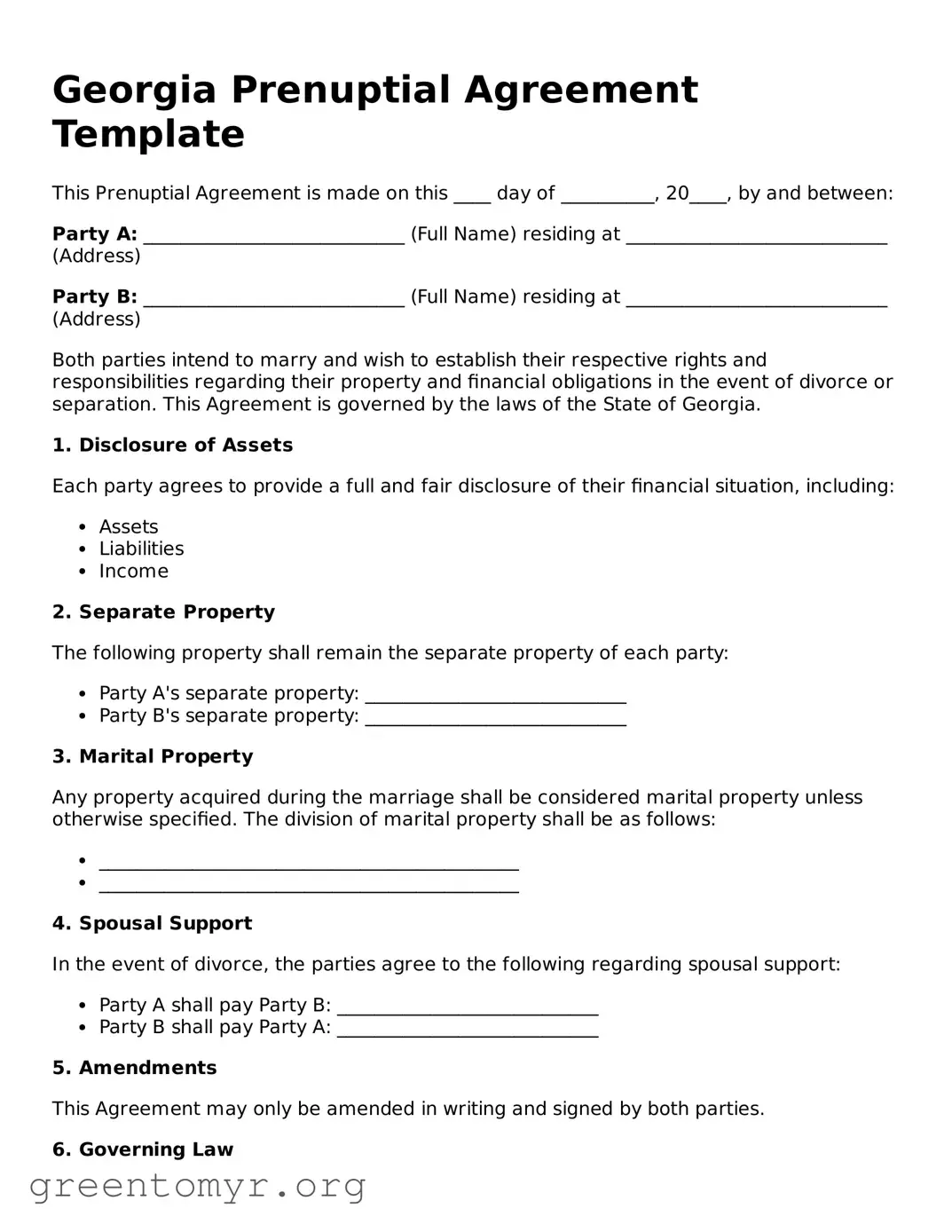
Georgia Prenuptial Agreement Template
This Prenuptial Agreement is made on this ____ day of __________, 20____, by and between:
Party A: ____________________________ (Full Name) residing at ____________________________ (Address)
Party B: ____________________________ (Full Name) residing at ____________________________ (Address)
Both parties intend to marry and wish to establish their respective rights and responsibilities regarding their property and financial obligations in the event of divorce or separation. This Agreement is governed by the laws of the State of Georgia.
1. Disclosure of Assets
Each party agrees to provide a full and fair disclosure of their financial situation, including:
2. Separate Property
The following property shall remain the separate property of each party:
3. Marital Property
Any property acquired during the marriage shall be considered marital property unless otherwise specified. The division of marital property shall be as follows:
4. Spousal Support
In the event of divorce, the parties agree to the following regarding spousal support:
5. Amendments
This Agreement may only be amended in writing and signed by both parties.
6. Governing Law
This Agreement shall be governed by and construed in accordance with the laws of the State of Georgia.
IN WITNESS WHEREOF, the parties have executed this Prenuptial Agreement as of the date first above written.
Party A Signature: ____________________________
Party B Signature: ____________________________
Witness Signature: ____________________________
Date: ____________________________
| Fact Name | Description |
|---|---|
| Definition | A prenuptial agreement is a contract between two individuals before marriage that outlines the distribution of assets and responsibilities in the event of divorce or separation. |
| Governing Law | The laws governing prenuptial agreements in Georgia are found in the Georgia Code, specifically under Title 19, Chapter 3. |
| Enforceability | For a prenuptial agreement to be enforceable in Georgia, it must be in writing and signed by both parties. |
| Full Disclosure | Both parties must fully disclose their financial situations, including assets and debts, for the agreement to be valid. |
| Voluntary Agreement | Each party must enter into the agreement voluntarily, without coercion or undue pressure. |
| Legal Representation | It is advisable for both parties to seek independent legal counsel to ensure their rights are protected. |
| Modification | Prenuptial agreements can be modified after marriage, but any changes must also be in writing and signed by both parties. |
| Limitations | Certain provisions, such as those regarding child custody and support, may not be enforceable in a prenuptial agreement. |
| Timing | It is best to create a prenuptial agreement well in advance of the wedding to avoid any appearance of coercion. |
| State-Specific Form | Georgia does not have a standardized prenuptial agreement form; however, the agreement must comply with state laws to be valid. |
Filling out the Georgia Prenuptial Agreement form requires careful attention to detail. This is a significant document, and ensuring accuracy is essential. Follow these steps to complete the form correctly.
After completing the form, it is advisable to keep copies for both parties. This ensures that each person has access to the agreement should any questions arise in the future.
A prenuptial agreement, often called a "prenup," is a legal document created by two individuals before they marry. In Georgia, this agreement outlines the division of assets and financial responsibilities in the event of divorce or separation. It can also address issues such as spousal support and debt allocation.
Many couples choose to create a prenuptial agreement for various reasons, including:
To be considered valid in Georgia, a prenuptial agreement must meet certain criteria:
Yes, a prenuptial agreement can be modified or revoked after marriage. Both parties must agree to the changes, and the modifications should be documented in writing and signed by both individuals. It is advisable to consult with a legal professional to ensure the changes are enforceable.
If one spouse does not adhere to the terms of the prenuptial agreement, the other spouse can seek legal enforcement through the courts. The court will review the agreement's validity and may enforce its terms, provided the agreement meets all legal requirements.
No, a prenuptial agreement is not solely for wealthy individuals. Anyone can benefit from a prenup, regardless of their financial situation. It can help clarify financial expectations and protect both parties' interests, making it a useful tool for couples of all income levels.
To begin the process of creating a prenuptial agreement in Georgia, follow these steps:
When completing the Georgia Prenuptial Agreement form, individuals often overlook crucial details that can lead to complications later. One common mistake is failing to fully disclose all assets and debts. Transparency is vital in a prenuptial agreement. If one party hides significant financial information, it could invalidate the agreement and create disputes in the future.
Another frequent error is not seeking legal advice. Many people assume they can draft their own agreement without professional help. However, laws regarding prenuptial agreements can be complex and vary by state. Consulting with an attorney ensures that the document complies with Georgia law and accurately reflects the intentions of both parties.
In addition, individuals sometimes neglect to consider the future. A prenuptial agreement should account for changes in circumstances, such as the birth of children or significant changes in income. Failing to address these potential future events can lead to misunderstandings and conflicts later on.
Some couples also make the mistake of not having the agreement reviewed by both parties. Each individual should have the opportunity to read the document thoroughly and understand its implications. This step not only fosters trust but also helps ensure that both parties are on the same page regarding their financial rights and responsibilities.
Lastly, individuals may rush through the signing process. It is essential to allow adequate time for both parties to review the agreement and discuss any concerns. Signing under pressure or without sufficient time for consideration can lead to claims of coercion or lack of understanding, potentially undermining the agreement's validity.
A prenuptial agreement is an important document for couples entering marriage, outlining the division of assets and responsibilities in the event of divorce or separation. Several other forms and documents may complement a Georgia Prenuptial Agreement, ensuring that both parties are protected and informed. Below is a list of these documents, each serving a specific purpose.
Each of these documents serves a unique purpose and can provide additional clarity and protection for both parties involved. It is advisable for couples to consider these forms when preparing for their future together, ensuring that their rights and responsibilities are clearly defined.
A Prenuptial Agreement is a legal document that outlines how assets and debts will be handled in the event of a divorce or separation. It shares similarities with several other legal documents. Here are four documents that are comparable to a Prenuptial Agreement:
When filling out the Georgia Prenuptial Agreement form, it's important to keep a few key points in mind. Here’s a list of things you should and shouldn't do:
Prenuptial agreements, often referred to as prenups, are legal documents that couples create before marriage to outline the division of assets and responsibilities in the event of a divorce. Despite their growing popularity, several misconceptions surround these agreements, particularly in Georgia. Here are eight common misunderstandings:
Understanding these misconceptions can help individuals make informed decisions about prenuptial agreements. Open dialogue about finances and expectations can lead to healthier relationships, regardless of whether a prenup is ultimately pursued.
When considering a prenuptial agreement in Georgia, it's important to understand the key aspects of the process. Here are some essential takeaways:
Understanding these points can help ensure that the prenuptial agreement serves its intended purpose effectively.