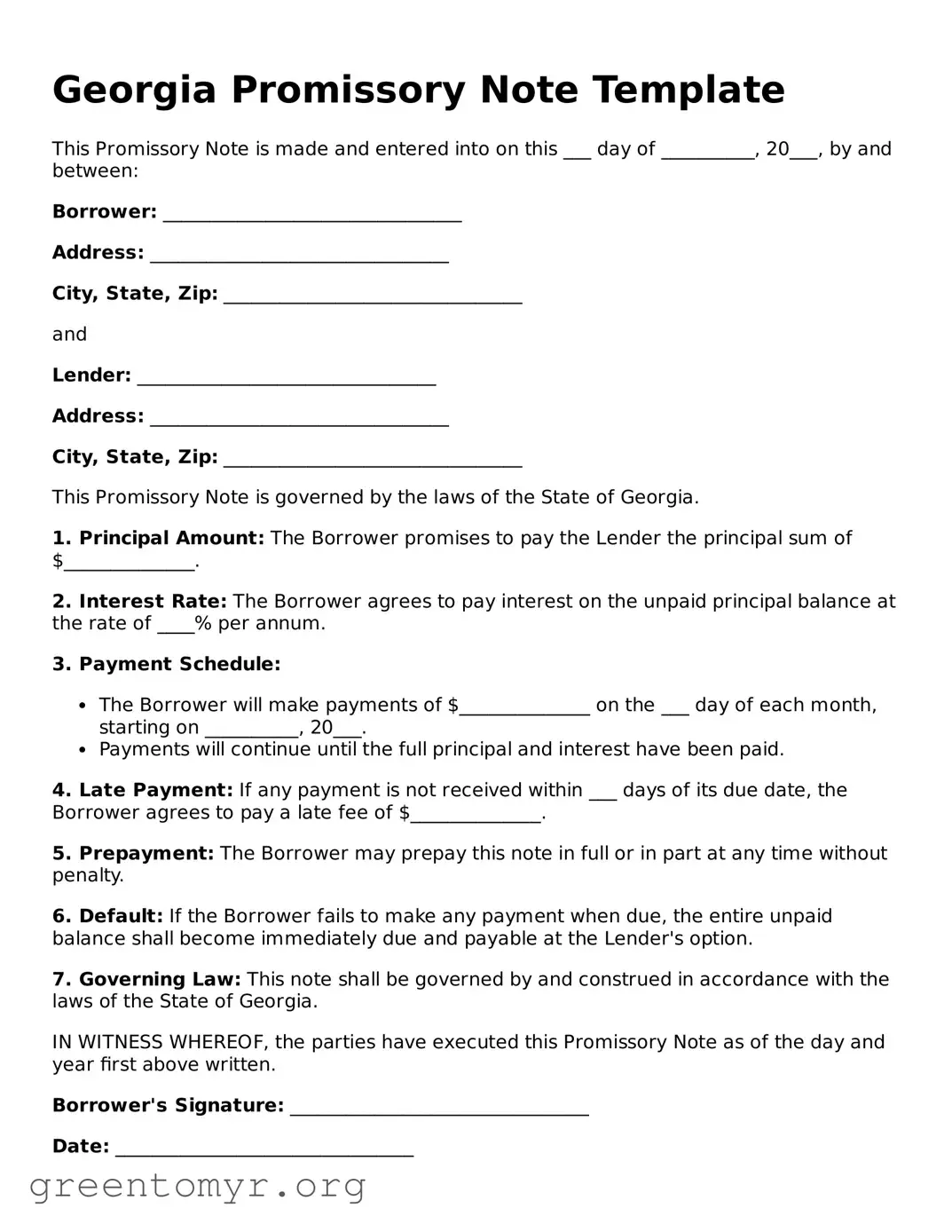
The Georgia Promissory Note form serves as a crucial financial document that outlines the terms of a loan agreement between a borrower and a lender. This form typically includes essential elements such as the principal amount, interest rate, repayment schedule, and any applicable fees. It is designed to clearly define the obligations of both parties, ensuring that the lender has a legal claim to repayment while providing the borrower with a structured repayment plan. Furthermore, the form may specify the consequences of default, including late fees or acceleration clauses, which allow the lender to demand full repayment if the borrower fails to meet the agreed-upon terms. Understanding the nuances of this document is vital for anyone engaging in lending or borrowing in Georgia, as it provides a framework for financial transactions and helps protect the rights of both parties involved.
Georgia Promissory Note Template
This Promissory Note is made and entered into on this ___ day of __________, 20___, by and between:
Borrower: ________________________________
Address: ________________________________
City, State, Zip: ________________________________
and
Lender: ________________________________
Address: ________________________________
City, State, Zip: ________________________________
This Promissory Note is governed by the laws of the State of Georgia.
1. Principal Amount: The Borrower promises to pay the Lender the principal sum of $______________.
2. Interest Rate: The Borrower agrees to pay interest on the unpaid principal balance at the rate of ____% per annum.
3. Payment Schedule:
4. Late Payment: If any payment is not received within ___ days of its due date, the Borrower agrees to pay a late fee of $______________.
5. Prepayment: The Borrower may prepay this note in full or in part at any time without penalty.
6. Default: If the Borrower fails to make any payment when due, the entire unpaid balance shall become immediately due and payable at the Lender's option.
7. Governing Law: This note shall be governed by and construed in accordance with the laws of the State of Georgia.
IN WITNESS WHEREOF, the parties have executed this Promissory Note as of the day and year first above written.
Borrower's Signature: ________________________________
Date: ________________________________
Lender's Signature: ________________________________
Date: ________________________________
| Fact Name | Description |
|---|---|
| Definition | A promissory note is a written promise to pay a specified amount of money to a designated person or entity at a specified time. |
| Governing Law | The Georgia Promissory Note is governed by the Official Code of Georgia Annotated (O.C.G.A.) § 10-3-1 et seq. |
| Parties Involved | The note typically involves two parties: the borrower (maker) and the lender (payee). |
| Interest Rate | The interest rate must be clearly stated in the note and can be fixed or variable. |
| Payment Terms | Payment terms should specify the due date, payment schedule, and method of payment. |
| Default Clause | A default clause outlines the consequences if the borrower fails to make payments as agreed. |
| Signature Requirement | The promissory note must be signed by the borrower to be legally binding. |
| Witnesses | While not required, having a witness sign the note can provide additional legal protection. |
| Notarization | Notarization is not mandatory in Georgia but can enhance the document's credibility. |
| Enforceability | For a promissory note to be enforceable, it must contain all essential elements: parties, amount, interest rate, and payment terms. |
Once you have the Georgia Promissory Note form ready, you will need to fill it out carefully. Make sure to provide accurate information to ensure the document is valid and enforceable.
Once you complete these steps, review the form for any errors. After confirming all information is correct, keep copies for both parties. This ensures everyone has a record of the agreement.
A Georgia Promissory Note is a legal document that outlines a borrower's promise to repay a specified amount of money to a lender under agreed-upon terms. This document serves as evidence of the debt and includes details such as the loan amount, interest rate, repayment schedule, and any applicable fees. It is important for both parties to understand the terms laid out in the note, as it can be enforced in court if necessary.
Any individual or entity can use a Georgia Promissory Note. This includes private lenders, financial institutions, businesses, and individuals borrowing money from friends or family. It is essential for all parties involved to ensure that the terms are clear and agreed upon to avoid misunderstandings in the future.
A Georgia Promissory Note generally includes the following information:
Including these details helps ensure clarity and can protect both parties’ interests.
Yes, a properly executed Georgia Promissory Note is legally binding. This means that if one party fails to fulfill their obligations under the note, the other party can take legal action to enforce the terms. To ensure the note is enforceable, it should be signed by both parties, and it is advisable to have it witnessed or notarized.
Yes, a Georgia Promissory Note can be modified after it is signed, but both parties must agree to the changes. Any modifications should be documented in writing and signed by both the borrower and the lender to avoid potential disputes. It is important to clearly outline the specific changes being made to the original terms.
If a borrower defaults on a Georgia Promissory Note, the lender has several options:
It is advisable to consult with a legal professional to understand the best course of action based on the specific circumstances.
Filling out the Georgia Promissory Note form can be straightforward, but several common mistakes can lead to complications. One frequent error is failing to include all necessary details about the borrower and lender. It's crucial to provide full names, addresses, and contact information. Omitting any of this information can create confusion and make it difficult to enforce the note later.
Another common mistake is not specifying the loan amount clearly. The amount should be written both in numerals and words to avoid any ambiguity. For example, if the loan amount is $5,000, it should be stated as "Five Thousand Dollars ($5,000)." This clarity helps prevent disputes over the amount owed.
People often overlook the importance of including the interest rate. If the form does not clearly state whether interest is charged, it can lead to misunderstandings. Additionally, the rate should comply with Georgia's usury laws. This ensures that the terms are legal and enforceable.
Finally, many individuals forget to sign and date the document. A promissory note is not valid unless it is properly executed. Both the borrower and lender must sign the form, and including the date of signing is essential. Without these signatures, the document may not hold up in court if a dispute arises.
When dealing with a Georgia Promissory Note, there are several other documents that may be useful. Each of these forms serves a specific purpose and can help clarify the terms of the agreement between the parties involved. Here’s a list of commonly used documents.
Using these forms alongside a Georgia Promissory Note can help ensure clarity and protection for all parties involved. Each document plays a vital role in the lending process, making it easier to manage expectations and responsibilities.
A Promissory Note is a financial document that establishes a promise to pay a specified amount of money under agreed terms. Several other documents share similarities with a Promissory Note. Below is a list of ten such documents:
When filling out the Georgia Promissory Note form, it’s important to be careful and thorough. Here are some things you should and shouldn’t do:
Following these guidelines will help ensure that the form is completed correctly and efficiently.
When it comes to the Georgia Promissory Note form, there are several misconceptions that can lead to confusion. Here are five common misunderstandings:
Understanding these misconceptions can help individuals navigate the use of promissory notes more effectively and ensure that their agreements are clear and enforceable.
When filling out and using the Georgia Promissory Note form, it is essential to understand several key aspects to ensure clarity and enforceability.
Understanding these elements can help both parties navigate the terms of the loan effectively.