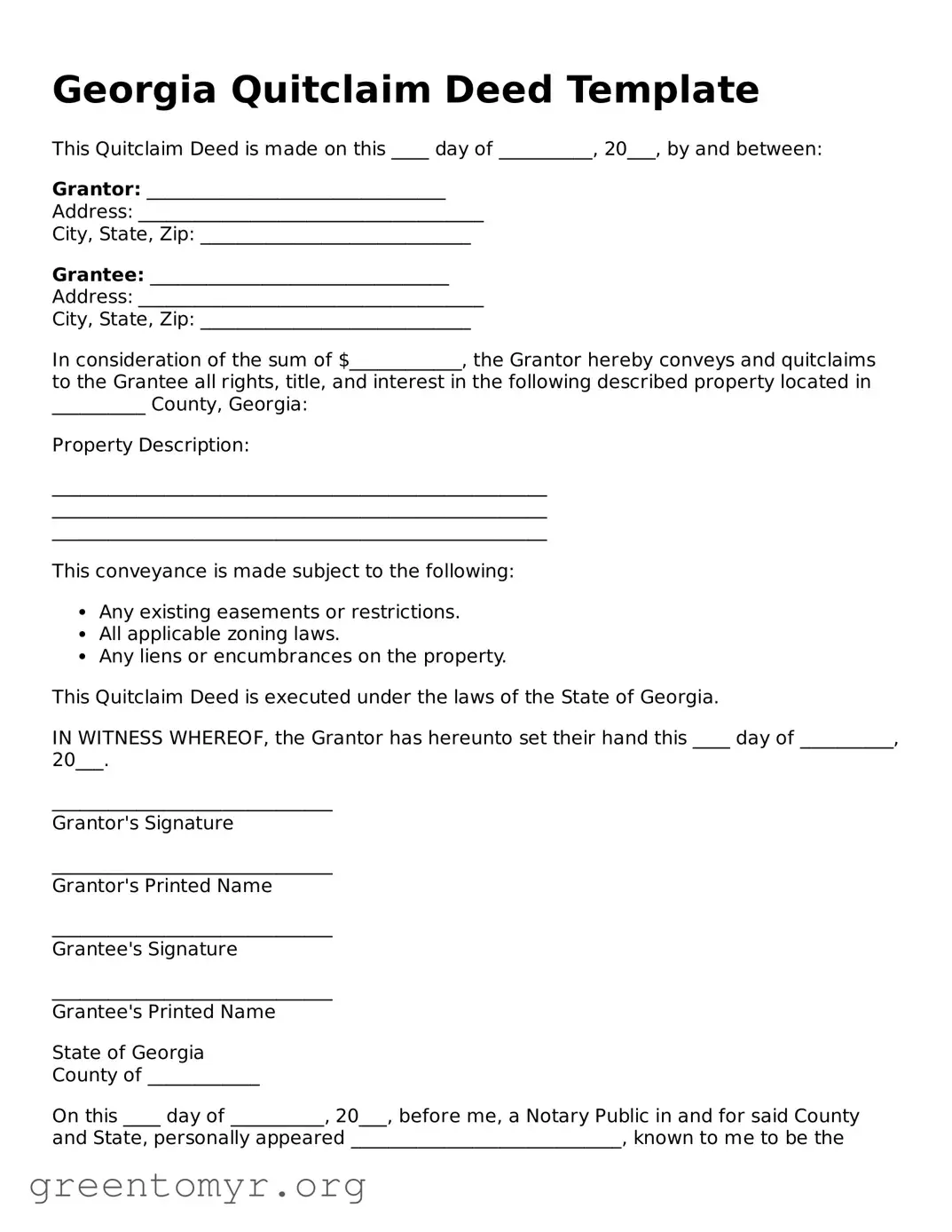
The Georgia Quitclaim Deed form serves as a vital tool in real estate transactions, allowing property owners to transfer their interest in a property to another party without making any guarantees about the title. This form is particularly useful in situations where the transferor may not be certain about the property’s title status or wishes to simplify the process of transferring ownership. The quitclaim deed is straightforward and typically includes essential information such as the names of the parties involved, a description of the property, and the date of the transfer. While it does not provide any warranties, it can be an effective means of conveying property between family members or in other informal arrangements. It is important for individuals using this form to understand its implications, as it may not protect the grantee against potential claims or liens on the property. Understanding the quitclaim deed's structure and function can help ensure that property transfers are conducted smoothly and with clarity.
Georgia Quitclaim Deed Template
This Quitclaim Deed is made on this ____ day of __________, 20___, by and between:
Grantor: ________________________________
Address: _____________________________________
City, State, Zip: _____________________________
Grantee: ________________________________
Address: _____________________________________
City, State, Zip: _____________________________
In consideration of the sum of $____________, the Grantor hereby conveys and quitclaims to the Grantee all rights, title, and interest in the following described property located in __________ County, Georgia:
Property Description:
_____________________________________________________
_____________________________________________________
_____________________________________________________
This conveyance is made subject to the following:
This Quitclaim Deed is executed under the laws of the State of Georgia.
IN WITNESS WHEREOF, the Grantor has hereunto set their hand this ____ day of __________, 20___.
______________________________
Grantor's Signature
______________________________
Grantor's Printed Name
______________________________
Grantee's Signature
______________________________
Grantee's Printed Name
State of Georgia
County of ____________
On this ____ day of __________, 20___, before me, a Notary Public in and for said County and State, personally appeared _____________________________, known to me to be the person whose name is subscribed to the within instrument, and acknowledged that they executed the same for the purposes therein contained.
In witness whereof, I have hereunto set my hand and affixed my official seal the day and year first above written.
______________________________
Notary Public
My Commission Expires: ____________
| Fact Name | Description |
|---|---|
| Definition | A quitclaim deed is a legal document used to transfer interest in real property from one party to another without guaranteeing that the title is clear. |
| Governing Law | The Georgia Quitclaim Deed is governed by Georgia law, specifically under O.C.G.A. § 44-5-30 et seq. |
| Use Cases | Commonly used among family members, in divorce settlements, or to clear up title issues, the quitclaim deed is a straightforward way to transfer property rights. |
| Limitations | Unlike warranty deeds, a quitclaim deed offers no warranties or guarantees about the property’s title, which means the buyer assumes all risks. |
After completing the Georgia Quitclaim Deed form, you will need to have it signed and notarized. Once that is done, you can file it with the appropriate county office to ensure that the transfer of property is officially recorded.
A Quitclaim Deed is a legal document used to transfer ownership of real estate from one party to another. Unlike a warranty deed, a quitclaim deed does not guarantee that the property title is clear or free of liens. It simply conveys whatever interest the grantor has in the property, if any.
Quitclaim Deeds are often used in situations where the parties know each other well, such as transferring property between family members, during divorce settlements, or when adding or removing a spouse from the title. They are also used to clear up title issues or to transfer property into a trust.
To complete a Quitclaim Deed in Georgia, you will need to include the following information:
While it is not legally required to have a lawyer prepare a Quitclaim Deed, it is advisable, especially if you are unfamiliar with property law. A lawyer can ensure that the deed is properly drafted and that all necessary information is included, reducing the risk of future disputes.
Yes, there is a fee to file a Quitclaim Deed in Georgia. The fee varies by county, so it is important to check with your local county clerk's office for the exact amount. Additionally, you may need to pay a recording fee when you submit the deed for filing.
In Georgia, a Quitclaim Deed must be filed with the county clerk's office in the county where the property is located. Once filed, the deed becomes part of the public record, providing notice of the transfer of ownership.
Transferring property via a Quitclaim Deed does not automatically affect your mortgage. However, it is important to review your mortgage agreement, as some lenders may have specific requirements regarding property transfers. In some cases, transferring ownership may trigger a due-on-sale clause, requiring the loan to be paid in full.
Once a Quitclaim Deed is executed and recorded, it cannot be revoked unilaterally. However, the parties involved can agree to a new deed or other legal arrangements to reverse the transfer. It is advisable to consult a legal professional to understand the implications of reversing a property transfer.
The primary risk of using a Quitclaim Deed is the lack of warranty regarding the title. If there are existing liens, encumbrances, or other claims against the property, the grantee may assume these risks without recourse. It is crucial to conduct a title search before accepting a Quitclaim Deed to understand any potential issues.
Yes, a Quitclaim Deed can be used for commercial property in Georgia. The same principles apply as with residential property. However, it is recommended to seek legal advice to ensure that the deed meets all necessary requirements and to understand the implications of the transfer.
Filling out a Georgia Quitclaim Deed form can be straightforward, but mistakes can lead to complications. One common error is not including the correct legal description of the property. This description should be precise and detailed. If it’s vague or inaccurate, it can create confusion about what property is being transferred.
Another mistake is failing to sign the document properly. Both the grantor and the grantee need to sign the form. If one party forgets to sign, the deed may be considered invalid. It’s essential to double-check that all required signatures are present before submitting the form.
People often overlook the importance of having the Quitclaim Deed notarized. In Georgia, a notary public must witness the signing of the deed. If this step is skipped, the deed might not be accepted by the county clerk’s office. It’s a simple step that can save a lot of trouble later on.
Finally, many individuals forget to record the Quitclaim Deed with the county. Recording the deed protects the grantee’s ownership rights and provides public notice of the transfer. Without this step, the transfer may not be recognized legally, which can lead to disputes down the line.
When dealing with property transfers in Georgia, the Quitclaim Deed is just one of several important documents you may encounter. Understanding these forms can help ensure a smooth transaction and protect your interests.
Each of these documents plays a crucial role in the property transfer process. Being familiar with them can help you navigate real estate transactions more effectively and with greater confidence.
When filling out the Georgia Quitclaim Deed form, it is essential to be careful and thorough. Here is a list of things you should and shouldn't do:
Following these guidelines can help ensure a smooth process when completing the Quitclaim Deed in Georgia.
Many people have misunderstandings about the Georgia Quitclaim Deed form. Here are six common misconceptions:
Understanding these misconceptions can help individuals navigate property transactions more effectively. Always consider seeking professional guidance when dealing with real estate matters.
When filling out and using the Georgia Quitclaim Deed form, it is important to consider the following key points:
Understanding these points can help ensure a smooth process when using the Quitclaim Deed in Georgia.