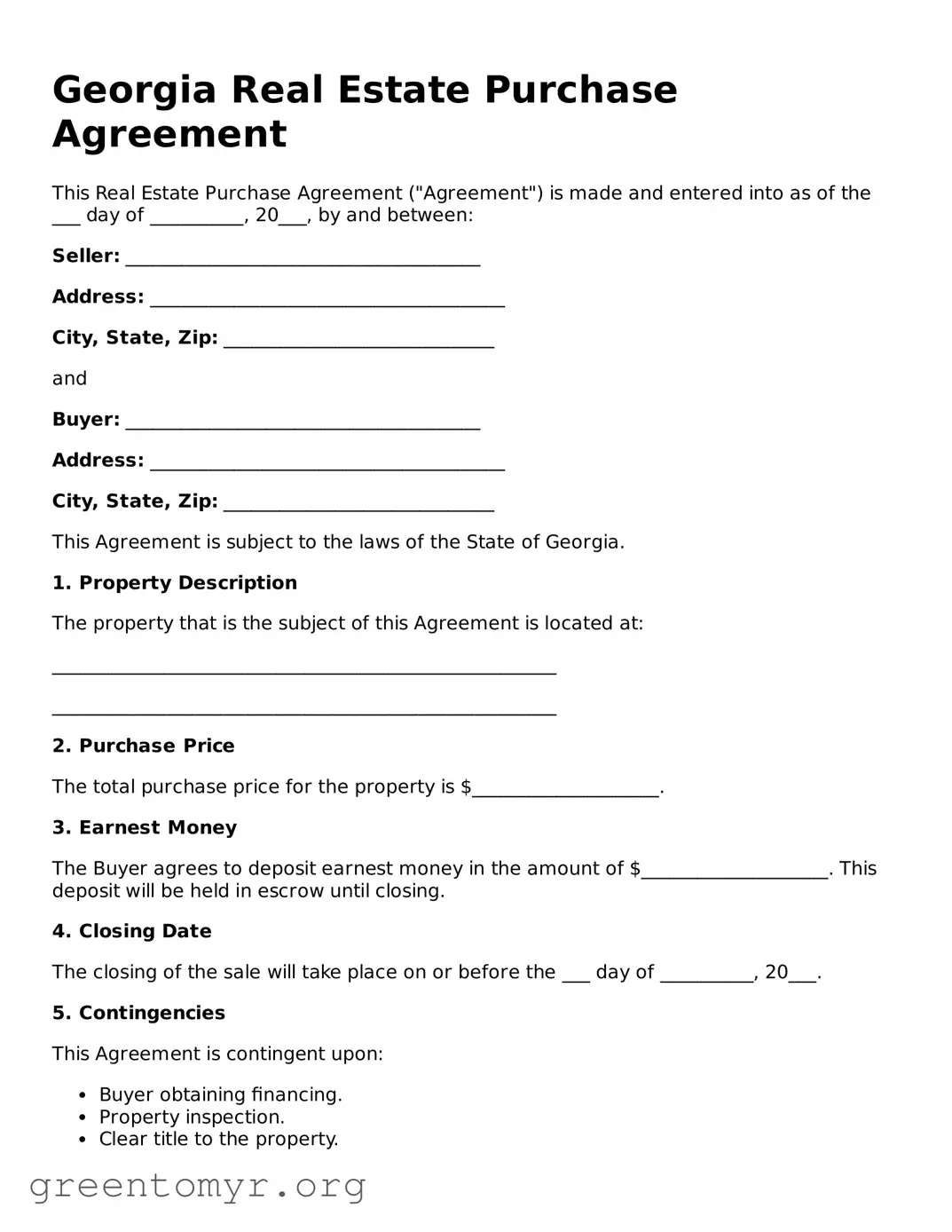
When buying or selling property in Georgia, a Real Estate Purchase Agreement is an essential document that outlines the terms and conditions of the transaction. This form serves as a binding contract between the buyer and the seller, detailing important aspects such as the purchase price, property description, and closing date. It also addresses contingencies, which are conditions that must be met for the sale to proceed, such as financing approval or satisfactory home inspections. Additionally, the agreement includes provisions for earnest money deposits, which show the buyer's commitment to the purchase. Both parties should be aware of their rights and obligations as outlined in the agreement, ensuring a smooth and transparent process. Understanding the components of this form can help buyers and sellers navigate their real estate transactions with confidence.
Georgia Real Estate Purchase Agreement
This Real Estate Purchase Agreement ("Agreement") is made and entered into as of the ___ day of __________, 20___, by and between:
Seller: ______________________________________
Address: ______________________________________
City, State, Zip: _____________________________
and
Buyer: ______________________________________
Address: ______________________________________
City, State, Zip: _____________________________
This Agreement is subject to the laws of the State of Georgia.
1. Property Description
The property that is the subject of this Agreement is located at:
______________________________________________________
______________________________________________________
2. Purchase Price
The total purchase price for the property is $____________________.
3. Earnest Money
The Buyer agrees to deposit earnest money in the amount of $____________________. This deposit will be held in escrow until closing.
4. Closing Date
The closing of the sale will take place on or before the ___ day of __________, 20___.
5. Contingencies
This Agreement is contingent upon:
6. Signatures
By signing below, both parties agree to the terms outlined in this Agreement.
Seller's Signature: ____________________________ Date: ________________
Buyer's Signature: ____________________________ Date: ________________
This Agreement constitutes the entire understanding between the parties and supersedes all prior negotiations, representations, or agreements, whether written or oral.
| Fact Name | Description |
|---|---|
| Governing Law | The Georgia Real Estate Purchase Agreement is governed by the laws of the State of Georgia. |
| Parties Involved | The agreement typically involves a buyer and a seller, both of whom must be legally competent to enter into a contract. |
| Property Description | The form requires a detailed description of the property being sold, including the address and legal description. |
| Purchase Price | The agreement specifies the purchase price, which is a critical component of the contract. |
| Earnest Money | Buyers often provide earnest money as a show of good faith, which is outlined in the agreement. |
| Contingencies | The form may include various contingencies, such as financing, inspections, and appraisal conditions. |
After obtaining the Georgia Real Estate Purchase Agreement form, you will need to carefully fill it out with the necessary details. This form is essential for documenting the agreement between the buyer and seller regarding the property transaction. Make sure to gather all required information before starting.
Once completed, review the form for accuracy before sharing it with the other party. This ensures that all details are correct and agreed upon by both the buyer and the seller.
The Georgia Real Estate Purchase Agreement form is a legal document used when buying or selling real estate in Georgia. This agreement outlines the terms and conditions of the sale, including the purchase price, financing details, and any contingencies. It serves to protect both the buyer and seller by clearly defining their rights and responsibilities throughout the transaction process.
A typical Georgia Real Estate Purchase Agreement includes several important components:
Yes, once both parties have signed the Georgia Real Estate Purchase Agreement, it becomes a legally binding contract. This means that both the buyer and seller are obligated to adhere to the terms outlined in the agreement. If either party fails to fulfill their obligations, the other party may have legal grounds to seek remedies, which could include enforcing the contract or seeking damages.
Changes can be made to the Georgia Real Estate Purchase Agreement, but both parties must agree to any modifications. This is typically done through an amendment or addendum, which should be signed by both the buyer and seller. It’s important to document any changes clearly to avoid misunderstandings later in the transaction.
If disputes arise concerning the Georgia Real Estate Purchase Agreement, the parties involved are encouraged to resolve the issues through communication and negotiation. However, if a resolution cannot be reached, legal action may be necessary. In such cases, mediation or arbitration may be pursued as alternative dispute resolution methods before resorting to litigation. Consulting with a legal professional can provide guidance on the best course of action.
Filling out the Georgia Real Estate Purchase Agreement form can be a daunting task. Many individuals make mistakes that can lead to complications later on. One common error is failing to include all necessary parties. It is crucial to ensure that all buyers and sellers are listed on the agreement. Omitting a party can result in disputes down the line.
Another frequent mistake is not clearly defining the property. Buyers should provide a complete legal description of the property, including the address and any relevant details. Vague descriptions can lead to misunderstandings regarding what is being purchased.
Additionally, people often overlook the importance of specifying the purchase price. The price should be clearly stated and agreed upon by all parties. Ambiguities in this section can lead to confusion and potential legal issues.
Many individuals also neglect to include the earnest money deposit amount. This deposit demonstrates the buyer's commitment and should be clearly outlined in the agreement. Failing to mention this can create uncertainty about the buyer's intentions.
Another common error is not addressing contingencies. Buyers should outline any conditions that must be met for the sale to proceed, such as financing or inspections. Without these contingencies, buyers may find themselves in difficult situations.
Inaccurate dates can also cause problems. Buyers and sellers must ensure that all relevant dates, including the closing date, are correct. Errors in dates can lead to delays and frustration for all parties involved.
People often forget to review the terms of the agreement thoroughly. It is essential to read through the entire document to ensure that all terms are understood and agreed upon. Misunderstandings can arise from not fully comprehending the terms.
Another mistake is not considering the inclusion of personal property. If any appliances or fixtures are part of the sale, they should be explicitly mentioned in the agreement. Failing to do so can lead to disputes over what is included in the purchase.
Buyers may also neglect to consult with a real estate professional. Seeking guidance can help avoid common pitfalls and ensure that the agreement is filled out correctly. Professional advice can be invaluable in navigating the complexities of real estate transactions.
Lastly, individuals sometimes fail to sign and date the agreement properly. All parties must sign and date the document for it to be legally binding. Incomplete signatures can render the agreement invalid.
When engaging in a real estate transaction in Georgia, several key documents accompany the Real Estate Purchase Agreement. Each document serves a specific purpose and helps facilitate a smooth process for both buyers and sellers. Here’s a brief overview of five important forms often used alongside the Purchase Agreement.
Understanding these documents can greatly enhance the buying or selling experience. Being well-prepared with the right forms ensures a smoother transaction and helps protect the interests of all parties involved.
When filling out the Georgia Real Estate Purchase Agreement form, it’s crucial to get it right. Here are some important dos and don’ts to keep in mind:
When dealing with the Georgia Real Estate Purchase Agreement form, several misconceptions can lead to confusion. Here are five common misunderstandings:
Being aware of these misconceptions can help buyers and sellers navigate the real estate process more effectively.
When filling out and using the Georgia Real Estate Purchase Agreement form, there are several important points to keep in mind. Here are some key takeaways:
By keeping these points in mind, you can navigate the Georgia Real Estate Purchase Agreement form more effectively and confidently.