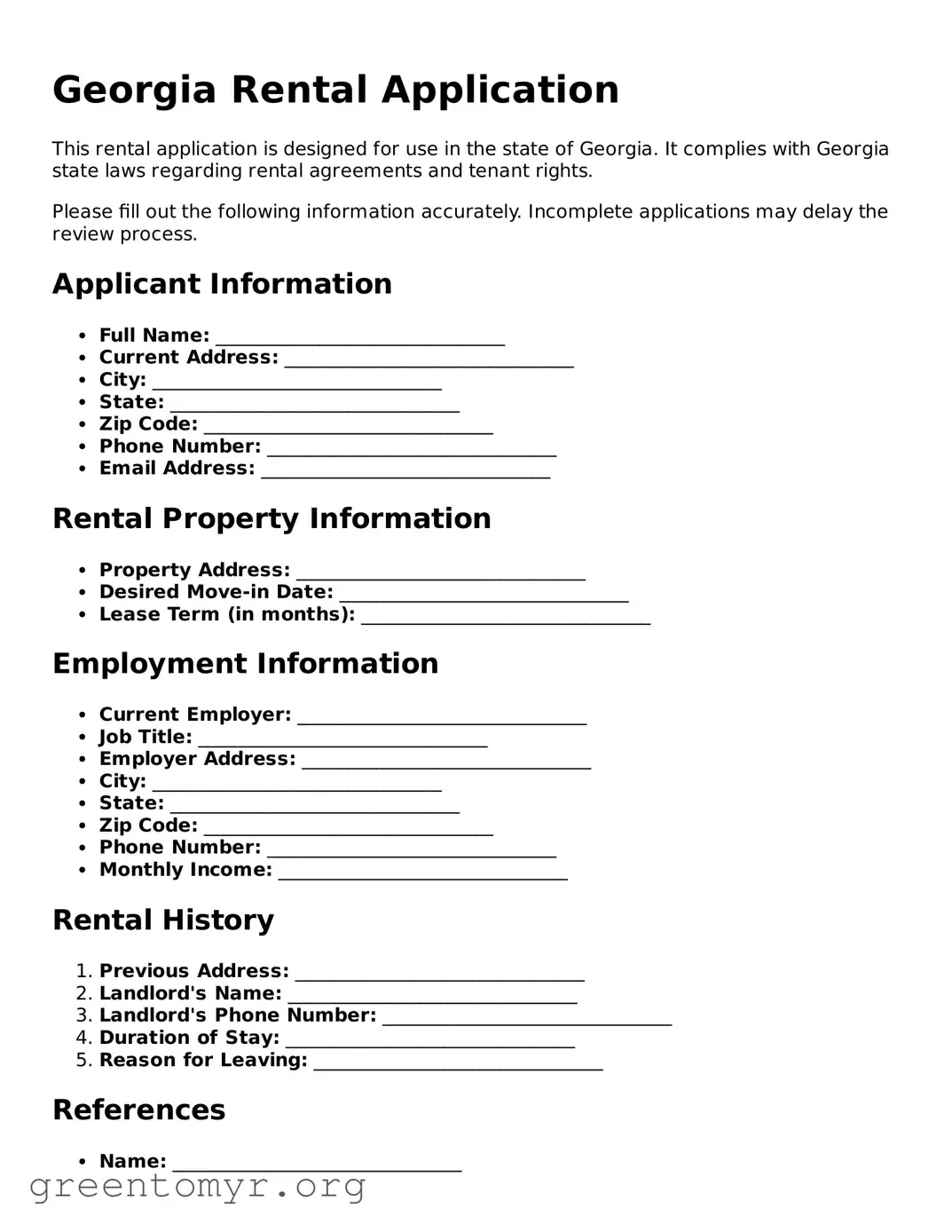
When seeking a rental property in Georgia, the rental application form plays a crucial role in the process. This form gathers essential information from potential tenants, helping landlords make informed decisions. Key aspects include personal details, employment history, and references. Applicants will typically need to provide information about their income and rental history, which helps landlords assess their ability to pay rent consistently. Additionally, the form often includes a section for consent to background and credit checks, ensuring that landlords can verify the information provided. Understanding the importance of this form can ease the application process and increase the chances of securing a desired rental property.
Georgia Rental Application
This rental application is designed for use in the state of Georgia. It complies with Georgia state laws regarding rental agreements and tenant rights.
Please fill out the following information accurately. Incomplete applications may delay the review process.
Applicant Information
Rental Property Information
Employment Information
Rental History
References
Additional Information
Please provide any additional information that may help in the application process:
__________________________________________________________
__________________________________________________________
By signing below, you confirm that the information provided is accurate to the best of your knowledge. You also consent to a background check and verification of the information provided.
Applicant Signature: _______________________________
Date: _______________________________
| Fact Name | Details |
|---|---|
| Purpose | The Georgia Rental Application form is used by landlords to screen potential tenants. |
| Information Required | Applicants typically provide personal details, rental history, and employment information. |
| Application Fee | Landlords may charge a non-refundable application fee to cover screening costs. |
| Fair Housing Laws | The application process must comply with federal and state fair housing laws, prohibiting discrimination. |
| Background Checks | Landlords often conduct background checks, which may include credit history and criminal records. |
| Approval Process | Once submitted, landlords review applications and decide to approve or deny based on set criteria. |
| Record Keeping | Landlords are advised to keep records of all applications for a specified period. |
| Governing Law | The Georgia Residential Landlord-Tenant Act governs rental agreements and applications in Georgia. |
Completing the Georgia Rental Application form is an essential step in securing a rental property. Once you have filled out the form, it will be reviewed by the landlord or property manager. They will use the information provided to assess your suitability as a tenant.
After completing these steps, review your application for any errors or omissions. Submitting a well-filled application can enhance your chances of being approved for the rental property.
The Georgia Rental Application form is a document used by landlords and property managers to collect information from prospective tenants. This form typically includes sections for personal information, rental history, employment details, and references. It helps landlords assess the suitability of applicants for renting a property.
A standard Georgia Rental Application form usually requests the following information:
Some applications may also ask for additional information, such as credit history or background checks, to further evaluate the applicant.
Many landlords charge a non-refundable application fee to cover the costs of processing the application, conducting background checks, and verifying information. This fee can vary widely, so it is important to ask the landlord or property manager about their specific fees before submitting the application.
The duration of the application process can vary based on several factors, including the landlord's policies and the thoroughness of the background checks. Generally, applicants can expect to receive a response within a few days to a week. However, it is advisable to follow up with the landlord if you have not heard back within a reasonable timeframe.
If an application is denied, landlords are usually required to provide a reason for the denial. Common reasons include insufficient income, poor rental history, or negative background check results. Applicants may request a copy of the report used in the decision-making process. If the denial is due to credit issues, applicants can take steps to improve their credit score before reapplying.
Filling out a rental application is often the first step in securing a new home. However, many individuals make common mistakes that can hinder their chances of approval. Understanding these pitfalls can lead to a smoother application process. One frequent error is providing incomplete information. Applicants may overlook sections or fail to fill in all required fields, which can raise red flags for landlords.
Another common mistake involves inaccuracies in personal information. Whether it’s misspelling a name or providing an incorrect Social Security number, these errors can create complications. Landlords rely on accurate information for background checks and credit reports. A simple typo can lead to delays or even rejection of the application.
Additionally, many applicants fail to disclose all sources of income. It is essential to provide a comprehensive view of one’s financial situation. Omitting a job or freelance work may create the impression of dishonesty, which landlords typically view unfavorably. Transparency is crucial when presenting financial information.
Another frequent oversight is neglecting to include references. Landlords often seek reassurance from previous landlords or employers about an applicant's reliability. Failing to provide this information can leave landlords with unanswered questions about the applicant's rental history and character.
Some applicants also underestimate the importance of including a cover letter or personal statement. This document can help to establish a personal connection with the landlord. It provides an opportunity to explain unique circumstances, such as credit issues or recent job changes, that may not be apparent from the application alone.
Another mistake involves not reading the application thoroughly. Each rental application may have specific requirements or stipulations. Ignoring these details can lead to misunderstandings or mistakes that could easily be avoided. Taking the time to read the application carefully can save applicants from unnecessary complications.
Furthermore, many individuals forget to check their credit history before applying. Landlords often conduct credit checks, and being unaware of one's credit standing can be detrimental. If there are inaccuracies or negative marks, addressing these issues beforehand can improve the chances of approval.
Some applicants also fail to follow up after submitting their applications. A simple phone call or email can demonstrate enthusiasm and commitment. It also provides an opportunity to address any questions the landlord may have, reinforcing the applicant's interest in the property.
Lastly, applicants sometimes overlook the importance of providing accurate contact information. If a landlord cannot reach the applicant due to incorrect phone numbers or email addresses, it could result in lost opportunities. Ensuring that contact details are correct is a straightforward but crucial step in the application process.
In conclusion, being aware of these common mistakes can significantly enhance the likelihood of a successful rental application. By taking the time to provide accurate and complete information, applicants can present themselves as reliable and responsible tenants.
When prospective tenants apply for a rental property in Georgia, several documents accompany the Georgia Rental Application form. These additional forms help landlords assess the applicant's suitability and ensure a smooth leasing process. Below are some commonly used documents.
These documents work together to provide a comprehensive view of the applicant, facilitating informed decisions for landlords and ensuring a clear understanding of the rental terms for tenants.
Lease Agreement: Like the rental application, a lease agreement outlines the terms of renting a property. It includes details such as the rental amount, duration of the lease, and responsibilities of both the landlord and tenant.
Background Check Authorization: This document is similar to the rental application as it collects personal information. It allows landlords to verify a potential tenant’s criminal history, credit score, and rental history.
Employment Verification Form: This form requests information about a tenant's employment status and income. It helps landlords assess whether a tenant can afford the rent, much like the financial information requested in a rental application.
Tenant Screening Report: Similar to the rental application, this report compiles data on a potential tenant’s rental history, creditworthiness, and any previous evictions. It helps landlords make informed decisions.
Guarantor Agreement: This document is often used alongside a rental application. It involves a third party agreeing to take responsibility for the lease if the tenant fails to pay rent or damages the property.
When filling out a rental application in Georgia, it is essential to approach the process with care and attention. Here are some important dos and don'ts to keep in mind.
By following these guidelines, you can enhance your chances of securing the rental property you desire. Remember, attention to detail and honesty are key components of a successful rental application.
When it comes to the Georgia Rental Application form, several misconceptions can lead to confusion for both landlords and tenants. Here are five common misunderstandings:
While many landlords do charge an application fee, it is not a requirement by law. Some landlords may choose to waive this fee or offer it as a refundable charge.
While rental history is important, landlords typically consider multiple factors, including credit score, income, and employment history, when evaluating an application.
Landlords have the right to deny applications based on their screening criteria. Approval is not guaranteed, even if the applicant meets certain requirements.
If an application is denied, applicants can request a reason for the denial. They may also have the option to dispute the decision if they believe it was made in error.
Most landlords require supporting documents, such as proof of income and identification, to process an application. Submitting a complete application increases the chances of approval.
When filling out and using the Georgia Rental Application form, several important considerations can help ensure a smooth process for both landlords and prospective tenants. Here are key takeaways:
Taking these factors into account can help streamline the rental application process in Georgia.