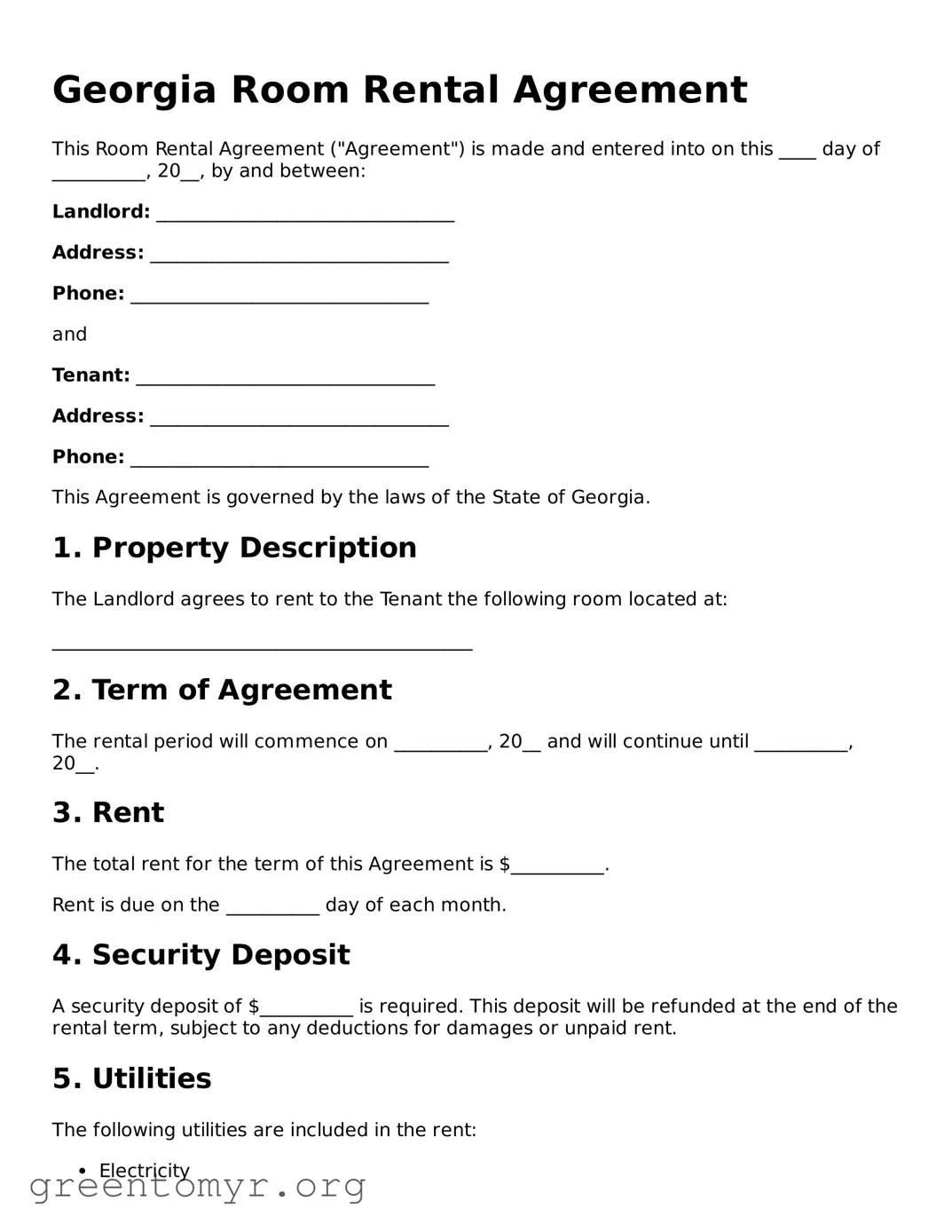
The Georgia Room Rental Agreement form serves as a vital document for both landlords and tenants, ensuring that all parties are clear on their rights and responsibilities. This agreement outlines essential details such as the rental property's address, the duration of the lease, and the amount of rent due. It specifies the payment schedule, security deposit requirements, and any additional fees that may apply. Furthermore, the form addresses maintenance responsibilities, rules regarding pets, and guidelines for terminating the agreement. By clearly defining these aspects, the Room Rental Agreement helps to prevent misunderstandings and disputes, fostering a smoother rental experience for everyone involved. Understanding this document can empower both landlords and tenants, providing a framework that supports a positive rental relationship.
Georgia Room Rental Agreement
This Room Rental Agreement ("Agreement") is made and entered into on this ____ day of __________, 20__, by and between:
Landlord: ________________________________
Address: ________________________________
Phone: ________________________________
and
Tenant: ________________________________
Address: ________________________________
Phone: ________________________________
This Agreement is governed by the laws of the State of Georgia.
1. Property Description
The Landlord agrees to rent to the Tenant the following room located at:
_____________________________________________
2. Term of Agreement
The rental period will commence on __________, 20__ and will continue until __________, 20__.
3. Rent
The total rent for the term of this Agreement is $__________.
Rent is due on the __________ day of each month.
4. Security Deposit
A security deposit of $__________ is required. This deposit will be refunded at the end of the rental term, subject to any deductions for damages or unpaid rent.
5. Utilities
The following utilities are included in the rent:
6. Maintenance and Repairs
The Tenant agrees to keep the premises clean and in good condition. The Landlord will be responsible for major repairs unless damage is caused by the Tenant's negligence.
7. Termination
Either party may terminate this Agreement by providing a written notice of ____ days to the other party.
8. Governing Law
This Agreement shall be governed by the laws of the State of Georgia.
9. Signatures
By signing below, both parties agree to the terms outlined in this Room Rental Agreement.
Landlord Signature: ________________________________ Date: ______________
Tenant Signature: ________________________________ Date: ______________
| Fact Name | Details |
|---|---|
| Governing Law | The Georgia Room Rental Agreement is governed by the laws of the State of Georgia. |
| Purpose | This form outlines the terms and conditions for renting a room, ensuring clarity between the landlord and tenant. |
| Required Information | Essential details such as the names of the parties, rental amount, and duration of the lease must be included. |
| Legal Binding | Once signed by both parties, the agreement becomes a legally binding contract, enforceable in a Georgia court. |
Completing the Georgia Room Rental Agreement form is an important step in securing your rental arrangement. By following the steps outlined below, you will ensure that all necessary information is accurately provided, making the process smoother for both you and your landlord.
Once the form is filled out, review it carefully for any errors or omissions. After that, you can present it to the landlord for their signature. This will finalize your rental agreement and help establish a clear understanding between both parties.
A Georgia Room Rental Agreement is a legal document that outlines the terms and conditions under which a room is rented. It serves as a contract between the landlord and the tenant, detailing the rights and responsibilities of both parties. This agreement typically includes information such as the rental amount, duration of the lease, security deposit requirements, and rules regarding the use of the property.
When creating a Room Rental Agreement in Georgia, it is essential to include several key elements to ensure clarity and protection for both parties. These elements typically include:
Terminating a Room Rental Agreement in Georgia requires adherence to specific procedures. Generally, the process depends on the terms outlined in the agreement and the reason for termination. Here are some common steps:
If the termination is due to a breach of contract, additional steps may be necessary, such as providing an opportunity to remedy the breach before termination becomes effective.
If a tenant fails to pay rent as agreed, the landlord has several options. First, the landlord may send a written notice to the tenant, often referred to as a "pay or quit" notice, which demands payment within a specified timeframe. If the tenant still does not pay, the landlord may initiate eviction proceedings. This process requires filing a complaint in the local court and obtaining a judgment to legally remove the tenant from the property. It is crucial for landlords to follow the legal process to avoid potential liability.
Yes, a Room Rental Agreement can be modified, but any changes must be made in writing and agreed upon by both the landlord and tenant. Common reasons for modification include changes in rental amount, lease duration, or rules regarding property use. Both parties should sign the amended agreement to ensure that it is legally binding. Verbal modifications are not typically enforceable, so it is always best to document any changes formally.
Filling out a Room Rental Agreement in Georgia can seem straightforward, but many individuals inadvertently make mistakes that can lead to complications down the line. One common error is failing to include all necessary personal information. Renters should ensure that they provide complete names, addresses, and contact details for both themselves and the landlord. Omitting even a single piece of information can create confusion and legal issues later.
Another frequent mistake involves neglecting to read the terms and conditions thoroughly. The Room Rental Agreement contains important clauses that dictate the rights and responsibilities of both parties. By skimming through the document, renters may overlook critical details such as payment deadlines, maintenance responsibilities, or penalties for late payments.
Additionally, some individuals mistakenly assume that all agreements are the same. Each rental agreement is unique, reflecting the specific circumstances of the rental situation. Therefore, it is essential to customize the agreement to accurately represent the arrangement, rather than relying on a generic template.
People often fail to discuss the security deposit and its terms adequately. A common error is not specifying the amount of the deposit or the conditions under which it will be returned. This can lead to misunderstandings and disputes when the rental period ends.
Another mistake is overlooking the importance of signatures. Both parties must sign the agreement for it to be legally binding. Sometimes, one party may assume that a verbal agreement suffices, but without signatures, the document lacks enforceability.
In addition, individuals sometimes neglect to include a clause regarding the duration of the rental. Clearly stating the start and end dates of the rental period helps prevent any confusion about tenancy duration and ensures that both parties are on the same page.
Moreover, it is not uncommon for renters to forget about maintenance and repair responsibilities. The agreement should clearly outline who is responsible for various aspects of property upkeep. Failing to address this can lead to disputes about who must handle repairs during the rental period.
Some individuals also make the mistake of not including provisions for early termination of the agreement. Life circumstances can change unexpectedly, and having a clear understanding of the process for ending the rental agreement can save both parties from potential legal headaches.
Finally, a significant oversight can occur when individuals do not keep a copy of the signed agreement. It is crucial to retain a copy for personal records, as this document serves as a reference point for both parties throughout the rental period.
When entering into a Room Rental Agreement in Georgia, it's essential to be aware of other documents that may accompany this agreement. These forms help clarify responsibilities, protect both parties, and ensure a smooth rental experience. Here are four commonly used forms that often go hand-in-hand with the Room Rental Agreement:
By understanding these accompanying documents, both landlords and tenants can foster a positive rental relationship. Having the right forms in place can prevent misunderstandings and ensure that everyone is on the same page throughout the rental process.
When considering a Room Rental Agreement, it's helpful to understand how it relates to other similar documents. Each of these agreements serves a distinct purpose but shares common elements that facilitate rental arrangements. Here are five documents that are similar to a Room Rental Agreement:
Understanding these related documents can provide clarity and confidence when entering into any rental arrangement. Each serves a unique purpose, yet all aim to protect the interests of both landlords and tenants.
When filling out the Georgia Room Rental Agreement form, it's important to be careful and thorough. Here are five things you should and shouldn't do:
Here are some common misconceptions about the Georgia Room Rental Agreement form:
Many people believe that a rental agreement is just a formality. In reality, once both parties sign it, it becomes a legally binding contract.
Some think that only the property owner needs to sign the agreement. However, both the landlord and tenant must sign to make the agreement valid.
Many assume that a verbal agreement is enough. Written agreements provide clear terms and protect both parties in case of disputes.
People often believe that all rental agreements are identical. Each agreement can vary based on specific terms, conditions, and local laws.
Some tenants think that landlords can choose whether to require a security deposit. In Georgia, landlords often require one, and it serves to protect them against damages or unpaid rent.
Many believe that once signed, the agreement lasts forever. In fact, rental agreements can have specific terms for duration and can be renewed or terminated as needed.
Some think that having just one signed copy is enough. Both the landlord and tenant should keep their own copies for reference.
People often assume they can change terms after signing. Any modifications must be agreed upon by both parties and documented in writing.
Some believe that the rental agreement does not address utilities. In fact, the agreement can specify who is responsible for paying utilities, which is important for both parties to know.
Understanding the Georgia Room Rental Agreement form is crucial for both landlords and tenants. Here are key takeaways to consider:
By paying attention to these key points, both landlords and tenants can navigate the rental process more effectively and avoid potential pitfalls.