In the state of Georgia, ensuring that a will is valid and can be easily accepted by the courts is of utmost importance for anyone looking to secure their final wishes. One essential tool in this process is the Georgia Self-Proving Affidavit. This legal document serves to simplify the probate process by allowing a will to be accepted without the need for witnesses to testify about its authenticity. By incorporating this affidavit, testators—those who create a will—can affirm that they signed the will voluntarily and were of sound mind at the time of signing. The affidavit must be signed by the testator and two witnesses in the presence of a notary public, thereby creating a robust layer of verification. This streamlined approach not only alleviates potential disputes among heirs but also expedites the court's acceptance of the will. Understanding how to properly complete and file this form is crucial for anyone wishing to navigate the complexities of estate planning in Georgia effectively.
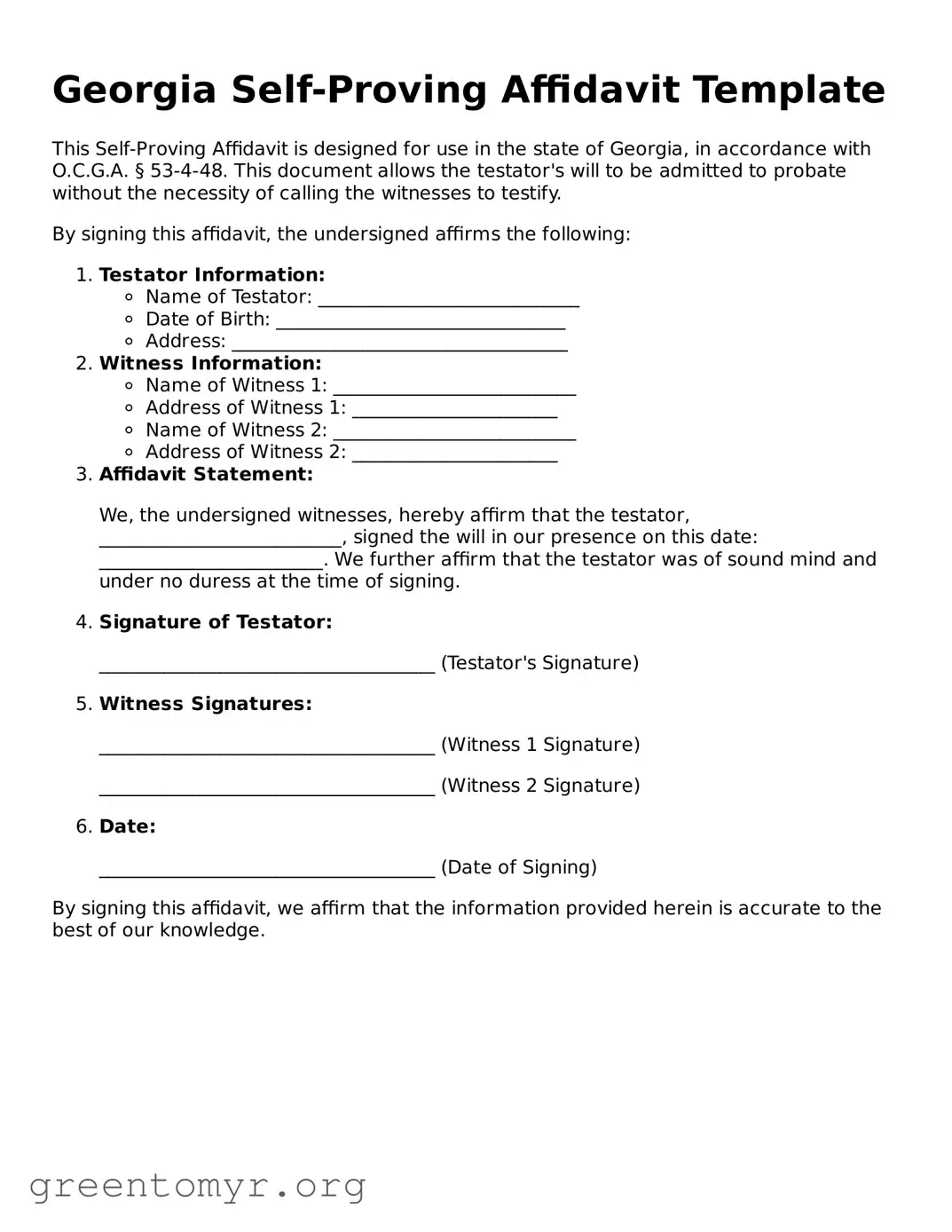
Georgia Self-Proving Affidavit Template
This Self-Proving Affidavit is designed for use in the state of Georgia, in accordance with O.C.G.A. § 53-4-48. This document allows the testator's will to be admitted to probate without the necessity of calling the witnesses to testify.
By signing this affidavit, the undersigned affirms the following:
We, the undersigned witnesses, hereby affirm that the testator, __________________________, signed the will in our presence on this date: ________________________. We further affirm that the testator was of sound mind and under no duress at the time of signing.
____________________________________ (Testator's Signature)
____________________________________ (Witness 1 Signature)
____________________________________ (Witness 2 Signature)
____________________________________ (Date of Signing)
By signing this affidavit, we affirm that the information provided herein is accurate to the best of our knowledge.
| Fact Name | Description |
|---|---|
| Purpose | The Georgia Self-Proving Affidavit allows a will to be validated without the need for witnesses to testify in court after the testator's death. |
| Governing Law | This form is governed by Georgia Code § 53-4-48, which outlines the requirements for self-proving wills. |
| Signatories | The affidavit must be signed by the testator and two witnesses in the presence of a notary public. |
| Benefits | Using this affidavit can expedite the probate process and reduce potential disputes among heirs. |
| Filing Requirements | The completed Self-Proving Affidavit should be filed with the will in the probate court to ensure its validity. |
After obtaining the Georgia Self-Proving Affidavit form, it is essential to fill it out accurately to ensure its validity. Following the steps below will help you complete the form correctly, paving the way for its acceptance in probate proceedings.
Once the form is filled out and notarized, it should be attached to the will when submitting it for probate. This process enhances the credibility of the will and may expedite the probate process.
A Georgia Self-Proving Affidavit is a legal document that allows a testator's will to be validated without the need for witnesses to testify in court after the testator's death. This affidavit is typically signed by the testator and witnesses in the presence of a notary public. By doing this, it simplifies the probate process and can help expedite the distribution of the estate.
To create a Self-Proving Affidavit in Georgia, follow these steps:
Using a Self-Proving Affidavit provides several advantages:
No, a Self-Proving Affidavit is not legally required in Georgia. However, it is highly recommended. Without it, witnesses may need to testify about the will’s execution, which can complicate and prolong the probate process. Including this affidavit can save time and reduce potential disputes.
Yes, a Self-Proving Affidavit can be revoked. If you decide to change your will or create a new one, the previous Self-Proving Affidavit becomes invalid. To ensure clarity, it’s best to include a statement in the new will that revokes all prior wills and affidavits. Always consult with a legal professional when making changes to your estate planning documents to ensure compliance with the law.
Filling out the Georgia Self-Proving Affidavit form can be a straightforward process, but many individuals make common mistakes that can jeopardize the validity of their documents. One frequent error is failing to properly identify the testator. The testator is the person who created the will. If the name is misspelled or incomplete, it can create confusion or disputes regarding the will's authenticity.
Another common mistake is neglecting to include the date of execution. The affidavit must clearly state when it was signed. Without a date, the affidavit may lack critical context, making it difficult to determine whether the will was executed in accordance with Georgia law.
Many people also overlook the requirement for witnesses. The Georgia Self-Proving Affidavit must be signed by at least two witnesses who were present during the signing of the will. If these signatures are missing or if the witnesses are not qualified, the affidavit may not hold up in court.
In addition, some individuals fail to have the affidavit notarized. A notary public must witness the signing of the affidavit to confirm its legitimacy. Without notarization, the affidavit may be considered invalid, which could lead to complications during the probate process.
Lastly, a common mistake involves misunderstanding the purpose of the affidavit. Some individuals think it is just a formality. However, the Self-Proving Affidavit serves a crucial role in simplifying the probate process. Failing to recognize its importance can lead to unnecessary delays and legal challenges when the will is submitted for probate.
The Georgia Self-Proving Affidavit is a useful legal document that allows a will to be validated without the need for the witnesses to appear in court. When preparing a will or managing estate matters in Georgia, several other forms and documents may accompany the Self-Proving Affidavit. Understanding these related documents can help ensure a smooth estate planning process.
Each of these documents plays a vital role in the estate planning and probate process in Georgia. By understanding their functions and interconnections, individuals can navigate the complexities of estate management more effectively.
The Self-Proving Affidavit is a legal document that serves to validate a will by confirming that the testator and witnesses signed it. Several other documents share similarities with the Self-Proving Affidavit in terms of purpose and function. Below are eight such documents:
Filling out the Georgia Self-Proving Affidavit form is a critical step in ensuring that your will is accepted in probate without the need for witnesses. Here are some important dos and don'ts to keep in mind.
Following these guidelines can help prevent complications during the probate process. Take the time to complete the affidavit correctly to safeguard your wishes.
The Georgia Self-Proving Affidavit is an important legal document that helps streamline the probate process for wills. However, there are several misconceptions surrounding this form that can lead to confusion. Here are six common misunderstandings:
Many people think that only those with significant assets need a Self-Proving Affidavit. In reality, anyone with a will can benefit from this form, regardless of their financial status. It simplifies the validation of the will, making it easier for loved ones to handle the estate.
Some believe that the Self-Proving Affidavit must be notarized prior to the signing of the will. However, the affidavit can be signed simultaneously with the will in the presence of witnesses. This flexibility allows for a smoother process.
This misconception suggests that if one witness is absent, the affidavit is invalid. In fact, as long as the required number of witnesses sign the will and the affidavit, it remains valid. The presence of all witnesses at the same time is not a strict requirement.
While it may seem optional, using a Self-Proving Affidavit can greatly expedite the probate process. Without it, the will may require additional verification steps, which can lead to delays and complications.
People often think they can attach a Self-Proving Affidavit to an old will whenever they choose. However, to ensure its effectiveness, the affidavit should be created at the same time as the will or with a new will that revokes the previous one.
While the Georgia Self-Proving Affidavit is specific to the state, many other states have similar forms. Understanding the requirements in your state is crucial, as the rules can vary significantly.
By clarifying these misconceptions, individuals can better navigate the complexities of estate planning and ensure their wishes are honored after they pass away.
The Georgia Self-Proving Affidavit is an important legal document that facilitates the probate process. Understanding how to properly fill out and utilize this form can ease the burden on loved ones during a difficult time. Here are key takeaways regarding the use of the Georgia Self-Proving Affidavit.