In Georgia, the Small Estate Affidavit serves as a valuable tool for individuals navigating the complexities of estate settlement when a loved one passes away. This form is designed for estates that do not exceed a certain value, allowing heirs to bypass the lengthy and often costly probate process. By using the Small Estate Affidavit, eligible heirs can claim the deceased's assets, such as bank accounts, personal property, and other possessions, without the need for formal court proceedings. The form requires specific information, including details about the deceased, a list of assets, and an affirmation of the heirs' rights to inherit. This streamlined approach not only simplifies the transfer of assets but also provides a sense of closure for families during a challenging time. Understanding the requirements and implications of the Small Estate Affidavit is essential for anyone facing the loss of a loved one and seeking to manage their estate efficiently.
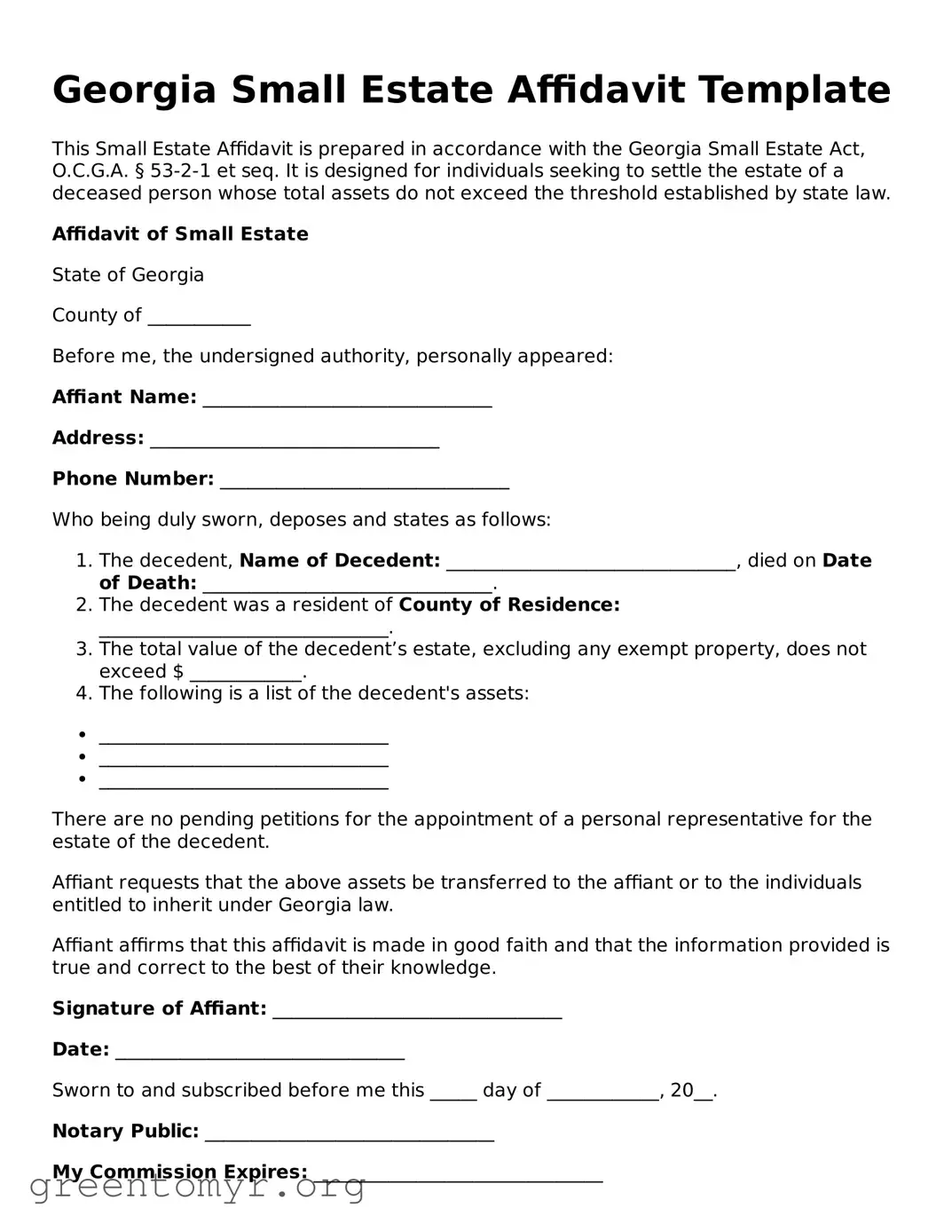
Georgia Small Estate Affidavit Template
This Small Estate Affidavit is prepared in accordance with the Georgia Small Estate Act, O.C.G.A. § 53-2-1 et seq. It is designed for individuals seeking to settle the estate of a deceased person whose total assets do not exceed the threshold established by state law.
Affidavit of Small Estate
State of Georgia
County of ___________
Before me, the undersigned authority, personally appeared:
Affiant Name: _______________________________
Address: _______________________________
Phone Number: _______________________________
Who being duly sworn, deposes and states as follows:
There are no pending petitions for the appointment of a personal representative for the estate of the decedent.
Affiant requests that the above assets be transferred to the affiant or to the individuals entitled to inherit under Georgia law.
Affiant affirms that this affidavit is made in good faith and that the information provided is true and correct to the best of their knowledge.
Signature of Affiant: _______________________________
Date: _______________________________
Sworn to and subscribed before me this _____ day of ____________, 20__.
Notary Public: _______________________________
My Commission Expires: _______________________________
| Fact Name | Description |
|---|---|
| Purpose | The Georgia Small Estate Affidavit allows heirs to claim assets of a deceased person without going through formal probate, provided the estate meets certain criteria. |
| Eligibility | To use this affidavit, the total value of the estate must be less than $10,000, excluding certain types of property. |
| Governing Law | This form is governed by Georgia Code § 53-2-40, which outlines the requirements and procedures for small estates. |
| Required Information | The affidavit must include details about the deceased, the heirs, and a list of the assets being claimed. |
| Filing Process | Once completed, the affidavit must be signed in front of a notary public and can be presented to financial institutions or other entities holding the deceased's assets. |
After gathering the necessary information, you are ready to fill out the Georgia Small Estate Affidavit form. This form will help you declare the assets of a deceased person without going through the full probate process. Follow the steps below to complete the form accurately.
Once the form is filled out and notarized, you can file it with the appropriate court or use it as needed to settle the estate.
The Georgia Small Estate Affidavit is a legal document that allows individuals to settle the estate of a deceased person without going through the formal probate process. This option is available when the total value of the estate does not exceed a specific threshold, which is currently set at $10,000 for personal property and $25,000 for real property.
Any individual who is a qualified heir or beneficiary of the deceased can use the Small Estate Affidavit. This includes spouses, children, parents, and other relatives, as well as individuals named in the will. However, the estate must meet the value limits set by Georgia law.
The Small Estate Affidavit can be used for various types of assets, including:
However, it does not cover assets held in a trust or those that require formal probate proceedings.
To complete a Small Estate Affidavit, follow these steps:
There is no filing fee associated with the Small Estate Affidavit itself, as it is not filed with the probate court. However, some institutions may require a small fee for processing the affidavit or transferring assets.
If the estate's value exceeds the limits set for the Small Estate Affidavit, the heirs must initiate formal probate proceedings. This process is more complex and typically requires legal representation to navigate the court system.
Yes, a Small Estate Affidavit can be contested. Other potential heirs or beneficiaries may challenge the affidavit if they believe they have a rightful claim to the estate or if they suspect that the affidavit was completed fraudulently. In such cases, it may lead to legal disputes that could require court intervention.
The time it takes to settle an estate using a Small Estate Affidavit can vary. Generally, the process is quicker than formal probate, often taking a few weeks to a few months. Factors such as the complexity of the estate and the responsiveness of financial institutions can influence the timeline.
For more information about the Small Estate Affidavit, individuals can visit the Georgia Probate Court website or consult with an attorney who specializes in estate planning. Local probate court offices can also provide guidance and resources regarding the affidavit process.
Filling out the Georgia Small Estate Affidavit form can seem straightforward, but many individuals make common mistakes that can delay the process or even lead to complications. Understanding these pitfalls can save time and frustration.
One frequent mistake is not including all required information. The form asks for specific details about the deceased, such as their full name, date of death, and last known address. Omitting any of this information can result in a rejection of the affidavit.
Another common error involves incorrectly identifying the heirs. It’s crucial to list all heirs accurately, as any missing individuals can challenge the affidavit later. This could lead to disputes and additional legal issues, so double-checking this section is essential.
People often forget to sign the affidavit in the appropriate places. A missing signature can render the document invalid. It's important to ensure that all required signatures are present before submission.
Many individuals also neglect to have the affidavit notarized. Notarization is a key step in making the document official. Without a notary's signature, the affidavit may not be accepted by the court or financial institutions.
Another mistake is failing to provide supporting documentation. This could include a copy of the death certificate or any relevant financial statements. These documents help establish the validity of the claim and should be attached to the affidavit.
Some people make the error of using outdated forms. The Georgia Small Estate Affidavit may be updated periodically, so it's important to ensure that the most current version is being used. An outdated form can lead to unnecessary complications.
In addition, individuals sometimes misunderstand the eligibility criteria for using the Small Estate Affidavit. This form is only applicable for estates valued below a certain threshold. If the estate exceeds this limit, a different legal process may be required.
Another issue arises when people submit the affidavit to the wrong court. Each county has its own probate court, and submitting to the wrong one can cause delays. It’s vital to confirm the correct jurisdiction before filing.
Lastly, individuals often underestimate the importance of keeping copies of all documents submitted. Having a record of what was filed can be invaluable in case any issues arise later. Always retain copies for personal records.
By being aware of these common mistakes, individuals can navigate the Georgia Small Estate Affidavit process more smoothly and ensure that their loved ones' affairs are handled efficiently.
When dealing with the Georgia Small Estate Affidavit, there are several other forms and documents that may be necessary to ensure a smooth process in settling an estate. Each of these documents serves a specific purpose and can help clarify the situation surrounding the estate. Below is a list of commonly used forms alongside the Small Estate Affidavit.
Having these documents ready can simplify the process of settling a small estate in Georgia. Each form plays a vital role in ensuring that everything is handled according to the law and the wishes of the deceased.
When filling out the Georgia Small Estate Affidavit form, it's important to approach the process with care. Here’s a helpful list of things to do and avoid to ensure everything goes smoothly.
By following these guidelines, you can navigate the Georgia Small Estate Affidavit process more confidently and effectively.
The Georgia Small Estate Affidavit is a useful tool for settling the estates of individuals who have passed away, particularly when their assets are below a certain threshold. However, several misconceptions surround this form that can lead to confusion. Here are nine common misunderstandings:
Understanding these misconceptions can help individuals navigate the estate settlement process more effectively. By clarifying the purpose and limitations of the Georgia Small Estate Affidavit, individuals can better prepare for managing the affairs of a deceased loved one.
The Georgia Small Estate Affidavit form is a legal document that allows individuals to settle the estate of a deceased person without going through formal probate. Below are key takeaways regarding its use and completion.