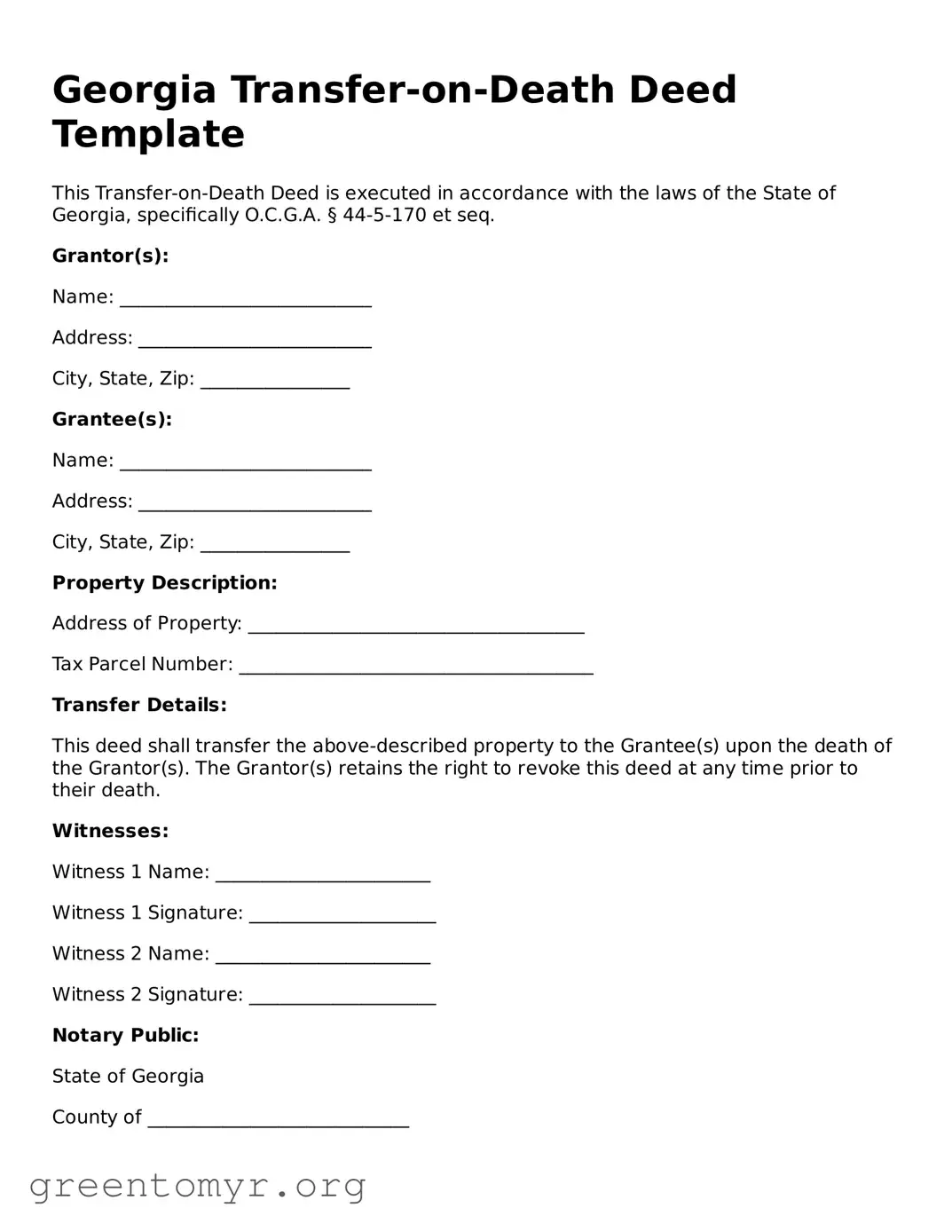
The Georgia Transfer-on-Death Deed form offers a straightforward way for property owners to transfer their real estate to designated beneficiaries upon their passing, without the need for probate. This legal tool allows individuals to maintain full control of their property during their lifetime while ensuring a smooth transition of ownership after death. By completing this form, property owners can specify who will inherit their property, which can help avoid potential disputes among heirs. Additionally, the form requires the signatures of the owner and a witness, along with notarization, to ensure its validity. The Transfer-on-Death Deed can be revoked or altered at any time before the owner's death, providing flexibility as personal circumstances change. Understanding the nuances of this deed can empower property owners in Georgia to make informed decisions about their estate planning and provide peace of mind for themselves and their loved ones.
Georgia Transfer-on-Death Deed Template
This Transfer-on-Death Deed is executed in accordance with the laws of the State of Georgia, specifically O.C.G.A. § 44-5-170 et seq.
Grantor(s):
Name: ___________________________
Address: _________________________
City, State, Zip: ________________
Grantee(s):
Name: ___________________________
Address: _________________________
City, State, Zip: ________________
Property Description:
Address of Property: ____________________________________
Tax Parcel Number: ______________________________________
Transfer Details:
This deed shall transfer the above-described property to the Grantee(s) upon the death of the Grantor(s). The Grantor(s) retains the right to revoke this deed at any time prior to their death.
Witnesses:
Witness 1 Name: _______________________
Witness 1 Signature: ____________________
Witness 2 Name: _______________________
Witness 2 Signature: ____________________
Notary Public:
State of Georgia
County of ____________________________
On this ____ day of __________, 20__, before me, a Notary Public, personally appeared ______________________, known to me to be the person whose name is subscribed to this instrument, and acknowledged that they executed the same for the purposes therein contained.
Notary Public Signature: ___________________________
My Commission Expires: _________________________
Important Notes:
| Fact Name | Details |
|---|---|
| Definition | A Transfer-on-Death Deed allows an individual to transfer real estate to a beneficiary upon their death without going through probate. |
| Governing Law | The Transfer-on-Death Deed in Georgia is governed by O.C.G.A. § 44-6-70 through § 44-6-77. |
| Eligibility | Any individual who owns real estate in Georgia can use a Transfer-on-Death Deed. |
| Beneficiary Designation | Multiple beneficiaries can be designated, and they can be individuals or entities. |
| Revocation | The deed can be revoked at any time before the death of the grantor by executing a new deed. |
| Recording Requirement | To be effective, the Transfer-on-Death Deed must be recorded in the county where the property is located. |
| Impact on Taxes | The transfer does not trigger a gift tax, and the property remains part of the grantor's estate for tax purposes until death. |
| Legal Assistance | While individuals can complete the deed without an attorney, consulting a legal professional is advisable to ensure compliance with state laws. |
| Limitations | This deed cannot be used for property held in joint tenancy or for properties subject to a mortgage unless the mortgage allows for such transfers. |
After obtaining the Georgia Transfer-on-Death Deed form, you will need to complete it accurately to ensure it reflects your intentions regarding property transfer. Follow these steps to fill out the form correctly.
A Transfer-on-Death Deed (TOD) is a legal document that allows an individual to transfer real estate to a designated beneficiary upon the owner's death. This type of deed bypasses the probate process, enabling a smoother and faster transition of property ownership. It is essential for property owners in Georgia who wish to designate heirs without the complications of probate court.
To create a Transfer-on-Death Deed in Georgia, follow these steps:
Ensure that all information is correct to avoid complications in the future.
Yes, a Transfer-on-Death Deed can be changed or revoked. To do this, the property owner must create a new deed or a revocation form. The new document must be signed, notarized, and recorded with the county clerk to be effective. It is advisable to consult with a legal expert to ensure that the changes are made correctly and legally binding.
Yes, there are limitations to consider:
Understanding these limitations can help in making informed decisions about estate planning.
If the designated beneficiary passes away before the property owner, the Transfer-on-Death Deed becomes ineffective for that beneficiary. The property owner can choose to designate a new beneficiary by creating a new deed or updating the existing one. If no new beneficiary is named, the property will be distributed according to the owner's will or, if there is no will, according to Georgia intestacy laws.
While it is possible to complete a Transfer-on-Death Deed without legal assistance, consulting with a legal professional is highly recommended. An attorney can provide guidance on the implications of the deed, ensure that all legal requirements are met, and help navigate any complexities that may arise during the process. This can ultimately save time and prevent potential disputes among heirs in the future.
Filling out a Georgia Transfer-on-Death Deed form can be a straightforward process, but many people stumble along the way. One common mistake occurs when individuals fail to include the correct legal description of the property. Instead of simply writing the address, it’s essential to provide a detailed description as found in the property deed. Omitting this information can lead to confusion and potential legal issues down the line.
Another frequent error is neglecting to properly identify the beneficiaries. It’s not enough to just list names; individuals must ensure that the names match those on official documents. Using nicknames or initials can create complications. Therefore, always double-check that the names are accurate and consistent.
Some people overlook the need for witnesses when signing the deed. In Georgia, two witnesses are required to validate the document. Failing to have these signatures can render the deed ineffective. It’s a simple step, but one that can have significant consequences.
Additionally, individuals sometimes forget to record the deed with the county clerk’s office. After completing the form, it’s crucial to file it properly. Without this step, the transfer may not be recognized, and the property could remain part of the original owner’s estate.
Another mistake is assuming that the Transfer-on-Death Deed automatically supersedes existing wills or trusts. This is not always the case. People should be aware that if there are conflicting documents, it may lead to disputes among heirs. Clear communication and thorough planning can help avoid such issues.
Some individuals fail to consider tax implications. While the Transfer-on-Death Deed allows for a smooth transfer of property, it does not eliminate potential tax responsibilities. It’s wise to consult with a tax professional to understand any financial obligations that may arise.
Moreover, people may not realize the importance of keeping the deed updated. Life changes such as marriage, divorce, or the birth of a child can affect beneficiaries. Regularly reviewing and, if necessary, revising the deed ensures that it reflects current intentions.
Lastly, many individuals rush through the process without seeking professional guidance. While it may seem simple, the nuances of property law can be complex. Consulting with an attorney or a knowledgeable paralegal can help clarify any uncertainties and ensure that the deed is filled out correctly.
When dealing with property transfers in Georgia, particularly with a Transfer-on-Death Deed, several other forms and documents may be required to ensure a smooth process. Here’s a list of some important documents that you might encounter:
Having these documents ready can help facilitate a smoother transaction when using a Transfer-on-Death Deed in Georgia. Always consider consulting a legal professional to ensure everything is in order.
The Transfer-on-Death Deed (TODD) is a unique legal document that allows individuals to transfer property to beneficiaries upon their death without the need for probate. Several other documents serve similar purposes in estate planning and property transfer. Here’s a list of ten documents that share similarities with the Transfer-on-Death Deed:
When filling out the Georgia Transfer-on-Death Deed form, it is essential to follow certain guidelines to ensure accuracy and compliance with state laws. Below is a list of things to do and avoid during this process.
Things You Should Do:
Things You Shouldn't Do:
The Georgia Transfer-on-Death Deed form is a useful tool for estate planning, but several misconceptions can lead to confusion. Here are four common misunderstandings:
Many believe that using a Transfer-on-Death Deed means they no longer need a will. This is not true. While the deed allows for the transfer of property outside of probate, a will is still essential for addressing other assets and wishes.
Some think that a Transfer-on-Death Deed can be revoked at any time without formalities. However, revocation must be done through a specific process, including filing a new deed or a formal revocation document.
This is a common misconception. The property does not transfer until the owner passes away. Until that time, the owner retains full control over the property.
Many people assume that the Transfer-on-Death Deed applies only to real estate. While it is primarily used for real property, it does not cover personal property, which may require different methods for transfer.
Understanding these misconceptions is crucial for effective estate planning. Ensure that you have the right information to make informed decisions.
When filling out and using the Georgia Transfer-on-Death Deed form, it is important to keep several key points in mind. Understanding these can help ensure a smooth process for transferring property upon death.