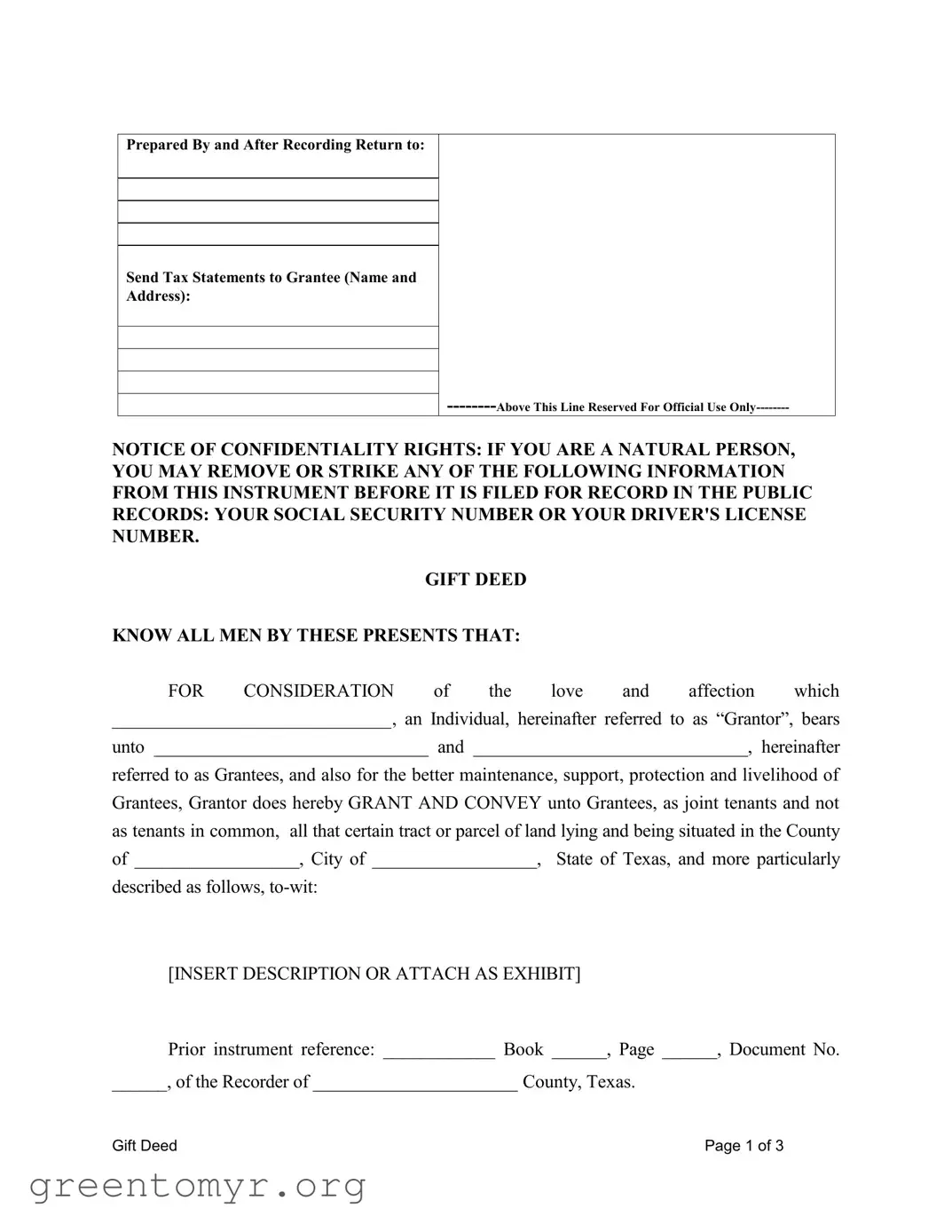
The Gift Deed Texas form serves as a legal instrument for transferring property ownership from one individual, known as the Grantor, to one or more individuals referred to as Grantees. This form is particularly significant as it facilitates the conveyance of property without any monetary exchange, typically based on love and affection. The document outlines essential details such as the names of the Grantor and Grantees, a description of the property being transferred, and the legal terms governing the transfer. It emphasizes the joint tenancy arrangement, allowing Grantees to hold the property together with rights of survivorship, which ensures that if one Grantee passes away, their interest in the property automatically transfers to the surviving Grantee. Additionally, the form includes provisions for the acknowledgment of the transaction by a notary public, which adds a layer of authenticity. Importantly, the Gift Deed Texas form also incorporates a notice regarding confidentiality rights, allowing natural persons to redact sensitive information like Social Security numbers before filing. Understanding these components is crucial for anyone considering the use of a Gift Deed in Texas.

Prepared By and After Recording Return to:
Send Tax Statements to Grantee (Name and
Address):
NOTICE OF CONFIDENTIALITY RIGHTS: IF YOU ARE A NATURAL PERSON, YOU MAY REMOVE OR STRIKE ANY OF THE FOLLOWING INFORMATION FROM THIS INSTRUMENT BEFORE IT IS FILED FOR RECORD IN THE PUBLIC RECORDS: YOUR SOCIAL SECURITY NUMBER OR YOUR DRIVER'S LICENSE NUMBER.
GIFT DEED
KNOW ALL MEN BY THESE PRESENTS THAT:
FOR CONSIDERATION of the love and affection which
______________________________, an Individual, hereinafter referred to as “Grantor”, bears
unto ______________________________ and ______________________________, hereinafter
referred to as Grantees, and also for the better maintenance, support, protection and livelihood of Grantees, Grantor does hereby GRANT AND CONVEY unto Grantees, as joint tenants and not as tenants in common, all that certain tract or parcel of land lying and being situated in the County of __________________, City of __________________, State of Texas, and more particularly
described as follows,
[INSERT DESCRIPTION OR ATTACH AS EXHIBIT]
Prior instrument reference: ____________ Book ______, Page ______, Document No.
______, of the Recorder of ______________________ County, Texas.
Gift Deed |
Page 1 of 3 |

TO HAVE AND TO HOLD the above described premises together with all and singular the rights and appurtenances thereto in anywise belonging unto the above named Grantees, their successors and assigns forever; and Grantor herein hereby binds itself, its successors, assigns, and administrators to WARRANT AND FOREVER DEFEND all and singular the said premises unto the above named Grantee, their successors and assigns, against every person whomsoever lawfully claiming or to claim the same or any part thereof.
Grantees, TO HAVE AND TO HOLD as joint tenants, with right of survivorship and not as tenants in common, their heirs, personal representatives, executors and assigns forever: it being the intention of the parties to this conveyance, that (unless the joint tenancy hereby created is severed or terminated during the joint lives of the grantees herein) in the event one Grantee herein survives the other, the entire interest in fee simple shall pass to the surviving Grantee, and if one does not survive the other, then the heirs and assigns of the Grantees herein shall take as tenants in common.
This conveyance is made and accepted subject to the following matters, to the extent same are in effect at this time: Any and all restrictions, covenants, conditions and easements, if any, relating to the hereinabove described property, but only to the extent they are still in effect, shown of record in the hereinabove mentioned County and State; and to all zoning laws, regulations and ordinances of municipal and/or other governmental authorities, if any, but only to the extent that they are still in effect, relating to the hereinabove described property.
The property herein conveyed is not a part of the homestead of Grantor, or is part of the homestead of Grantor and the conveyance is joined by both Husband and Wife.
WITNESS Grantor’s hand this the ______ day of __________________, 20______.
Grantor
Type or Print Name
Gift Deed |
Page 2 of 3 |

STATE OF TEXAS
COUNTY OF __________________
This instrument was acknowledged before me on __________________ (date) by
____________________________________ (name of representative) as
____________________________________ (title of representative) of
________________________________________________ (name of entity or person
represented).
Notary Public
My commission expires:
Type or Print Name
Mailing Address of Grantee:
Name
Address
Gift Deed |
Page 3 of 3 |
| Fact Name | Details |
|---|---|
| Governing Law | The Gift Deed in Texas is governed by the Texas Property Code. |
| Confidentiality Rights | Natural persons can remove their Social Security or driver's license numbers from the document before filing. |
| Joint Tenancy | The deed establishes joint tenancy with rights of survivorship for the grantees. |
| Consideration | The deed is executed for love and affection, which is a valid consideration under Texas law. |
| Property Description | A detailed description of the property must be included or attached as an exhibit. |
| Homestead Status | The deed specifies whether the property is part of the grantor's homestead, which affects the validity of the conveyance. |
After completing the Gift Deed Texas form, you will need to file it with the appropriate county office. Ensure that all required signatures and notary acknowledgments are in place before submission.
A Gift Deed in Texas is a legal document used to transfer ownership of property from one individual (the Grantor) to another (the Grantee) without any exchange of money. This type of deed is often executed to express love and affection, and it can be used for various types of property, including real estate. The deed ensures that the Grantees receive the property as joint tenants, which means they share ownership equally and have rights of survivorship.
To complete a Gift Deed, several key pieces of information are necessary:
Additionally, the Grantor must indicate whether the property is part of their homestead, which may affect the transfer process.
Yes, Texas law provides confidentiality rights for natural persons. Before filing the Gift Deed for public record, individuals may remove or strike certain personal information, such as their Social Security number or driver's license number. This provision helps protect sensitive information from public disclosure.
In the case of a Gift Deed that establishes joint tenancy with rights of survivorship, if one Grantee passes away, the entire interest in the property automatically transfers to the surviving Grantee. This means the surviving Grantee will have full ownership of the property without the need for probate proceedings.
Once a Gift Deed is executed and recorded, it generally cannot be revoked or changed unilaterally. However, the Grantor may have the option to create a new deed that explicitly revokes the previous Gift Deed. It is advisable to consult with a legal professional to understand the implications and procedures involved in revoking or altering a Gift Deed.
While it is not legally required to have a lawyer to create a Gift Deed, seeking legal advice can be beneficial. A lawyer can help ensure that the deed is properly drafted, complies with Texas laws, and accurately reflects the intentions of the parties involved. This can help avoid potential disputes or complications in the future.
When filling out the Gift Deed Texas form, people often make several common mistakes. One frequent error is failing to provide a complete and accurate description of the property being transferred. This description is crucial, as it helps to clearly identify the land involved in the gift. Without it, the deed may be considered incomplete or invalid.
Another mistake is neglecting to include all necessary parties in the document. If there are multiple grantees, all their names must be listed. Omitting a name can lead to disputes later on regarding ownership. Similarly, when the grantor is married, both spouses typically need to sign the deed, especially if the property is part of the homestead.
People often forget to check the box indicating whether the property is part of the homestead. This detail can affect tax implications and the rights of the grantees. Ignoring this section might lead to complications that could have been easily avoided.
Some individuals also fail to include the correct county and city where the property is located. This information is essential for proper recording and ensures that the deed is filed in the right jurisdiction. Errors in this area can result in delays or rejections during the recording process.
Another common mistake is not signing the document in front of a notary public. The deed must be notarized to be legally binding. Without this step, the deed may not hold up in court if challenged. It is vital to ensure that the notary’s information is filled out correctly as well.
People sometimes overlook the importance of including the date of the transfer. This date is important for establishing the timeline of ownership and can be critical in legal situations. Missing this detail can cause confusion regarding when the gift actually took place.
Additionally, individuals may forget to remove personal information, such as social security numbers, before filing. This step is crucial for protecting privacy and preventing identity theft. The form allows for the removal of sensitive information, and it is wise to take advantage of this option.
Another mistake is not providing a mailing address for the grantee. This information is necessary for tax statements and future correspondence. Without it, the grantee may miss important notifications regarding the property.
Some people also fail to review the deed for errors before submission. Simple typos or incorrect information can lead to significant issues down the line. Taking the time to double-check the form can save a lot of trouble later.
Lastly, individuals might not understand the implications of joint tenancy versus tenancy in common. This choice affects how the property will be handled if one of the grantees passes away. Understanding these terms can help prevent misunderstandings and ensure that the intentions of the grantor are honored.
The Gift Deed in Texas is an essential document for transferring property without monetary exchange. However, several other forms and documents are often used in conjunction with it to ensure a smooth transaction. Here are some of the key documents that may accompany a Gift Deed:
These documents play a crucial role in ensuring that the gift transfer is legally sound and that all parties understand their rights and obligations. Properly preparing and filing these forms can help prevent future disputes and complications.
When filling out the Gift Deed Texas form, it's important to approach the task with care. Here are some key things to keep in mind:
By following these guidelines, you can help ensure that the Gift Deed Texas form is filled out correctly and efficiently.
Misconceptions about the Gift Deed Texas form can lead to confusion and potential issues during property transfers. Here are six common misconceptions:
Understanding these misconceptions can help ensure a smoother property transfer process and protect the interests of both the grantor and the grantee.
When filling out and using the Gift Deed Texas form, consider the following key takeaways:
Following these guidelines can help ensure that the Gift Deed is completed correctly and legally valid in Texas.