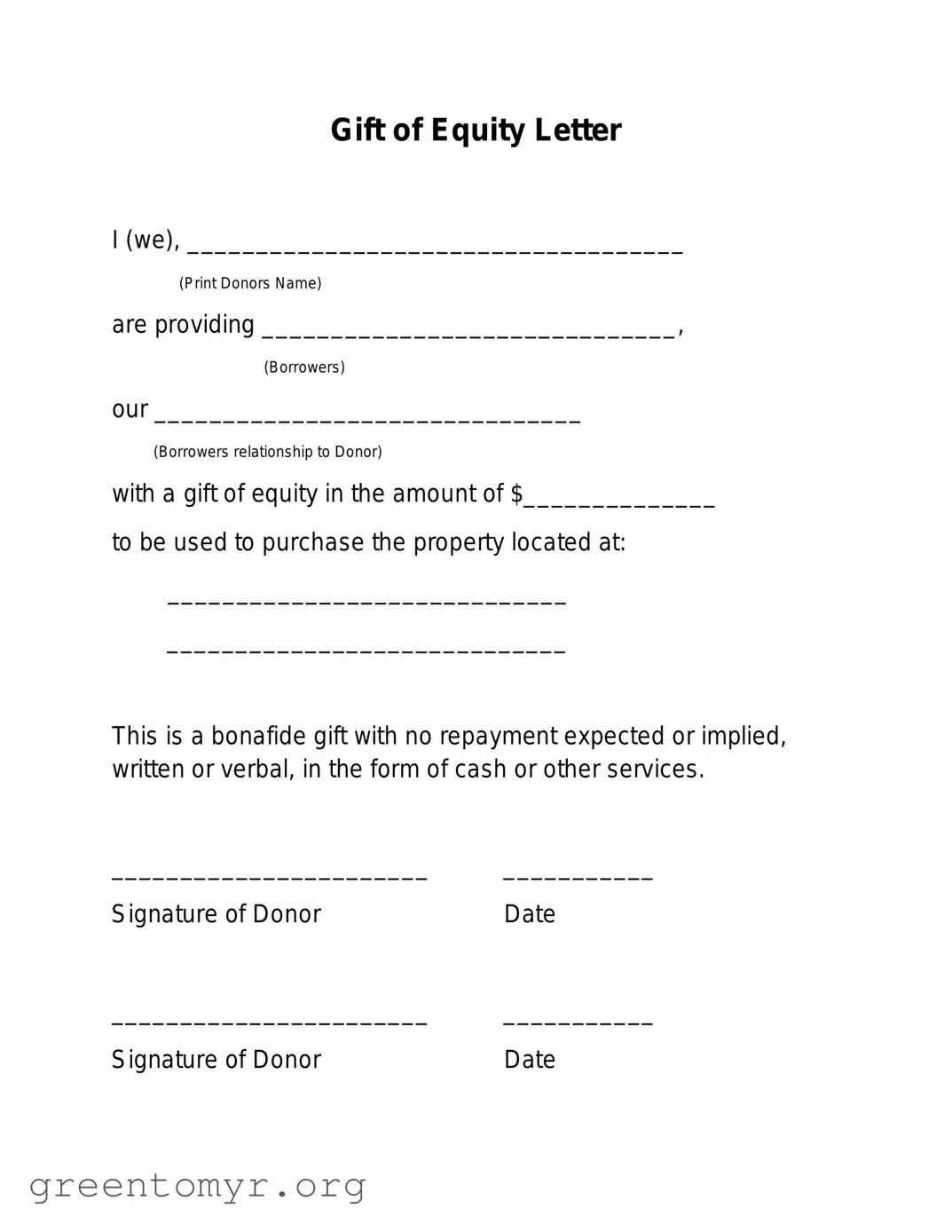
When navigating the complexities of real estate transactions, particularly those involving family or close relationships, the Gift of Equity Letter form emerges as a crucial document. This form serves to formalize the transfer of equity from a donor to a borrower, often a family member, facilitating the purchase of property. It outlines essential details, including the names of both the donor and the borrower, their relationship, and the specific amount of equity being gifted. Notably, the letter emphasizes that this transfer is a genuine gift, devoid of any expectation for repayment, whether in cash or services. By clearly stating these terms, the form helps to prevent misunderstandings and provides clarity for all parties involved. Additionally, it requires the signatures of the donors, affirming their intent and commitment to the transaction, thus ensuring that the gift is documented and recognized legally.
Gift of Equity Letter
I (we), ____________________________________
(Print Donors Name)
are providing ______________________________,
(Borrowers)
our _______________________________
(Borrowers relationship to Donor)
with a gift of equity in the amount of $______________
to be used to purchase the property located at:
_____________________________
_____________________________
This is a bonafide gift with no repayment expected or implied, written or verbal, in the form of cash or other services.
_______________________ |
___________ |
Signature of Donor |
Date |
_______________________ |
___________ |
Signature of Donor |
Date |
| Fact Name | Description |
|---|---|
| Purpose | The Gift of Equity Letter is used to document a gift of equity from a donor to a borrower, often a family member, to assist in purchasing property. |
| Contents | The form includes the names of the donor and borrower, their relationship, the amount of the gift, and the property address. |
| Legal Implications | This letter states that the gift is a bona fide gift with no expectation of repayment, which is important for tax and legal purposes. |
| State-Specific Forms | Different states may have specific requirements for gift letters. For example, in California, the governing law is the California Civil Code, which addresses gift transactions. |
Filling out the Gift of Equity Letter form is an important step in the process of transferring equity as a gift. Once completed, this letter will serve as a clear record of the gift, ensuring all parties understand the nature of the transaction. Follow these steps carefully to ensure the form is filled out correctly.
A Gift of Equity Letter is a document that outlines a financial gift from one party to another, specifically in the context of real estate transactions. This letter indicates that the donor is providing equity in a property to the recipient, often a family member, to assist with the purchase of that property.
Family members often use a Gift of Equity Letter when one relative wants to help another buy a home. For example, a parent might gift equity to a child to make it easier for them to secure a mortgage or reduce the purchase price of a home.
The letter typically includes the following details:
Generally, a gift of equity is not considered taxable income for the recipient. However, the donor should be aware of annual gift tax exclusions and limits. It’s always wise to consult with a tax professional for personalized advice.
While it’s not legally required to have a lawyer draft a Gift of Equity Letter, it can be beneficial. A lawyer can ensure that the document meets all legal requirements and protects the interests of both parties involved.
Once the gift is made and the letter is signed, it typically cannot be revoked. The donor should be certain about their decision before finalizing the letter, as it is a formal declaration of intent.
The value of the property may fluctuate, but this does not affect the validity of the Gift of Equity Letter. The amount stated in the letter remains fixed, and any increase or decrease in value is separate from the terms of the gift.
Yes, a Gift of Equity can be used as a down payment on a home. Lenders often accept this type of gift as part of the borrower’s equity, which can help in qualifying for a mortgage.
If the borrower defaults, the lender may foreclose on the property. However, the donor's gift does not create a financial obligation for the donor to cover the mortgage payments. The donor's involvement typically ends once the gift is made.
To execute a Gift of Equity Letter properly:
Filling out a Gift of Equity Letter form can seem straightforward, but many people make common mistakes that can lead to confusion or complications later on. One frequent error is leaving the donor's name blank or incomplete. This section is crucial, as it identifies who is providing the gift. Without a clear name, the document loses its effectiveness.
Another mistake is failing to specify the borrower's relationship to the donor. This information helps establish the context of the gift. If this section is overlooked, it may raise questions about the nature of the transaction.
Many individuals forget to include the amount of the gift. This figure is essential, as it defines the value of the equity being gifted. Leaving it blank can lead to misunderstandings regarding the terms of the agreement.
People often neglect to provide the property address where the gift of equity will be applied. Without this information, it can be difficult to determine the specifics of the transaction, which may lead to complications during the property transfer process.
Some individuals mistakenly think that a verbal agreement suffices. However, the Gift of Equity Letter must clearly state that this is a "bonafide gift with no repayment expected or implied." Omitting this language can create ambiguity and may lead to disputes later.
Another common error is not signing the document. Both donors must provide their signatures along with the date. Without these, the letter may not hold up in legal situations or when dealing with financial institutions.
People sometimes forget to double-check for spelling errors or incorrect information. Small mistakes can undermine the credibility of the document. It’s always a good idea to review the letter carefully before submitting it.
Additionally, some individuals do not keep a copy of the signed letter. This is important for record-keeping and future reference. Without a copy, it can be challenging to prove the terms of the gift if questions arise later.
Failing to consult with a professional can also be a mistake. While the form may seem simple, seeking guidance ensures that all legal and financial implications are understood. This step can save time and stress down the line.
Lastly, people sometimes overlook the importance of timeliness. Filling out the form too close to the property closing date can create unnecessary pressure. Allowing ample time ensures that all details are correct and that the gift can be processed smoothly.
When engaging in a real estate transaction that involves a Gift of Equity, several other forms and documents may be necessary to ensure a smooth process. Each of these documents serves a specific purpose and can help clarify the terms of the transaction, protect all parties involved, and facilitate the transfer of property. Below is a list of commonly used documents that accompany a Gift of Equity Letter.
Understanding these documents can help all parties navigate the complexities of a real estate transaction involving a Gift of Equity. Being well-informed ensures that everyone’s rights and responsibilities are clear, ultimately leading to a more successful transfer of property.
Gift Letter: This document serves a similar purpose by confirming that a donor is giving a gift to a borrower for the purpose of purchasing a home. Like the Gift of Equity Letter, it states that the funds do not need to be repaid.
Affidavit of Support: This document is used to affirm that a person is providing financial support to another, often for immigration purposes. It outlines the support being offered, similar to how the Gift of Equity Letter details the gift being provided for a property purchase.
Down Payment Gift Agreement: This agreement specifies that a donor is providing funds to cover the down payment on a home. Like the Gift of Equity Letter, it clearly states that the gift is not a loan and does not require repayment.
Letter of Intent: This document expresses a party's intention to enter into an agreement or transaction. In the context of real estate, it can outline intentions regarding financial gifts, similar to the intentions stated in the Gift of Equity Letter.
Loan Gift Letter: This document is used when a borrower receives funds from a relative or friend to assist with a loan. It confirms that the funds are a gift and not a loan, paralleling the no-repayment clause found in the Gift of Equity Letter.
When filling out the Gift of Equity Letter form, it is important to follow certain guidelines to ensure accuracy and clarity. Here are four things to do and not do:
Here are ten common misconceptions about the Gift of Equity Letter form:
When it comes to the Gift of Equity Letter form, understanding its purpose and how to use it correctly is crucial. Here are some key takeaways to keep in mind:
By keeping these points in mind, you can confidently fill out and utilize the Gift of Equity Letter form. This can be a valuable tool in property transactions, ensuring clarity and understanding among all parties involved.