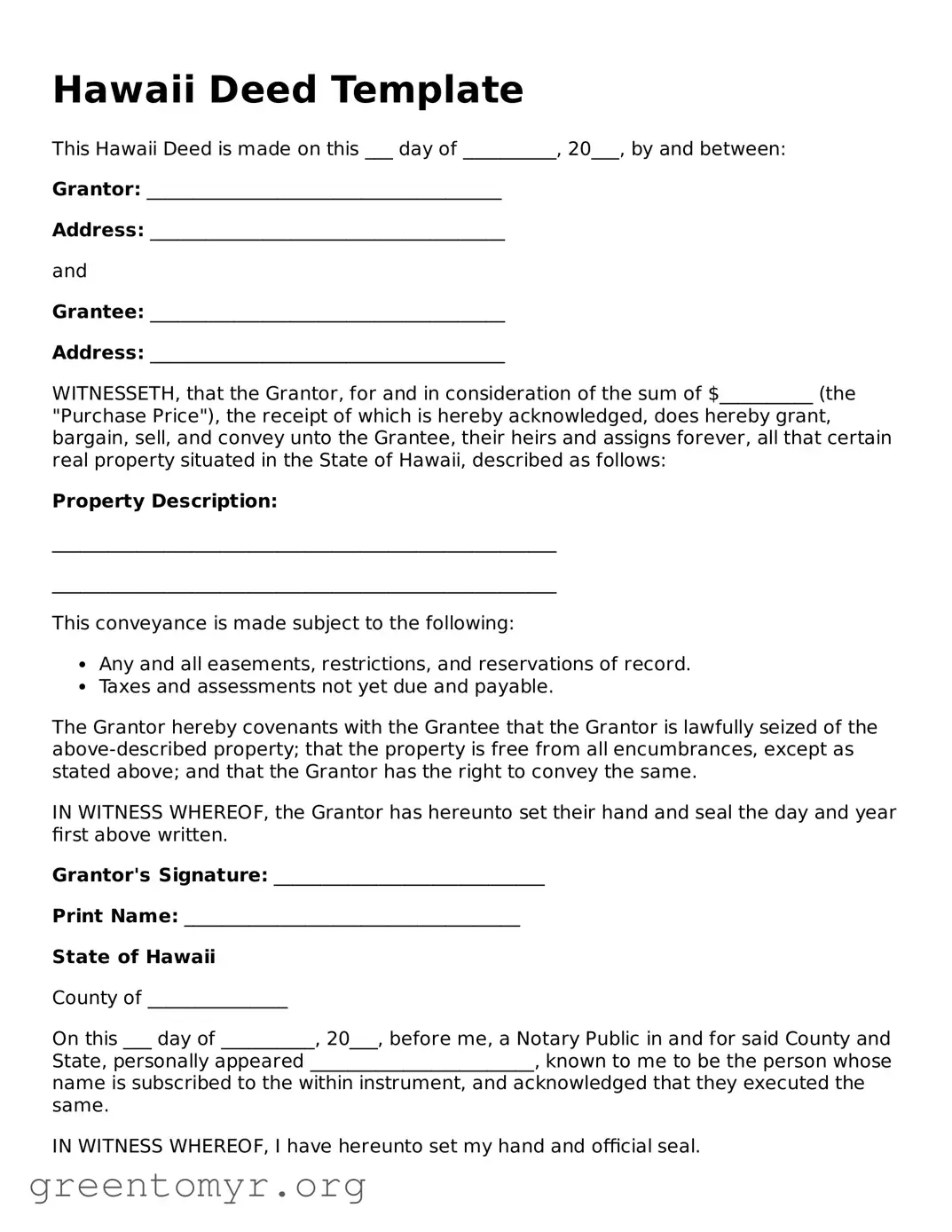
The Hawaii Deed form is a crucial legal document used in real estate transactions throughout the state. It serves to transfer ownership of property from one party to another, ensuring that the rights of both the grantor and grantee are clearly defined and protected. This form typically includes essential details such as the names of the parties involved, a description of the property being transferred, and any specific terms or conditions related to the transfer. Additionally, it may require signatures from witnesses and a notary public to validate the transaction. Understanding the components of the Hawaii Deed form is vital for anyone engaged in property dealings, as it lays the groundwork for legal ownership and can affect future property rights. Properly completing and filing this document can prevent disputes and ensure a smooth transfer process, making it an indispensable tool for buyers and sellers alike.
Hawaii Deed Template
This Hawaii Deed is made on this ___ day of __________, 20___, by and between:
Grantor: ______________________________________
Address: ______________________________________
and
Grantee: ______________________________________
Address: ______________________________________
WITNESSETH, that the Grantor, for and in consideration of the sum of $__________ (the "Purchase Price"), the receipt of which is hereby acknowledged, does hereby grant, bargain, sell, and convey unto the Grantee, their heirs and assigns forever, all that certain real property situated in the State of Hawaii, described as follows:
Property Description:
______________________________________________________
______________________________________________________
This conveyance is made subject to the following:
The Grantor hereby covenants with the Grantee that the Grantor is lawfully seized of the above-described property; that the property is free from all encumbrances, except as stated above; and that the Grantor has the right to convey the same.
IN WITNESS WHEREOF, the Grantor has hereunto set their hand and seal the day and year first above written.
Grantor's Signature: _____________________________
Print Name: ____________________________________
State of Hawaii
County of _______________
On this ___ day of __________, 20___, before me, a Notary Public in and for said County and State, personally appeared ________________________, known to me to be the person whose name is subscribed to the within instrument, and acknowledged that they executed the same.
IN WITNESS WHEREOF, I have hereunto set my hand and official seal.
Notary Public Signature: ______________________
My Commission Expires: ______________________
| Fact Name | Description |
|---|---|
| Type of Deed | The Hawaii deed form can be a warranty deed, quitclaim deed, or special warranty deed, depending on the needs of the parties involved. |
| Governing Law | Hawaii's deed forms are governed by Hawaii Revised Statutes (HRS) Chapter 501. |
| Signature Requirement | The deed must be signed by the grantor (the person transferring the property) in the presence of a notary public. |
| Recording | To be effective against third parties, the deed should be recorded at the Bureau of Conveyances in Hawaii. |
| Consideration | The deed must state the consideration, which is the value exchanged for the property. |
| Legal Description | A precise legal description of the property must be included in the deed to identify it clearly. |
| Transfer Tax | Hawaii imposes a conveyance tax on the transfer of real property, which must be paid upon recording the deed. |
After you have gathered the necessary information and documents, you will be ready to fill out the Hawaii Deed form. Completing this form accurately is crucial for ensuring a smooth transfer of property ownership. Follow the steps below to fill out the form correctly.
A Hawaii Deed form is a legal document used to transfer ownership of real estate in the state of Hawaii. This form outlines the details of the transaction, including the names of the parties involved, a description of the property, and the terms of the transfer. It is essential for ensuring that the transfer is legally recognized and recorded with the appropriate county office.
Hawaii offers several types of deeds, each serving different purposes. The most common include:
To complete a Hawaii Deed form, follow these steps:
While it is not legally required to have a lawyer prepare a Hawaii Deed form, it is often advisable. A legal professional can ensure that the deed is completed correctly and complies with all state laws. If you are unfamiliar with the process or the legal requirements, consulting with a lawyer can help prevent mistakes that could affect the property transfer.
Once you file the Hawaii Deed form with the Bureau of Conveyances, the deed becomes a matter of public record. This means that anyone can access the information about the property transfer. You should receive a confirmation of the recording, which serves as proof of the transfer. It is important to keep this documentation for your records, as it may be needed for future transactions or legal matters related to the property.
Filling out a deed form in Hawaii can be a straightforward process, but many individuals make common mistakes that can lead to delays or even legal complications. One frequent error is failing to provide accurate property descriptions. A vague or incorrect description can create confusion about the property being transferred. Always ensure that the legal description matches the information on your property title.
Another mistake is neglecting to include all necessary parties. Both the grantor (the person transferring the property) and the grantee (the person receiving the property) must be clearly identified. Omitting a co-owner or misidentifying a party can invalidate the deed. Double-check that names are spelled correctly and that titles, such as “Mr.” or “Mrs.,” are used appropriately.
People often forget to sign the deed. A deed without signatures is not legally binding. Both the grantor and, in some cases, the grantee must sign the document. Additionally, having the deed notarized is crucial. A notary public verifies the identities of the signers, adding an important layer of authenticity to the document.
Another common oversight is not dating the deed. While it might seem minor, the date is essential for establishing the timeline of the property transfer. If a dispute arises later, having a clear date can help clarify when the transfer took place.
In some instances, individuals fail to check for any existing liens or encumbrances on the property before completing the deed. If there are outstanding debts tied to the property, the new owner could inherit these issues. Conducting a thorough title search can prevent unpleasant surprises down the road.
People also sometimes overlook the importance of filing the deed with the appropriate county office. After the deed is completed and signed, it must be recorded to provide public notice of the property transfer. Skipping this step can lead to disputes over ownership and complicate future transactions.
Lastly, many individuals do not seek professional help when needed. While it’s possible to fill out a deed form independently, consulting with a real estate attorney or a professional familiar with Hawaii’s property laws can save time and prevent costly mistakes. Getting expert advice ensures that all aspects of the deed are handled correctly.
When transferring property in Hawaii, various forms and documents accompany the deed to ensure a smooth transaction. Each document serves a specific purpose, contributing to the overall legality and clarity of the property transfer process.
Understanding these documents is crucial for anyone involved in a property transaction in Hawaii. Each form plays a vital role in ensuring that the transfer is conducted legally and efficiently.
The Deed form shares similarities with several other legal documents. Each document serves a specific purpose but often overlaps in function or intent. Here’s a list of documents that are similar to the Deed form:
When filling out the Hawaii Deed form, it’s essential to follow certain guidelines to ensure accuracy and compliance. Here’s a list of things you should and shouldn’t do:
By following these guidelines, you can help ensure a smooth and efficient process when completing the Hawaii Deed form.
Understanding the Hawaii Deed form is essential for anyone involved in real estate transactions in the state. However, several misconceptions often arise regarding its use and requirements. Here are nine common misconceptions:
This is not true. There are different types of deeds, such as warranty deeds and quitclaim deeds, each serving specific purposes and having different legal implications.
In fact, most deeds in Hawaii must be notarized to be legally effective. This ensures that the signatures are valid and that the parties involved have willingly signed the document.
This misconception can lead to confusion. A deed is a document that transfers ownership, while a title is the legal right to own and use the property.
This is incorrect. While a recorded deed is a public document, it can be amended or corrected through a new deed if necessary.
A legal description is essential for identifying the property being transferred. It provides precise details that distinguish the property from others.
Some transactions, such as those involving certain types of trusts or corporate transfers, may not require a deed, depending on the circumstances.
Signing a deed does not automatically make it valid. It must be properly executed, notarized, and recorded with the appropriate county office to take effect.
In reality, there are fees for recording deeds, which vary by county. It is important to be aware of these costs when preparing for a property transfer.
By clarifying these misconceptions, individuals can better navigate the process of creating and recording a Hawaii Deed.
When filling out and using the Hawaii Deed form, it is essential to understand several key aspects to ensure a smooth and legally sound process. Here are five important takeaways:
By keeping these key points in mind, you can navigate the process of filling out and using the Hawaii Deed form with greater confidence and clarity.