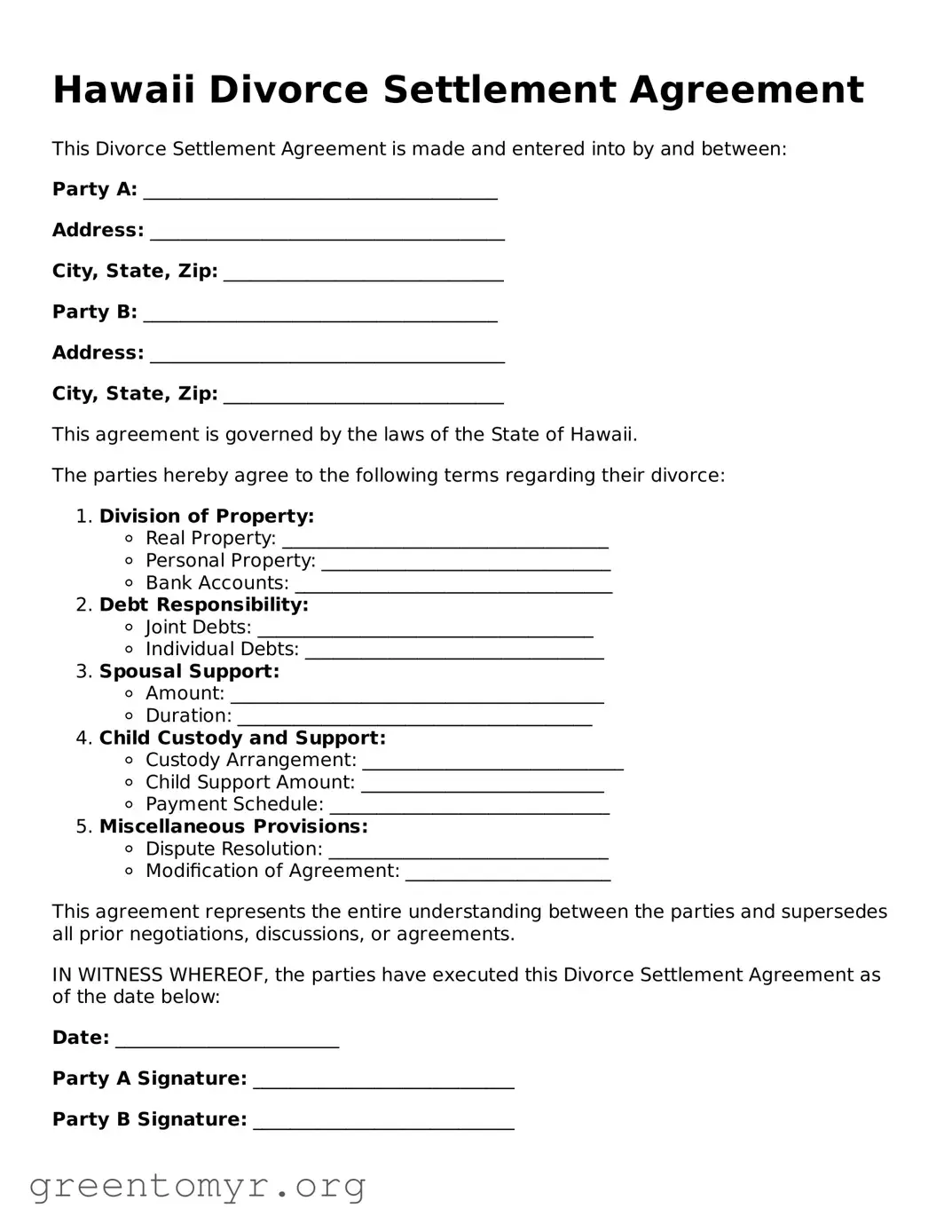
When navigating the complexities of divorce in Hawaii, one critical document comes into play: the Divorce Settlement Agreement form. This form serves as a comprehensive outline of the terms agreed upon by both spouses regarding the division of assets, child custody, and support obligations. It addresses key issues such as property distribution, which includes both real estate and personal belongings, ensuring that both parties understand their rights and responsibilities. Additionally, the agreement covers child custody arrangements, detailing where the children will live and how decisions will be made regarding their welfare. Financial considerations are also a significant part of this document, including child support and alimony, which help to ensure that both parties can maintain a reasonable standard of living post-divorce. By clearly laying out these terms, the Divorce Settlement Agreement form not only facilitates a smoother legal process but also aims to minimize potential conflicts in the future, providing a solid foundation for both individuals as they transition into their new lives.
Hawaii Divorce Settlement Agreement
This Divorce Settlement Agreement is made and entered into by and between:
Party A: ______________________________________
Address: ______________________________________
City, State, Zip: ______________________________
Party B: ______________________________________
Address: ______________________________________
City, State, Zip: ______________________________
This agreement is governed by the laws of the State of Hawaii.
The parties hereby agree to the following terms regarding their divorce:
This agreement represents the entire understanding between the parties and supersedes all prior negotiations, discussions, or agreements.
IN WITNESS WHEREOF, the parties have executed this Divorce Settlement Agreement as of the date below:
Date: ________________________
Party A Signature: ____________________________
Party B Signature: ____________________________
| Fact Name | Description |
|---|---|
| Purpose | The Hawaii Divorce Settlement Agreement form outlines the terms of a divorce, including asset division, child custody, and support obligations. |
| Governing Law | This form is governed by the Hawaii Revised Statutes, specifically Chapter 580, which addresses divorce and family law. |
| Filing Requirement | Both parties must sign the agreement for it to be valid and enforceable in court. |
| Child Custody | The agreement must include provisions for child custody arrangements, ensuring the best interests of the child are prioritized. |
| Asset Division | It specifies how marital property and debts will be divided between the spouses, which can include real estate, bank accounts, and personal belongings. |
| Spousal Support | The form may outline any spousal support (alimony) obligations, detailing the amount and duration of payments. |
| Modification | Once filed, the agreement can be modified only through a mutual written agreement or court order, ensuring that both parties consent to any changes. |
After obtaining the Hawaii Divorce Settlement Agreement form, you will need to complete it accurately to ensure that all relevant information is included. This form is essential for formalizing the terms of your divorce, including asset division and any child custody arrangements. Follow these steps to fill out the form correctly.
A Hawaii Divorce Settlement Agreement is a legal document that outlines the terms of a divorce between spouses. It covers important aspects such as property division, child custody, visitation rights, and spousal support. This agreement helps ensure that both parties have a clear understanding of their rights and responsibilities after the divorce is finalized.
While it's not required to have a lawyer, it is highly recommended. A lawyer can provide valuable guidance, ensure that your rights are protected, and help you navigate any complexities in your situation. If both parties agree on the terms, they may choose to create the agreement together, but legal advice can help avoid potential pitfalls.
Your Divorce Settlement Agreement should cover several key areas:
Including these elements helps ensure clarity and can prevent future disputes.
To file the agreement, you must submit it to the Family Court in your county. Make sure to follow the local court rules for filing documents. You may need to pay a filing fee, and it’s important to ensure all necessary signatures are in place before submission.
Yes, the Divorce Settlement Agreement can be modified, but both parties must agree to the changes. If circumstances change significantly, such as a change in income or relocation, you can petition the court to modify the terms. It’s best to document any changes in writing to maintain clarity.
If one party fails to comply with the terms of the agreement, the other party can seek enforcement through the court. This may involve filing a motion for contempt or asking the court to enforce the terms. Having a well-drafted agreement can make this process smoother.
The timeline can vary depending on several factors, including the complexity of the case and the court’s schedule. Generally, if both parties agree on the terms and the paperwork is in order, the process can take a few months. However, if disputes arise, it may take longer.
Yes, once the agreement is signed by both parties and approved by the court, it becomes legally binding. This means that both parties are required to adhere to its terms. Failing to do so can lead to legal consequences.
If you and your spouse cannot reach an agreement, consider mediation or negotiation with the help of professionals. Mediation can facilitate discussions and help both parties find common ground. If that fails, the court may need to intervene and make decisions on contested issues.
Templates for Divorce Settlement Agreements can often be found online through legal aid websites or family court resources. However, it’s crucial to ensure that any template you use complies with Hawaii laws. Consulting with a lawyer can also provide you with a tailored agreement that meets your specific needs.
Filling out the Hawaii Divorce Settlement Agreement form can be a daunting task, and many individuals make common mistakes that can complicate the process. One frequent error is failing to provide complete and accurate information. When individuals skip details or provide vague descriptions, it can lead to misunderstandings or delays. It’s crucial to ensure that all relevant information, such as financial details, property descriptions, and child custody arrangements, is clearly stated.
Another mistake people often make is not fully understanding the implications of the agreements they are signing. For instance, individuals may agree to certain terms without realizing the long-term consequences. This is especially true in matters involving alimony or child support. Taking the time to consult with a legal expert can help clarify these terms and ensure that individuals are making informed decisions that will serve their best interests.
Additionally, some people overlook the importance of reviewing the form thoroughly before submission. Errors such as typos or incorrect calculations can lead to significant issues down the line. A simple mistake can result in financial discrepancies or even affect custody arrangements. Therefore, it is advisable to double-check the entire document and, if possible, have someone else review it as well.
Lastly, many individuals fail to consider the need for a witness or notary when finalizing the agreement. In Hawaii, certain legal documents must be notarized to be enforceable. Neglecting this step can render the agreement invalid, causing unnecessary complications. Ensuring that all procedural requirements are met is essential for a smooth divorce process.
When navigating a divorce in Hawaii, several key documents may accompany the Divorce Settlement Agreement. Each of these forms serves a specific purpose in ensuring that the divorce process is thorough and legally sound. Below is a list of commonly used documents in conjunction with the Divorce Settlement Agreement.
Understanding these documents is crucial for anyone going through a divorce in Hawaii. Each form plays a vital role in ensuring that the rights and responsibilities of both parties are clearly defined and legally recognized.
The Divorce Settlement Agreement is a crucial document in the process of ending a marriage. It outlines the terms agreed upon by both parties regarding various aspects of their separation. Several other documents serve similar purposes in different contexts. Here’s a look at eight documents that share similarities with the Divorce Settlement Agreement:
Each of these documents plays a significant role in clarifying expectations and responsibilities, making the transition during and after a divorce smoother for everyone involved.
When filling out the Hawaii Divorce Settlement Agreement form, it is important to approach the process with care. Below are essential dos and don'ts to consider.
Following these guidelines will help ensure a smoother process during your divorce proceedings.
When dealing with divorce in Hawaii, many people have misconceptions about the Divorce Settlement Agreement form. Here are eight common misunderstandings:
Understanding these misconceptions can help individuals navigate the divorce process more effectively and ensure that their rights and interests are protected.
Filling out the Hawaii Divorce Settlement Agreement form is an important step in the divorce process. Here are some key takeaways to keep in mind:
These points can help ensure that the process goes smoothly and that both parties are satisfied with the outcomes.