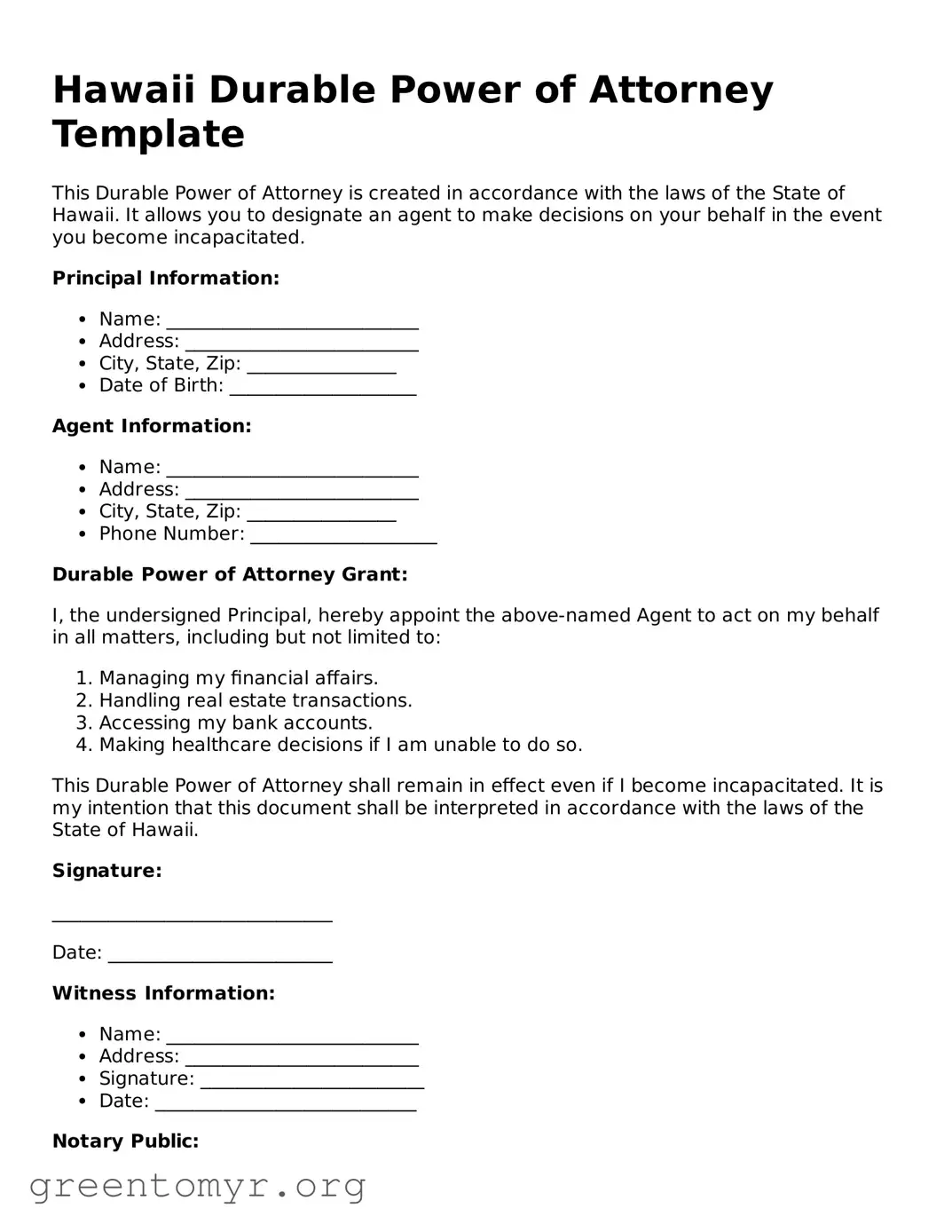
The Hawaii Durable Power of Attorney form serves as a crucial legal document that empowers individuals to designate someone they trust to make important financial and healthcare decisions on their behalf, should they become unable to do so themselves. This form is particularly significant because it remains effective even if the individual becomes incapacitated, ensuring that their wishes are honored and that necessary actions can be taken without delay. It allows for a broad range of powers to be granted, including managing bank accounts, paying bills, and making medical decisions. By carefully selecting an agent and clearly outlining the extent of their authority, individuals can maintain control over their affairs, even in challenging circumstances. Understanding the nuances of this form is essential, as it not only provides peace of mind but also safeguards one’s interests and well-being during times of uncertainty.
Hawaii Durable Power of Attorney Template
This Durable Power of Attorney is created in accordance with the laws of the State of Hawaii. It allows you to designate an agent to make decisions on your behalf in the event you become incapacitated.
Principal Information:
Agent Information:
Durable Power of Attorney Grant:
I, the undersigned Principal, hereby appoint the above-named Agent to act on my behalf in all matters, including but not limited to:
This Durable Power of Attorney shall remain in effect even if I become incapacitated. It is my intention that this document shall be interpreted in accordance with the laws of the State of Hawaii.
Signature:
______________________________
Date: ________________________
Witness Information:
Notary Public:
State of Hawaii
County of ________________________
Subscribed and sworn to before me this _____ day of ____________, 20__.
______________________________
Notary Public Signature
My Commission Expires: ________________
| Fact Name | Description |
|---|---|
| Definition | A Durable Power of Attorney (DPOA) allows an individual to appoint someone else to make decisions on their behalf, even if they become incapacitated. |
| Governing Law | The DPOA in Hawaii is governed by Hawaii Revised Statutes, Chapter 551E. |
| Durability | The term "durable" means that the authority granted remains in effect even if the principal becomes mentally incapacitated. |
| Principal and Agent | The person creating the DPOA is called the principal, while the person designated to act is known as the agent or attorney-in-fact. |
| Types of Powers | The DPOA can grant a wide range of powers, including financial decisions, property management, and healthcare choices. |
| Execution Requirements | In Hawaii, the DPOA must be signed by the principal and witnessed by two individuals or notarized. |
| Revocation | The principal can revoke the DPOA at any time as long as they are mentally competent to do so. |
| Agent's Duties | The agent has a fiduciary duty to act in the best interest of the principal and must avoid conflicts of interest. |
| Limitations | Some powers may be limited or excluded, depending on the principal's wishes and the specific wording of the DPOA. |
| Legal Advice | It is advisable to seek legal counsel when creating a DPOA to ensure it meets all legal requirements and reflects the principal's intentions. |
Filling out the Hawaii Durable Power of Attorney form is an important step in planning for your future. This document allows you to appoint someone you trust to make decisions on your behalf if you're unable to do so. Here’s how to fill it out correctly.
Once you have completed these steps, your Durable Power of Attorney will be ready for use. Make sure to review it periodically and update it if your circumstances change.
A Durable Power of Attorney (DPOA) in Hawaii is a legal document that allows an individual, known as the principal, to appoint another person, called the agent, to make decisions on their behalf. This authority remains effective even if the principal becomes incapacitated, ensuring that their affairs can be managed without interruption.
Creating a DPOA is important for several reasons:
In Hawaii, you can appoint any competent adult as your agent. This may include family members, friends, or professionals. It is crucial to choose someone who is trustworthy and capable of handling your affairs responsibly.
To create a DPOA in Hawaii, follow these steps:
Yes, in Hawaii, a Durable Power of Attorney must be notarized to be legally valid. This requirement helps ensure that the principal is signing the document voluntarily and understands its contents.
Yes, you can revoke a Durable Power of Attorney at any time as long as you are competent. To do so, you must create a written revocation document and notify your agent and any relevant institutions that may have a copy of the original DPOA.
You can grant a wide range of powers to your agent, including:
It is essential to specify the powers clearly in the document to avoid any confusion.
If you do not have a DPOA and become incapacitated, a court may appoint a guardian or conservator to manage your affairs. This process can be lengthy and costly, and it may not reflect your wishes. Having a DPOA in place helps ensure that your preferences are honored.
A Durable Power of Attorney created in another state may be recognized in Hawaii, but it is advisable to check the specific requirements and consult legal counsel. Each state has its own laws regarding DPOAs, and ensuring compliance with Hawaii's regulations is important for the document to be effective.
Filling out a Durable Power of Attorney (DPOA) form in Hawaii is an important step in ensuring that your financial and medical decisions are handled according to your wishes. However, many people make common mistakes that can lead to complications down the line. Understanding these pitfalls can help you navigate the process more smoothly.
One frequent mistake is failing to choose the right agent. Your agent is the person who will make decisions on your behalf, so it’s crucial to select someone you trust completely. Many individuals opt for a family member or friend without considering their ability to handle financial matters or make tough decisions. Take the time to think about who would be best suited for this responsibility.
Another common error is not being specific enough about the powers granted. The DPOA form allows you to outline exactly what your agent can and cannot do. Leaving this section vague can lead to confusion or misuse of power. Be clear and detailed in your instructions to ensure your agent knows their limits and responsibilities.
Many people also overlook the importance of signing and dating the document properly. In Hawaii, a Durable Power of Attorney must be signed by you and acknowledged before a notary public. Skipping the notary step or forgetting to date the form can render it invalid. Make sure to follow all the necessary steps to avoid any legal issues.
Additionally, individuals often forget to inform their agents about their role. It’s not enough to simply fill out the form; your chosen agent should be aware of their responsibilities and your wishes. A conversation about your preferences and any specific instructions can help prevent misunderstandings when the time comes for them to act on your behalf.
Finally, neglecting to review and update the DPOA can lead to problems as circumstances change. Life events such as marriage, divorce, or the death of an agent can affect your decisions. Regularly revisiting your Durable Power of Attorney ensures that it reflects your current situation and wishes. Keeping it up to date is a simple yet vital step in maintaining control over your future.
When creating a Durable Power of Attorney (DPOA) in Hawaii, it’s important to consider additional documents that can complement this legal tool. Each of these documents serves a specific purpose and can provide further clarity and protection regarding your wishes and decisions. Here’s a brief overview of some commonly used forms alongside the DPOA.
Incorporating these documents with your Durable Power of Attorney can create a comprehensive plan that covers both your financial and healthcare needs. This proactive approach helps ensure that your wishes are clear and respected, providing peace of mind for you and your loved ones.
The Durable Power of Attorney (DPOA) is an important legal document that allows one person to make decisions on behalf of another. It shares similarities with several other documents. Here are four such documents:
When filling out the Hawaii Durable Power of Attorney form, it’s important to follow certain guidelines to ensure the document is valid and effective. Here are some things you should and shouldn’t do:
Understanding the Hawaii Durable Power of Attorney form is crucial for effective estate planning. However, several misconceptions may lead to confusion. Below is a list of common misconceptions along with clarifications.
This is incorrect. While many people associate the Durable Power of Attorney with financial decisions, it can also cover healthcare and other personal matters, depending on how it is drafted.
In fact, the purpose of a Durable Power of Attorney is to remain effective even if the principal becomes incapacitated. This is what differentiates it from a standard Power of Attorney.
Many people choose to establish a Durable Power of Attorney at a younger age, especially if they want to ensure their wishes are followed in case of unexpected events.
This is not true. A principal can revoke a Durable Power of Attorney at any time, as long as they are mentally competent to do so. This can be done through a written notice.
This is misleading. Each state, including Hawaii, has specific laws and requirements regarding Durable Powers of Attorney. It is essential to comply with Hawaii's regulations to ensure validity.
The agent is legally obligated to act in the best interest of the principal and follow their instructions as outlined in the document. They cannot act outside the scope of authority granted.
This is incorrect. A principal can amend or create a new Durable Power of Attorney at any time, as long as they are mentally competent. It is advisable to review the document periodically.
Filling out and using the Hawaii Durable Power of Attorney form is an important step in planning for the future. Here are some key takeaways to keep in mind:
By following these steps, you can ensure that your Durable Power of Attorney is set up correctly and serves your needs effectively.