When it comes to managing your affairs in Hawaii, the General Power of Attorney form is an essential tool that allows you to designate someone you trust to act on your behalf. This legal document grants your chosen agent the authority to make decisions regarding your finances, property, and other important matters, ensuring that your interests are protected even when you are unable to manage them yourself. Whether you're planning for a temporary absence or preparing for a longer-term situation, having a General Power of Attorney in place can provide peace of mind. It covers a wide range of powers, from handling bank transactions to managing real estate and even dealing with insurance claims. Importantly, this form can be tailored to fit your specific needs, allowing you to grant broad or limited powers as you see fit. Understanding the ins and outs of this form is crucial, as it empowers you to take control of your future while ensuring that your designated agent acts in accordance with your wishes.
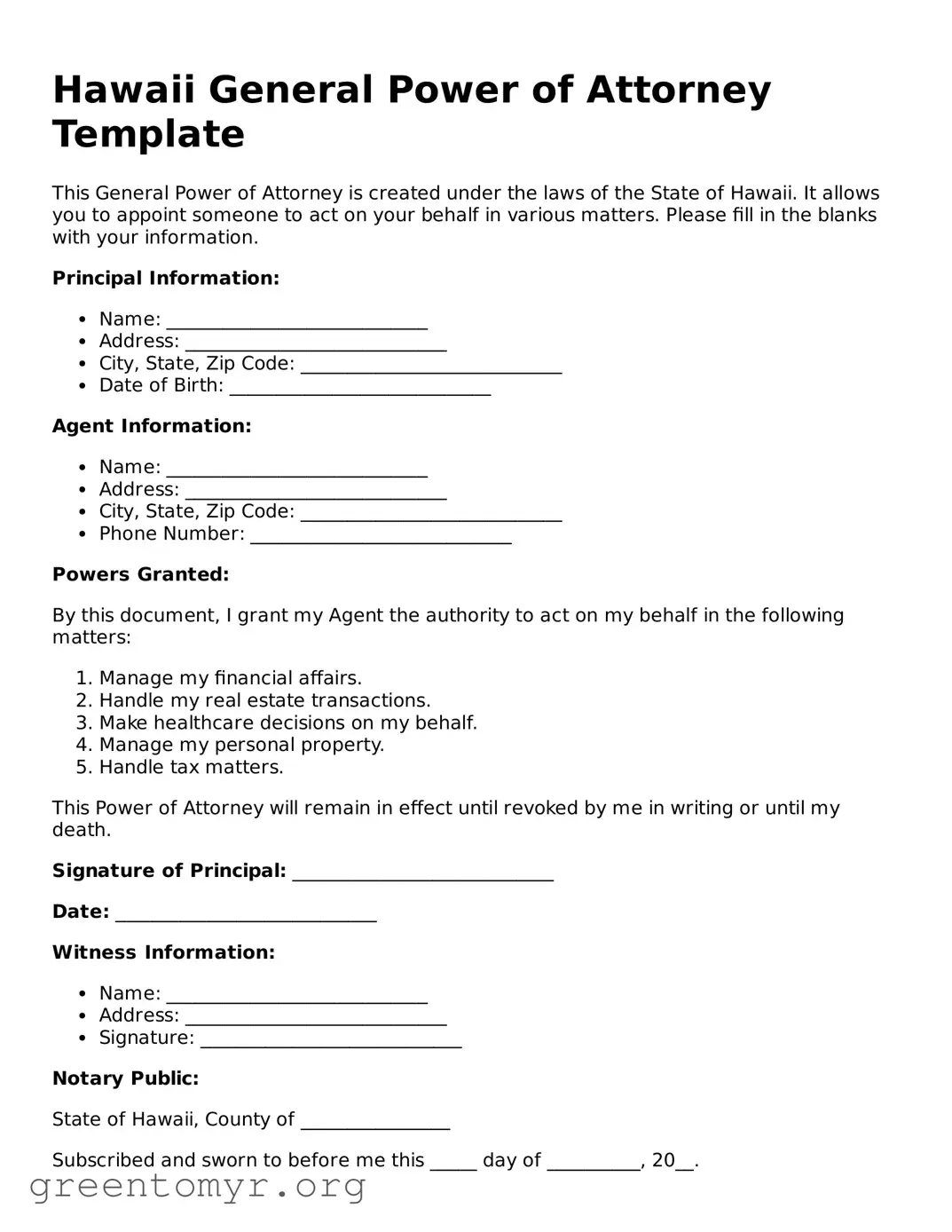
Hawaii General Power of Attorney Template
This General Power of Attorney is created under the laws of the State of Hawaii. It allows you to appoint someone to act on your behalf in various matters. Please fill in the blanks with your information.
Principal Information:
Agent Information:
Powers Granted:
By this document, I grant my Agent the authority to act on my behalf in the following matters:
This Power of Attorney will remain in effect until revoked by me in writing or until my death.
Signature of Principal: ____________________________
Date: ____________________________
Witness Information:
Notary Public:
State of Hawaii, County of ________________
Subscribed and sworn to before me this _____ day of __________, 20__.
______________________________
Notary Public Signature
My Commission Expires: ____________________________
| Fact Name | Details |
|---|---|
| Definition | A General Power of Attorney in Hawaii allows an individual to appoint someone else to manage their financial and legal affairs. |
| Governing Law | The form is governed by Hawaii Revised Statutes, Chapter 551E. |
| Durability | This type of power of attorney can be made durable, meaning it remains effective even if the principal becomes incapacitated. |
| Execution Requirements | The form must be signed by the principal and witnessed by two individuals or notarized. |
| Revocation | A General Power of Attorney can be revoked at any time by the principal, provided they are competent to do so. |
| Use Cases | Commonly used for managing finances, real estate transactions, and other legal matters when the principal is unavailable. |
Filling out the Hawaii General Power of Attorney form is a straightforward process. After completing the form, you will need to ensure that it is signed and notarized to make it legally binding. This document allows you to designate someone to act on your behalf in financial or legal matters.
A Hawaii General Power of Attorney is a legal document that allows one person, known as the principal, to grant another person, called the agent or attorney-in-fact, the authority to act on their behalf. This authority can cover a wide range of financial and legal decisions, making it an important tool for managing affairs when the principal is unable to do so themselves.
Any adult who is of sound mind can create a General Power of Attorney in Hawaii. This means that the individual must understand the nature and consequences of the document they are signing. It’s essential to choose someone trustworthy as your agent, as they will have significant control over your affairs.
The powers granted can be broad or limited, depending on the principal's preferences. Common powers include:
It’s crucial to clearly outline the specific powers in the document to avoid any confusion later on.
Yes, a General Power of Attorney typically becomes effective immediately upon signing, unless the principal specifies a different date or condition. This means the agent can start acting on the principal's behalf right away, which can be beneficial in urgent situations.
Absolutely. The principal has the right to revoke a General Power of Attorney at any time, as long as they are mentally competent. To revoke the document, the principal should create a written notice of revocation and provide it to the agent and any relevant institutions or parties involved.
If the principal becomes incapacitated, a General Power of Attorney remains in effect unless it is specifically stated that it should terminate upon incapacity. This can be particularly helpful for managing affairs when the principal is unable to make decisions for themselves.
Yes, in Hawaii, it is generally required to have the General Power of Attorney notarized to ensure its validity. Notarization adds a layer of authenticity and can help prevent disputes regarding the document’s legitimacy.
No, a General Power of Attorney does not cover healthcare decisions. For that, you would need a specific document known as an Advance Healthcare Directive or a Healthcare Power of Attorney. This document allows you to designate someone to make medical decisions on your behalf if you are unable to do so.
While there is no official state form, it is advisable to use a template or create a document that meets Hawaii’s legal requirements. It should clearly outline the powers being granted and include the necessary signatures and notarization to ensure it is legally binding.
A General Power of Attorney remains in effect until the principal revokes it, the principal passes away, or the document specifies a termination date. It’s important to keep track of any changes in your circumstances that might necessitate updating or revoking the document.
Filling out a General Power of Attorney form in Hawaii can seem straightforward, but many individuals make critical mistakes that can lead to complications. One common error is failing to specify the powers granted. While the form may provide a general outline, it is essential to clearly define what decisions the agent can make on your behalf. Without this clarity, your agent may not have the authority to act in specific situations when needed.
Another mistake occurs when individuals overlook the importance of selecting a competent agent. It’s vital to choose someone trustworthy and capable of handling your affairs. Some people may choose a family member out of obligation, rather than considering their skills and judgment. This can lead to conflicts or mismanagement of your affairs, which can be detrimental in times of need.
Additionally, many fail to sign the form correctly. In Hawaii, a General Power of Attorney must be signed in the presence of a notary public. Neglecting this step can invalidate the document. It’s important to ensure that all signatures are completed properly to avoid any legal disputes later on.
Another frequent oversight is not updating the form when circumstances change. Life events such as marriage, divorce, or the death of an agent can impact the effectiveness of your Power of Attorney. Regularly reviewing and, if necessary, revising the document ensures that it reflects your current wishes and circumstances.
Lastly, individuals often forget to provide copies of the completed form to relevant parties. Once the General Power of Attorney is executed, it should be shared with your agent and any institutions that may need to recognize it, such as banks or healthcare providers. Without these copies, your agent may face unnecessary hurdles when trying to act on your behalf.
When creating a General Power of Attorney in Hawaii, several other forms and documents may be beneficial to ensure comprehensive legal coverage. Each of these documents serves a specific purpose and can help clarify the authority granted to the agent or attorney-in-fact.
Understanding these additional forms can help individuals navigate the complexities of legal authority and ensure that their wishes are honored. Each document plays a vital role in comprehensive estate planning and decision-making processes.
When filling out the Hawaii General Power of Attorney form, it's important to approach the task with care. Here are some key things to keep in mind:
By following these guidelines, you can help ensure that your General Power of Attorney is filled out correctly and reflects your wishes.
Understanding the Hawaii General Power of Attorney form is crucial for anyone considering its use. However, several misconceptions can lead to confusion. Here are eight common misconceptions, along with clarifications to help you navigate this important legal document.
By addressing these misconceptions, individuals can better understand the implications and functionalities of the Hawaii General Power of Attorney form. This knowledge empowers principals to make informed decisions about their legal and financial affairs.
Filling out and using the Hawaii General Power of Attorney form is an important task that requires careful attention. Here are some key takeaways to consider: