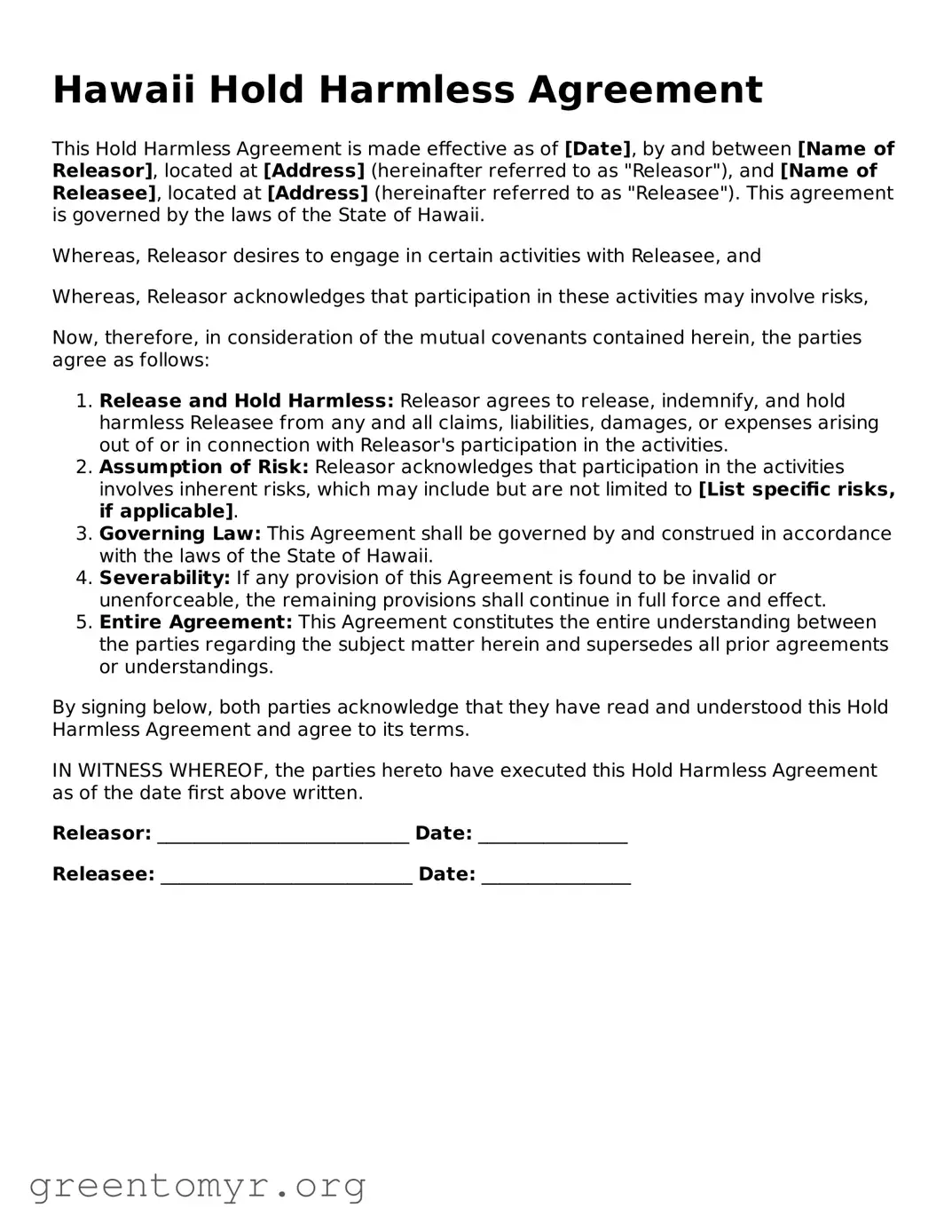
In the beautiful state of Hawaii, where outdoor adventures and community events thrive, the Hold Harmless Agreement form plays a crucial role in protecting individuals and organizations from potential legal liabilities. This form is often used in various contexts, such as during recreational activities, events, or even when renting facilities. By signing this agreement, participants acknowledge the inherent risks associated with certain activities and agree to release the organizers or property owners from responsibility for any injuries or damages that may occur. The essence of the Hold Harmless Agreement lies in its ability to foster a sense of safety and trust, allowing individuals to engage in activities without the looming fear of legal repercussions. It typically outlines the responsibilities of both parties, ensuring that everyone understands their rights and obligations. In Hawaii, where the spirit of 'ohana (family) and community is strong, this agreement serves as a vital tool for promoting enjoyable and worry-free experiences.
Hawaii Hold Harmless Agreement
This Hold Harmless Agreement is made effective as of [Date], by and between [Name of Releasor], located at [Address] (hereinafter referred to as "Releasor"), and [Name of Releasee], located at [Address] (hereinafter referred to as "Releasee"). This agreement is governed by the laws of the State of Hawaii.
Whereas, Releasor desires to engage in certain activities with Releasee, and
Whereas, Releasor acknowledges that participation in these activities may involve risks,
Now, therefore, in consideration of the mutual covenants contained herein, the parties agree as follows:
By signing below, both parties acknowledge that they have read and understood this Hold Harmless Agreement and agree to its terms.
IN WITNESS WHEREOF, the parties hereto have executed this Hold Harmless Agreement as of the date first above written.
Releasor: ___________________________ Date: ________________
Releasee: ___________________________ Date: ________________
| Fact Name | Description |
|---|---|
| Definition | The Hawaii Hold Harmless Agreement is a legal document designed to protect one party from liability for certain risks associated with an activity. |
| Purpose | Its primary purpose is to ensure that one party agrees not to hold the other party liable for any injuries or damages that may occur. |
| Governing Law | This agreement is governed by the laws of the State of Hawaii, specifically under Hawaii Revised Statutes. |
| Parties Involved | Typically, the agreement involves two parties: the indemnitor (the party providing the hold harmless clause) and the indemnitee (the party being protected). |
| Scope of Liability | The agreement can cover a wide range of activities, from recreational events to business operations, depending on the specific terms outlined. |
| Enforceability | For the agreement to be enforceable, it must be clear, specific, and voluntarily agreed upon by both parties. |
| Limitations | There may be limitations on the enforceability of hold harmless agreements, particularly in cases of gross negligence or willful misconduct. |
| Mutual Agreements | Sometimes, the agreement can be mutual, meaning both parties agree to hold each other harmless under specified circumstances. |
| Written Requirement | While verbal agreements may exist, it is highly advisable to have the hold harmless agreement in writing to avoid disputes. |
| Common Uses | This type of agreement is commonly used in various contexts, including sports, events, and business contracts. |
Once you have obtained the Hawaii Hold Harmless Agreement form, you can begin the process of filling it out. This form typically requires specific information to ensure that all parties involved are clearly identified and that the terms are understood. Follow the steps below to complete the form accurately.
A Hawaii Hold Harmless Agreement is a legal document that protects one party from liability for any injuries or damages that may occur during a specific activity or event. Essentially, it allows one party to "hold harmless" the other party, meaning they agree not to hold them responsible for certain risks involved.
You should consider using a Hold Harmless Agreement whenever you are engaging in activities that carry a risk of injury or damage. Common scenarios include:
In these situations, having a Hold Harmless Agreement can provide peace of mind and legal protection.
Typically, both parties involved in the agreement should sign it. This includes the party providing the service or hosting the event and the individual or group participating in the activity. Each party should understand the terms and implications of the agreement before signing.
A well-drafted Hold Harmless Agreement should include the following elements:
Including these components helps ensure that the agreement is clear and enforceable.
Yes, a Hold Harmless Agreement can be legally binding in Hawaii, provided it is properly drafted and signed by all parties involved. However, it's important to note that certain limitations may apply. For example, the agreement may not protect against gross negligence or willful misconduct.
Absolutely! You can modify a Hold Harmless Agreement as long as both parties agree to the changes. It's best to document any modifications in writing and have all parties sign the revised agreement to avoid confusion later on.
If someone is injured despite the existence of a Hold Harmless Agreement, the enforceability of the agreement will be evaluated. Courts will look at factors such as whether the agreement was clear, whether the injured party understood the risks, and if any gross negligence was involved. In some cases, the agreement may still hold up in court, while in others, it may not.
Yes, consulting a lawyer is always a wise decision when dealing with legal documents. A lawyer can help ensure that your Hold Harmless Agreement is tailored to your specific needs and complies with Hawaii law. This can provide you with added confidence that you are adequately protected.
When individuals fill out the Hawaii Hold Harmless Agreement form, several common mistakes can lead to complications down the line. Awareness of these pitfalls can help ensure that the agreement serves its intended purpose effectively. One frequent error is failing to read the entire document thoroughly. Many people skim through the form, missing critical sections that outline their rights and responsibilities.
Another mistake occurs when individuals neglect to provide accurate personal information. This includes names, addresses, and contact details. Inaccuracies can result in delays or complications should any issues arise later. Additionally, some individuals might overlook the importance of specifying the scope of the agreement. It is essential to clearly define what activities or situations the agreement covers to avoid misunderstandings.
People often forget to include the date when signing the agreement. This seemingly minor detail can lead to questions about the agreement's validity. Furthermore, failing to have the document witnessed or notarized, when required, can also create problems. Some may assume that a signature alone suffices, but having a third-party verification can add an extra layer of protection.
Another common error involves misunderstanding the terms of the agreement. Individuals may agree to hold someone harmless without fully comprehending the implications. This can lead to unintended liabilities. It’s crucial to take the time to understand what “holding harmless” truly means in the context of the agreement.
Additionally, individuals might neglect to discuss the agreement with all relevant parties. Failing to communicate with others who may be affected by the agreement can lead to confusion and disputes later on. Open dialogue ensures that everyone is on the same page and understands the terms being agreed upon.
Some individuals also make the mistake of not keeping a copy of the signed agreement. It is vital to retain a record for personal reference and to provide proof if any issues arise in the future. Lastly, procrastination can be detrimental. Delaying the completion and submission of the form can lead to missed deadlines or opportunities.
By being mindful of these common mistakes, individuals can fill out the Hawaii Hold Harmless Agreement form more effectively. Taking the time to review, discuss, and understand the document can ultimately lead to a smoother experience and better protection against potential liabilities.
When engaging in activities or transactions that involve risk, it's essential to have a clear understanding of the legal documents that can protect all parties involved. The Hawaii Hold Harmless Agreement is just one piece of the puzzle. Below are several other forms and documents that are often used in conjunction with this agreement to ensure clarity and security.
Understanding these documents can significantly enhance the safety and security of any venture. By ensuring that all parties are aware of their rights and responsibilities, you can create a more secure environment for everyone involved.
The Hold Harmless Agreement is a common legal document that shares similarities with several other agreements. Here are six documents that are comparable to it:
When filling out the Hawaii Hold Harmless Agreement form, it's important to follow certain guidelines to ensure accuracy and compliance. Here are some dos and don'ts to keep in mind:
The Hawaii Hold Harmless Agreement is often misunderstood. Below are ten common misconceptions about this form, along with clarifications to help you better understand its purpose and implications.
This is incorrect. The agreement is designed to protect both parties involved. It outlines the responsibilities and liabilities of each party, ensuring that both are aware of the risks.
This is a misconception. While the agreement limits liability, it does not completely eliminate the right to seek legal recourse in cases of gross negligence or intentional harm.
This is false. The Hold Harmless Agreement can be used in various contexts, including business transactions, construction projects, and events, not just recreational activities.
While having legal counsel is beneficial, it is not mandatory. Many templates are available that can be customized to fit specific needs.
This is misleading. Each state, including Hawaii, has its own laws and regulations regarding Hold Harmless Agreements, which may affect their enforceability.
This is not entirely true. While notarization can add an extra layer of authenticity, it is not a requirement for the agreement to be legally binding.
This is a misconception. The agreement limits liability for certain risks, but parties may still be held accountable for negligence or failure to meet safety standards.
This is incorrect. Once signed, the agreement is a legally binding document, and all parties must adhere to its terms.
This is misleading. Even low-risk activities can benefit from a Hold Harmless Agreement to clarify responsibilities and protect all parties involved.
This is false. If properly drafted and executed, a Hold Harmless Agreement can be enforceable in a court of law, provided it complies with state regulations.
Understanding these misconceptions can help individuals and businesses navigate the complexities of liability and risk management effectively. Always consider the specific context and legal requirements when dealing with Hold Harmless Agreements.
When filling out and using the Hawaii Hold Harmless Agreement form, keep these key points in mind:
Taking these steps will help ensure that you fill out the Hawaii Hold Harmless Agreement correctly and use it effectively.