In Hawaii, a Living Will is an essential document that allows individuals to express their preferences regarding medical treatment in the event they become unable to communicate their wishes. This form serves as a guide for healthcare providers and family members, outlining the types of life-sustaining measures one may or may not want, such as resuscitation efforts, mechanical ventilation, and feeding tubes. By completing a Living Will, individuals can ensure their healthcare choices are respected, even in critical situations where they cannot speak for themselves. It is important to note that this document only becomes effective when a person is diagnosed with a terminal condition or is in a persistent vegetative state. Additionally, the Living Will must be signed and witnessed to be legally binding, reinforcing the importance of careful consideration and clear communication in the decision-making process. Understanding the nuances of this form can empower individuals to take control of their healthcare decisions, providing peace of mind for both themselves and their loved ones.
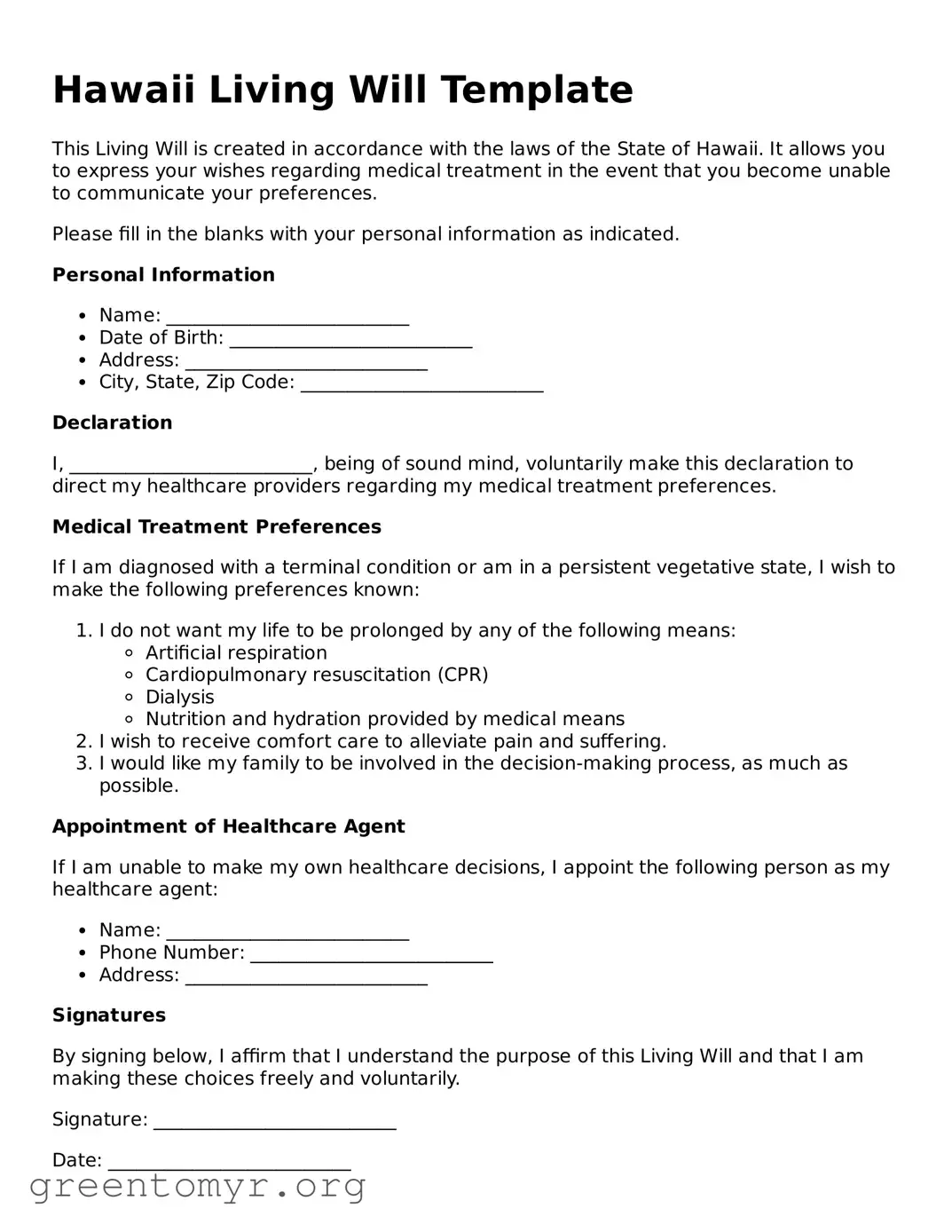
Hawaii Living Will Template
This Living Will is created in accordance with the laws of the State of Hawaii. It allows you to express your wishes regarding medical treatment in the event that you become unable to communicate your preferences.
Please fill in the blanks with your personal information as indicated.
Personal Information
Declaration
I, __________________________, being of sound mind, voluntarily make this declaration to direct my healthcare providers regarding my medical treatment preferences.
Medical Treatment Preferences
If I am diagnosed with a terminal condition or am in a persistent vegetative state, I wish to make the following preferences known:
Appointment of Healthcare Agent
If I am unable to make my own healthcare decisions, I appoint the following person as my healthcare agent:
Signatures
By signing below, I affirm that I understand the purpose of this Living Will and that I am making these choices freely and voluntarily.
Signature: __________________________
Date: __________________________
Witnesses
This document must be witnessed by two individuals who are not related to me and who will not benefit from my estate.
Witnesses' Signatures:
| Fact Name | Description |
|---|---|
| Governing Law | The Hawaii Living Will is governed by Hawaii Revised Statutes § 327E. |
| Purpose | A Living Will outlines an individual's wishes regarding medical treatment in case they become unable to communicate. |
| Eligibility | Any adult resident of Hawaii can create a Living Will. |
| Signature Requirement | The document must be signed by the individual or by another person at their direction and in their presence. |
| Witness Requirement | Two witnesses must sign the Living Will, affirming that the individual is of sound mind. |
| Revocation | A Living Will can be revoked at any time by the individual, verbally or in writing. |
| Durability | The Living Will remains effective until revoked or the individual passes away. |
| Notarization | Notarization is not required for a Living Will in Hawaii. |
Filling out the Hawaii Living Will form is an important step in ensuring that your healthcare preferences are respected. Once completed, this document will guide your loved ones and medical providers in making decisions about your care in the event that you are unable to communicate your wishes.
A Hawaii Living Will is a legal document that allows individuals to outline their preferences for medical treatment in the event they become unable to communicate their wishes. It specifically addresses end-of-life care and helps ensure that a person's healthcare choices are respected by medical professionals and family members.
Any adult who wants to have a say in their medical treatment should consider creating a Living Will. This document is especially important for individuals with serious health conditions, those undergoing major surgery, or anyone who wants to ensure their wishes are known in case of a medical emergency.
A Living Will should clearly state your preferences regarding medical treatments and interventions. Common elements to include are:
A Living Will focuses specifically on medical treatment preferences when you are unable to speak for yourself. In contrast, a Power of Attorney (POA) allows you to designate someone to make decisions on your behalf, which may include financial and legal matters, in addition to healthcare decisions.
To create a Living Will in Hawaii, follow these steps:
Yes, you can change or revoke your Living Will at any time, as long as you are mentally competent. To make changes, simply create a new Living Will that supersedes the previous one. For revocation, you can destroy the document or inform your healthcare provider and family members of your decision.
Yes, a properly executed Living Will is legally binding in Hawaii. Healthcare providers are required to follow the instructions outlined in the document, as long as they are aware of its existence and the document meets state requirements.
Store your Living Will in a safe but accessible place. It’s advisable to keep copies with your healthcare provider, family members, and anyone designated to make healthcare decisions on your behalf. Make sure that those close to you know where to find it in case of an emergency.
Filling out a Hawaii Living Will form is an important step in ensuring that your healthcare wishes are respected. However, many individuals make common mistakes that can lead to confusion or invalidation of the document. One frequent error is failing to clearly state preferences regarding medical treatment. Individuals often assume that their intentions are understood, but vague language can lead to misinterpretation by healthcare providers.
Another mistake is not including the necessary signatures. The Hawaii Living Will requires the signatures of the individual and two witnesses. Some people forget to have their witnesses sign the document, or they may not realize that their witnesses must be adults who are not related to them or beneficiaries of their estate. Without these signatures, the document may not be considered valid.
Additionally, many individuals neglect to update their Living Will as their circumstances change. Life events such as marriage, divorce, or the birth of children can affect one's healthcare preferences. Failing to revise the document to reflect these changes can lead to confusion during critical moments.
Another common error is not discussing the Living Will with family members. Open communication about healthcare wishes is essential. When family members are unaware of the contents of the Living Will, they may make decisions that contradict the individual’s preferences. This can create conflict during emotionally charged situations.
Some people also overlook the importance of choosing the right witnesses. In Hawaii, witnesses must meet specific criteria to validate the Living Will. If witnesses do not meet these requirements, the document may be challenged or deemed invalid. It is essential to ensure that chosen witnesses are not only willing but also eligible.
Finally, individuals often fail to store the Living Will in an accessible location. After completing the form, it should be kept in a place where family members and healthcare providers can easily find it. If the document is lost or inaccessible when needed, the individual’s wishes may not be honored. Proper storage and sharing of the document can prevent this issue.
When creating a comprehensive plan for healthcare decisions in Hawaii, several documents complement the Living Will form. Each of these forms plays a crucial role in ensuring your wishes are respected and understood by your loved ones and healthcare providers. Here’s a brief overview of some key documents often used alongside the Hawaii Living Will.
By utilizing these documents alongside your Hawaii Living Will, you can create a more complete and clear plan for your healthcare decisions. This proactive approach not only alleviates stress for your loved ones but also ensures that your values and preferences are respected during critical moments.
A Living Will is an important document that outlines an individual's wishes regarding medical treatment in the event they become unable to communicate those wishes themselves. Several other documents serve similar purposes, helping individuals express their healthcare preferences. Here are four documents that are similar to a Living Will:
Understanding these documents can help individuals make informed choices about their healthcare and ensure that their wishes are respected when they are unable to communicate them directly.
When filling out the Hawaii Living Will form, it is essential to follow certain guidelines to ensure that your wishes are clearly expressed. Here are four things you should and shouldn't do:
Many people have misconceptions about the Hawaii Living Will form. Understanding the truth behind these misconceptions can help ensure that your wishes are respected. Here are eight common misunderstandings:
While both documents deal with medical decisions, a Living Will specifically outlines your wishes regarding end-of-life care. A Power of Attorney grants someone else the authority to make decisions on your behalf.
Anyone over the age of 18 can benefit from having a Living Will. Accidents and unexpected health issues can happen at any age.
Each state has its own laws regarding Living Wills. A Living Will created in Hawaii may not be recognized in another state, so it’s important to check local laws if you move.
You can update or revoke your Living Will at any time, as long as you are mentally competent. Regularly reviewing your wishes is a good practice.
Without a written document, family members may disagree about your care. A Living Will clearly communicates your preferences, reducing confusion and potential conflict.
While it primarily addresses medical care, it can also provide guidance on other personal wishes, such as organ donation and funeral arrangements.
While legal assistance can be helpful, many states, including Hawaii, provide templates that allow individuals to create their own Living Wills without a lawyer.
A Living Will can apply to any situation where you cannot communicate your wishes, not just terminal illnesses. It ensures your preferences are known in critical situations.
Understanding these misconceptions can help you make informed decisions about your healthcare preferences. A Living Will is an important tool for ensuring your wishes are honored.
When filling out and using the Hawaii Living Will form, consider these key takeaways:
By keeping these points in mind, you can ensure that your Living Will accurately reflects your healthcare wishes and provides peace of mind for you and your loved ones.