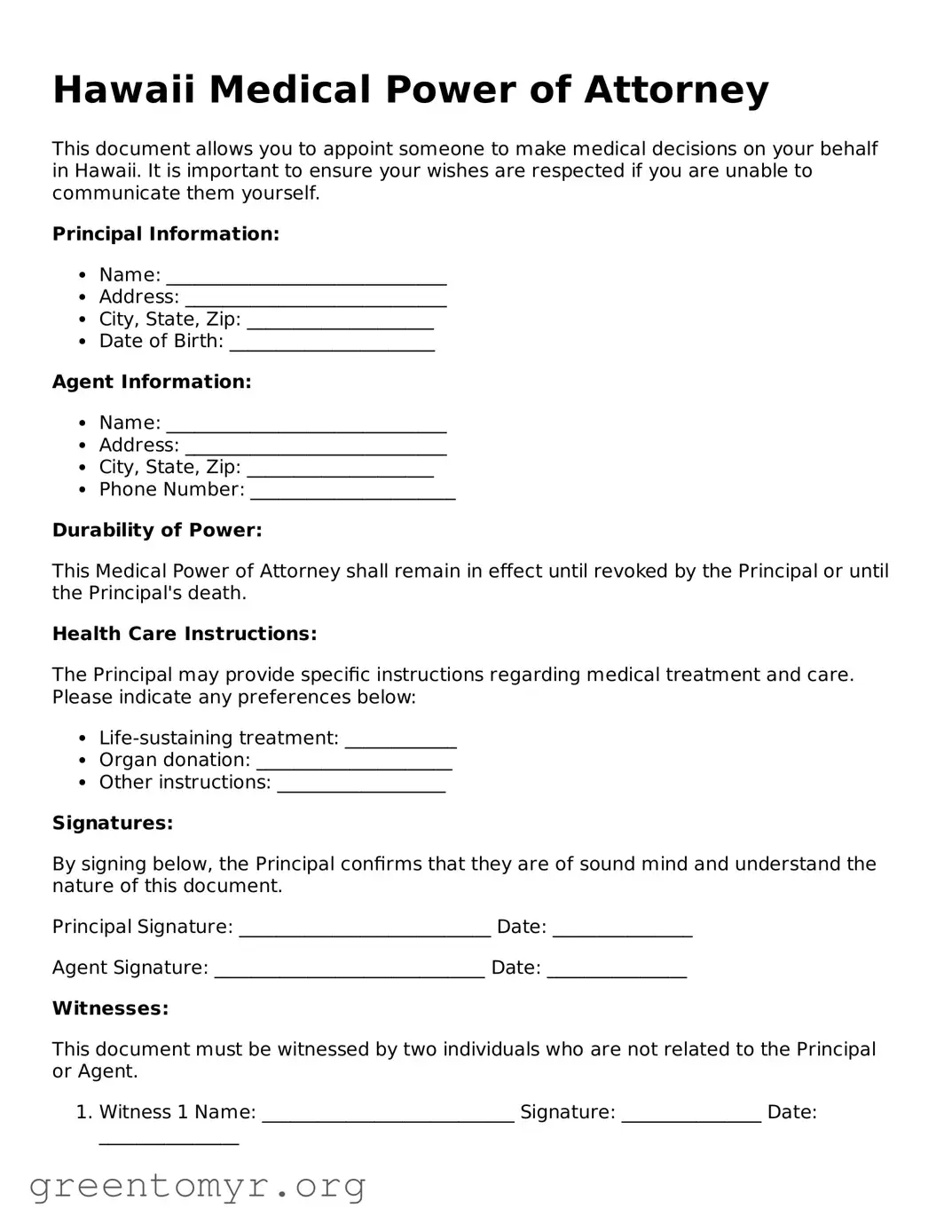
The Hawaii Medical Power of Attorney form is a vital document that empowers individuals to make crucial healthcare decisions on behalf of another person when they are unable to do so themselves. This legal instrument allows you to designate a trusted individual, often referred to as an agent or surrogate, to act in your best interest regarding medical treatment and procedures. By outlining your preferences for medical care, this form ensures that your values and wishes are respected during times of incapacity. It covers key aspects such as the authority granted to the agent, the scope of medical decisions they can make, and any specific instructions you wish to include. Additionally, the form provides a framework for discussing end-of-life care, organ donation, and other significant health-related choices, making it an essential tool for anyone looking to safeguard their healthcare preferences in Hawaii. Understanding how to properly complete and execute this form can help ensure that your healthcare decisions align with your personal beliefs and desires, providing peace of mind for both you and your loved ones.
Hawaii Medical Power of Attorney
This document allows you to appoint someone to make medical decisions on your behalf in Hawaii. It is important to ensure your wishes are respected if you are unable to communicate them yourself.
Principal Information:
Agent Information:
Durability of Power:
This Medical Power of Attorney shall remain in effect until revoked by the Principal or until the Principal's death.
Health Care Instructions:
The Principal may provide specific instructions regarding medical treatment and care. Please indicate any preferences below:
Signatures:
By signing below, the Principal confirms that they are of sound mind and understand the nature of this document.
Principal Signature: ___________________________ Date: _______________
Agent Signature: _____________________________ Date: _______________
Witnesses:
This document must be witnessed by two individuals who are not related to the Principal or Agent.
This Medical Power of Attorney is governed by the laws of the State of Hawaii.
| Fact Name | Details |
|---|---|
| Definition | A Hawaii Medical Power of Attorney form allows you to designate someone to make healthcare decisions on your behalf if you become unable to do so. |
| Governing Law | This form is governed by Hawaii Revised Statutes, Chapter 327E, which outlines the requirements for health care powers of attorney. |
| Signing Requirements | The form must be signed by you and witnessed by two individuals or notarized to be legally valid. |
| Revocation | You can revoke the Medical Power of Attorney at any time, as long as you are mentally competent to do so. |
Filling out the Hawaii Medical Power of Attorney form is an important step in designating someone to make medical decisions on your behalf if you are unable to do so. After completing the form, ensure that it is signed and witnessed according to the requirements in Hawaii.
A Medical Power of Attorney (MPOA) in Hawaii is a legal document that allows an individual, known as the principal, to designate another person, referred to as the agent, to make healthcare decisions on their behalf if they become unable to do so. This document ensures that the principal's medical preferences are respected even when they cannot communicate them directly.
In Hawaii, any competent adult can be appointed as an agent. This includes family members, friends, or trusted individuals. However, certain individuals, such as healthcare providers involved in the principal's care, cannot serve as agents to avoid potential conflicts of interest.
An agent can make a wide range of healthcare decisions, including but not limited to:
No, a Medical Power of Attorney and a Living Will are not the same. A Living Will outlines specific medical treatment preferences in the event of terminal illness or incapacitation. In contrast, a Medical Power of Attorney designates someone to make healthcare decisions on behalf of the principal, which may include following the wishes stated in a Living Will.
To create a Medical Power of Attorney in Hawaii, follow these steps:
Yes, you can revoke your Medical Power of Attorney at any time as long as you are mentally competent. To revoke it, you should inform your agent and any healthcare providers in writing. It is also advisable to destroy any copies of the previous MPOA document to prevent confusion.
If you do not have a Medical Power of Attorney and become incapacitated, medical decisions may be made by family members or, if there is no agreement, by the court. This can lead to delays and disputes, making it crucial to have a designated agent in place.
While you can designate multiple agents in a Medical Power of Attorney, it is advisable to appoint one primary agent and one or two alternates. This helps avoid confusion and ensures that someone is always available to make decisions if the primary agent is unable to do so.
While it is not legally required to have an attorney to create a Medical Power of Attorney in Hawaii, consulting with one can provide guidance and ensure that your document meets all legal requirements and reflects your wishes accurately.
It is advisable to review your Medical Power of Attorney periodically, especially after significant life events such as marriage, divorce, or the death of an agent. Regular reviews ensure that the document remains aligned with your current wishes and circumstances.
When filling out the Hawaii Medical Power of Attorney form, individuals often encounter common pitfalls that can lead to complications. One frequent mistake is not clearly identifying the agent. The agent is the person authorized to make medical decisions on behalf of the individual. If the agent's name is not written legibly or is missing altogether, it can create confusion and delay in critical situations.
Another common error is failing to specify the powers granted to the agent. The form allows for customization regarding the extent of authority given. If a person simply checks the general box without considering specific medical decisions, it may limit the agent’s ability to act effectively when needed.
Some individuals neglect to date the form upon completion. A date is essential as it indicates when the document becomes effective. Without a date, there could be disputes regarding the validity of the document, especially if it is challenged later in court.
Additionally, people sometimes overlook the requirement for witnesses or notarization. In Hawaii, the Medical Power of Attorney must be signed in the presence of two witnesses or a notary public. Failing to meet this requirement can render the document invalid, leaving the individual without a designated decision-maker.
Another mistake involves not reviewing the form after completion. Errors in spelling, grammar, or clarity can lead to misunderstandings. It is advisable to read through the document carefully to ensure that all information is accurate and clearly stated.
Some individuals also forget to inform their chosen agent about their role and responsibilities. Open communication is crucial. The agent should be aware of the individual’s healthcare preferences and values to make informed decisions when necessary.
Lastly, people may not update their Medical Power of Attorney when their circumstances change. Life events such as marriage, divorce, or the death of a previously appointed agent can necessitate changes to the document. Regularly reviewing and updating the form ensures that it reflects current wishes and conditions.
When creating a Hawaii Medical Power of Attorney, it’s important to consider other related documents that can help ensure your healthcare wishes are honored. These forms work together to provide clarity and support in medical decision-making. Below is a list of commonly used documents that may accompany the Medical Power of Attorney.
By understanding and preparing these documents, you can create a clear plan for your medical care. This proactive approach can provide peace of mind for you and your loved ones, knowing that your wishes will be respected in times of need.
The Medical Power of Attorney (MPOA) form is an important legal document that allows individuals to designate someone to make medical decisions on their behalf if they become unable to do so. There are several other documents that serve similar purposes or work in conjunction with the MPOA. Here’s a list of eight documents that share similarities with the Medical Power of Attorney:
Understanding these documents can help ensure that your medical and personal preferences are respected, even when you cannot communicate them yourself. It's essential to consider which documents best suit your needs and to discuss your choices with your loved ones and healthcare providers.
When filling out the Hawaii Medical Power of Attorney form, it's crucial to approach the task with care and attention. Here are some important dos and don'ts to keep in mind:
By following these guidelines, you can ensure that your Medical Power of Attorney form is filled out correctly and effectively communicates your wishes regarding medical care.
When it comes to the Hawaii Medical Power of Attorney form, several misconceptions can lead to confusion. Understanding the facts can help ensure that individuals make informed decisions regarding their healthcare preferences.
This is not true. A Medical Power of Attorney designates someone to make healthcare decisions on your behalf, while a Living Will outlines your preferences for medical treatment in specific situations.
In fact, you can designate multiple individuals as your agents. However, it's essential to clarify their roles to avoid confusion during critical moments.
This misconception overlooks the fact that anyone, regardless of age, can experience a medical emergency. Having a Medical Power of Attorney ensures your wishes are respected at any age.
While notarization can add an extra layer of authenticity, it is not a requirement in Hawaii. The form must be signed by two witnesses who are not related to you.
This is incorrect. You maintain the right to make your own medical decisions as long as you are capable. The Medical Power of Attorney only takes effect when you are unable to communicate your wishes.
This is misleading. You can revoke or change your Medical Power of Attorney at any time, as long as you are of sound mind. Regular reviews of your healthcare documents are advisable.
Filling out and using the Hawaii Medical Power of Attorney form is an important step in ensuring your healthcare wishes are honored. Here are some key takeaways to consider:
Taking these steps can help ensure that your healthcare decisions reflect your values and preferences, providing peace of mind for you and your loved ones.