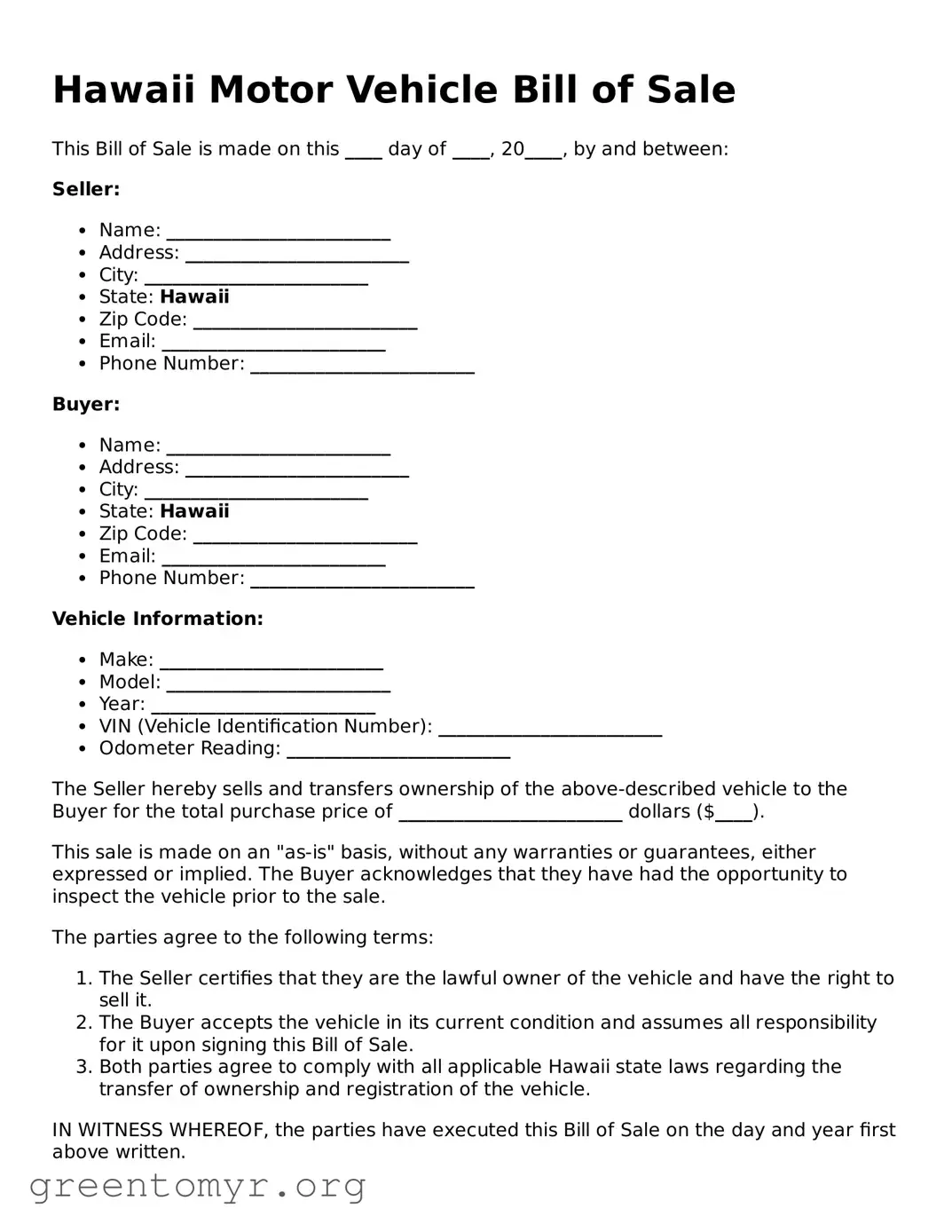
The Hawaii Motor Vehicle Bill of Sale form is an essential document for anyone involved in the buying or selling of a vehicle in the state. This form serves as a legal record of the transaction, providing crucial information about the vehicle, including its make, model, year, and Vehicle Identification Number (VIN). Additionally, it captures the names and addresses of both the buyer and seller, ensuring that both parties are clearly identified. The form also outlines the sale price and may include details about any warranties or conditions related to the vehicle's condition at the time of sale. By completing this document, both the buyer and seller can protect their interests, as it helps to establish proof of ownership and can be used for registration purposes. Understanding the importance of this form is vital for a smooth transaction and for compliance with state regulations.
Hawaii Motor Vehicle Bill of Sale
This Bill of Sale is made on this ____ day of ____, 20____, by and between:
Seller:
Buyer:
Vehicle Information:
The Seller hereby sells and transfers ownership of the above-described vehicle to the Buyer for the total purchase price of ________________________ dollars ($____).
This sale is made on an "as-is" basis, without any warranties or guarantees, either expressed or implied. The Buyer acknowledges that they have had the opportunity to inspect the vehicle prior to the sale.
The parties agree to the following terms:
IN WITNESS WHEREOF, the parties have executed this Bill of Sale on the day and year first above written.
Seller's Signature: ___________________________ Date: ________________
Buyer's Signature: ___________________________ Date: ________________
| Fact Name | Description |
|---|---|
| Purpose | The Hawaii Motor Vehicle Bill of Sale form is used to document the sale and transfer of ownership of a motor vehicle in Hawaii. |
| Governing Law | This form is governed by Hawaii Revised Statutes, Chapter 286, which covers motor vehicle registration and title. |
| Parties Involved | The form requires the signatures of both the seller and the buyer to validate the transaction. |
| Vehicle Information | Details such as the vehicle identification number (VIN), make, model, and year must be included in the form. |
| Sales Price | The agreed-upon sales price of the vehicle must be clearly stated on the form. |
| Condition of Vehicle | The seller may include a statement regarding the condition of the vehicle, which can protect both parties. |
| Notarization | While notarization is not required, having the document notarized can provide additional legal protection. |
| Record Keeping | Both the buyer and seller should keep a copy of the completed Bill of Sale for their records. |
| Transfer of Title | The Bill of Sale is often used in conjunction with the vehicle title transfer process at the Department of Motor Vehicles (DMV). |
Completing the Hawaii Motor Vehicle Bill of Sale form is a straightforward process that involves providing specific information about the transaction. After filling out the form, it is essential to ensure that all details are accurate before submitting it to the appropriate authorities.
A Hawaii Motor Vehicle Bill of Sale is a legal document that records the transfer of ownership of a vehicle from one party to another. This document serves as proof of the transaction and outlines essential details about the vehicle and the parties involved.
The Bill of Sale is crucial for several reasons:
A comprehensive Bill of Sale should include the following information:
In Hawaii, notarization is not a requirement for the Bill of Sale. However, having it notarized can add an extra layer of authenticity and may help in case of future disputes.
While you can use a generic Bill of Sale form, it is advisable to use a form specifically designed for Hawaii. This ensures compliance with state laws and includes all necessary information relevant to vehicle transactions in the state.
If the vehicle has an existing lien, it is essential to disclose this information in the Bill of Sale. The seller should ensure that the lien is satisfied before completing the sale. This protects the buyer from future claims against the vehicle.
To complete the Bill of Sale, follow these steps:
After the sale, both the buyer and seller should retain a copy of the Bill of Sale for their records. The buyer will need it for vehicle registration, while the seller should keep it as proof of the transaction.
There is no fee specifically associated with creating a Bill of Sale in Hawaii. However, fees may apply for vehicle registration and titling at the Department of Motor Vehicles (DMV). It is advisable to check with local authorities for any applicable charges.
Filling out the Hawaii Motor Vehicle Bill of Sale form can be a straightforward process, but many individuals make common mistakes that can lead to complications later. One frequent error is failing to provide accurate vehicle information. This includes the Vehicle Identification Number (VIN), make, model, and year. Omitting or incorrectly entering any of these details can create confusion and may delay the transfer of ownership.
Another mistake often encountered is neglecting to include the purchase price. This figure is essential not only for the transaction but also for tax purposes. Leaving it blank or entering an incorrect amount can result in issues with the Department of Motor Vehicles (DMV) and may lead to additional fees or penalties.
Additionally, many people overlook the requirement for both the buyer and seller to sign the form. Without both signatures, the Bill of Sale may be considered incomplete. This can complicate the transfer process and may even lead to disputes about ownership in the future.
Some individuals also fail to date the form appropriately. The date of the transaction is crucial for establishing the timeline of ownership. An incorrect or missing date can lead to complications, especially if there are questions about when the sale occurred.
Another common oversight is not providing the correct contact information for both parties. This includes addresses and phone numbers. Accurate contact details are vital should any issues arise after the sale. Without them, communication can become difficult, potentially leading to misunderstandings.
Lastly, many individuals do not keep a copy of the completed Bill of Sale for their records. Retaining a copy is essential for both the buyer and seller. It serves as proof of the transaction and can be invaluable if disputes arise or if there is a need to verify ownership in the future.
When completing a vehicle transaction in Hawaii, the Motor Vehicle Bill of Sale form is an essential document. However, it is often accompanied by other forms and documents that help ensure a smooth transfer of ownership. Below is a list of five commonly used documents that complement the Bill of Sale.
Having these documents prepared and organized can greatly facilitate the vehicle transfer process. Each form plays a vital role in ensuring compliance with state laws and protecting both the buyer and seller during the transaction.
When filling out the Hawaii Motor Vehicle Bill of Sale form, there are several important considerations to keep in mind. Here is a list of things you should and shouldn't do:
The Hawaii Motor Vehicle Bill of Sale form is an important document for anyone involved in buying or selling a vehicle in the state. However, several misconceptions surround this form that can lead to confusion. Below are nine common misunderstandings about the Hawaii Motor Vehicle Bill of Sale form, along with explanations to clarify the facts.
In reality, while it is particularly useful for private transactions, a Bill of Sale is also beneficial for dealership sales. It serves as proof of purchase and can protect both parties involved.
This is not true. The Bill of Sale is a supplementary document that provides evidence of the transaction, but it does not substitute the need for a title transfer, which is a separate legal requirement.
While notarization can add an extra layer of authenticity, it is not a requirement for the Hawaii Motor Vehicle Bill of Sale. The signatures of both the buyer and seller are sufficient.
In fact, both the buyer and the seller must sign the document. This mutual agreement solidifies the transaction and ensures that both parties acknowledge the sale.
Even if a vehicle is given as a gift, a Bill of Sale is still advisable. It provides a record of the transaction and can help avoid disputes regarding ownership in the future.
This form is applicable to various types of motor vehicles, including motorcycles, trucks, and boats. Its versatility makes it a valuable tool for any vehicle transaction.
There is no minimum sale amount that dictates the necessity of a Bill of Sale. It is recommended for all vehicle transactions, regardless of price, to ensure proper documentation.
On the contrary, a properly completed and signed Bill of Sale is a legally binding document. It can be used in court to prove ownership and the terms of the sale if disputes arise.
While various templates are available, it is crucial to use a form that complies with Hawaii state laws. Using the correct template ensures that all necessary information is included and that the document is valid.
Understanding these misconceptions can help individuals navigate the vehicle buying and selling process more effectively in Hawaii. Proper documentation, including the Bill of Sale, plays a vital role in ensuring smooth transactions and protecting the interests of all parties involved.
When dealing with the Hawaii Motor Vehicle Bill of Sale form, it's essential to understand its purpose and the necessary steps for proper completion. Here are some key takeaways to keep in mind: