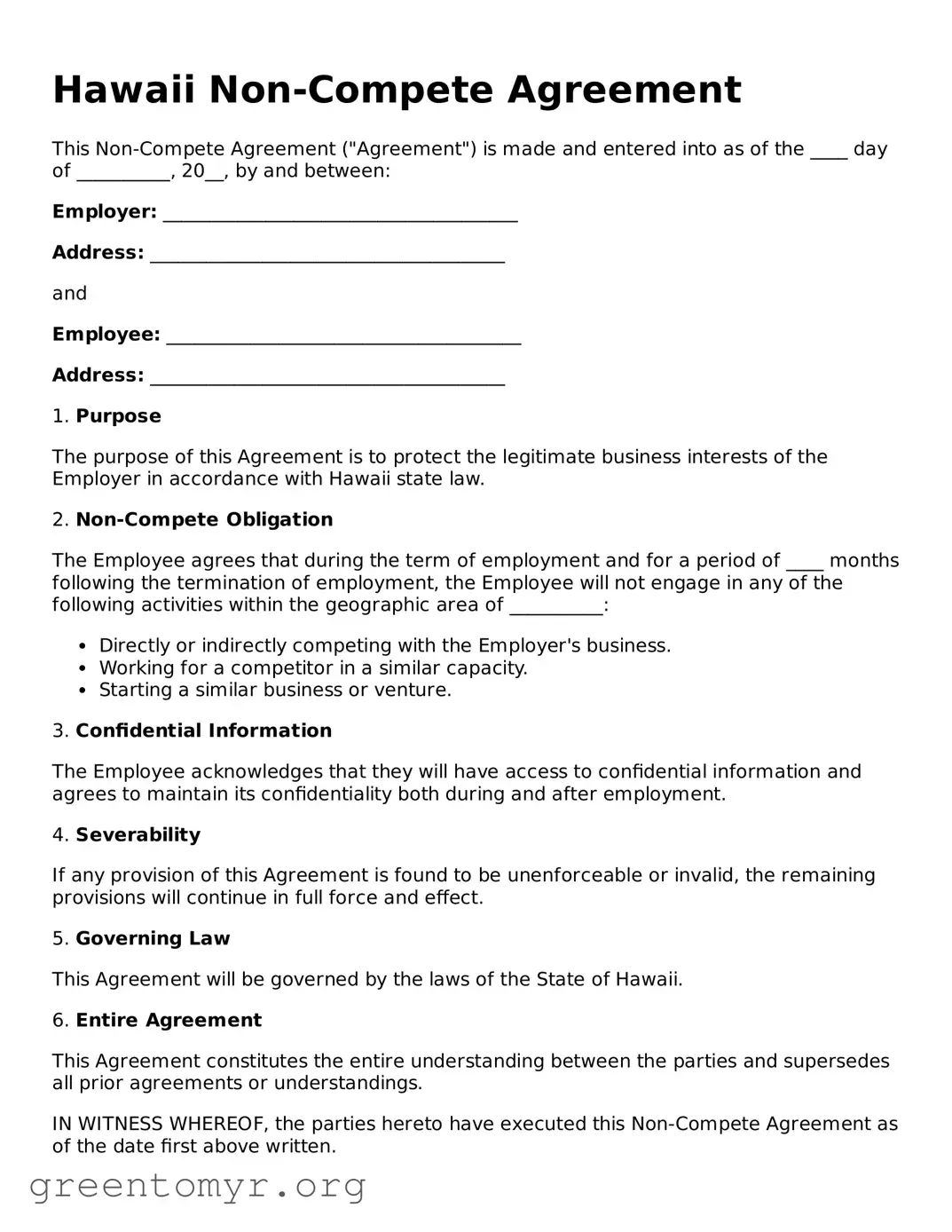
The Hawaii Non-compete Agreement is a crucial document that plays a significant role in the employment landscape of the state. This form is designed to protect businesses by restricting employees from engaging in competitive activities after leaving a job. It outlines specific terms, such as the duration of the non-compete period, the geographical area where the restrictions apply, and the types of activities that are prohibited. Employers often use this agreement to safeguard their trade secrets, client relationships, and proprietary information. Employees, on the other hand, should carefully review the terms to understand their rights and obligations before signing. The enforceability of these agreements can vary, depending on factors like reasonableness and public policy considerations. In Hawaii, courts generally evaluate whether the restrictions are necessary to protect legitimate business interests without unduly limiting an individual’s ability to earn a living. Understanding the nuances of the Hawaii Non-compete Agreement is essential for both employers and employees, as it can significantly impact career trajectories and business operations.
Hawaii Non-Compete Agreement
This Non-Compete Agreement ("Agreement") is made and entered into as of the ____ day of __________, 20__, by and between:
Employer: ______________________________________
Address: ______________________________________
and
Employee: ______________________________________
Address: ______________________________________
1. Purpose
The purpose of this Agreement is to protect the legitimate business interests of the Employer in accordance with Hawaii state law.
2. Non-Compete Obligation
The Employee agrees that during the term of employment and for a period of ____ months following the termination of employment, the Employee will not engage in any of the following activities within the geographic area of __________:
3. Confidential Information
The Employee acknowledges that they will have access to confidential information and agrees to maintain its confidentiality both during and after employment.
4. Severability
If any provision of this Agreement is found to be unenforceable or invalid, the remaining provisions will continue in full force and effect.
5. Governing Law
This Agreement will be governed by the laws of the State of Hawaii.
6. Entire Agreement
This Agreement constitutes the entire understanding between the parties and supersedes all prior agreements or understandings.
IN WITNESS WHEREOF, the parties hereto have executed this Non-Compete Agreement as of the date first above written.
Employer Signature: ___________________________
Date: ______________________________________
Employee Signature: ___________________________
Date: ______________________________________
| Fact Name | Description |
|---|---|
| Governing Law | The Hawaii Non-compete Agreement is governed by Hawaii Revised Statutes § 480-4. |
| Enforceability | Non-compete agreements in Hawaii are enforceable only if they are reasonable in scope and duration. |
| Reasonable Duration | A typical duration for a non-compete agreement in Hawaii should not exceed two years. |
| Geographic Scope | The geographic area covered by the agreement must be limited to where the employee worked. |
| Consideration | There must be valid consideration for the agreement, such as a job offer or promotion. |
| Public Policy | Hawaii courts may refuse to enforce non-compete agreements that violate public policy. |
| Exceptions | Certain professions, such as physicians, have specific regulations regarding non-compete agreements. |
Once you have the Hawaii Non-compete Agreement form in front of you, it’s time to start filling it out. This process will require you to provide specific information about the parties involved, the terms of the agreement, and any relevant dates. Carefully following each step will ensure that the form is completed accurately.
A non-compete agreement is a contract between an employer and an employee. It restricts the employee from working for competitors or starting a competing business for a specified period after leaving the company. In Hawaii, these agreements must be reasonable in scope and duration to be enforceable.
Yes, non-compete agreements can be enforceable in Hawaii, but they are subject to certain limitations. Courts will evaluate the agreement based on its reasonableness regarding time, geographic area, and the nature of the restricted activities. If an agreement is deemed overly broad or unfair, it may be invalidated.
Courts in Hawaii typically consider several factors, including:
These factors help determine whether the agreement is reasonable and necessary to protect the employer's legitimate business interests.
While there is no strict limit on the duration, non-compete agreements in Hawaii should generally be limited to a reasonable timeframe. Typically, durations of six months to two years are more likely to be considered reasonable. However, the specific circumstances of each case will influence what is deemed acceptable.
Yes, employees can negotiate the terms of a non-compete agreement. It is advisable to discuss any concerns regarding the agreement with the employer before signing. Negotiating for a shorter duration, a smaller geographic area, or a more specific scope can lead to a more balanced agreement.
If an employee believes that a non-compete agreement is unfair or overly restrictive, they should consider seeking legal advice. An attorney can help assess the agreement's enforceability and provide guidance on possible actions, such as negotiating terms or challenging the agreement in court.
Yes, there are exceptions. For example, non-compete agreements are generally not enforceable against employees who are terminated without cause. Additionally, certain professions, such as those in healthcare, may have specific regulations that limit the enforceability of non-compete agreements.
Filling out the Hawaii Non-compete Agreement form can be tricky. Many people make common mistakes that can lead to misunderstandings or even legal issues. Awareness of these pitfalls is essential for anyone involved in the process.
One frequent mistake is failing to read the entire document carefully. Skimming through the agreement can result in overlooking important clauses. Each section contains vital information that impacts your rights and obligations.
Another error is not providing complete information. Incomplete forms may lead to delays or rejections. Ensure that all required fields are filled out accurately and thoroughly.
Many individuals also neglect to specify the duration of the non-compete clause. A vague timeframe can create confusion later. Clearly state how long the agreement will be in effect to avoid potential disputes.
Some people forget to include the geographic scope of the non-compete. Without clear boundaries, the agreement may be too broad or unenforceable. Define the area where the restrictions apply to protect both parties.
Additionally, failing to consult with a legal professional is a common oversight. While it may seem unnecessary, expert advice can clarify complex terms and help you understand the implications of the agreement.
Another mistake is signing the form without fully understanding it. Signing a document you do not comprehend can lead to unintended consequences. Take the time to ask questions and seek clarification before putting your name on the line.
Some individuals mistakenly assume that non-compete agreements are one-size-fits-all. Each situation is unique, and the terms should be tailored to fit specific circumstances. Customizing the agreement can prevent future complications.
Moreover, not considering the enforceability of the agreement is a significant error. Non-compete clauses can vary in legality depending on the state and specific terms. Ensure that the agreement complies with Hawaii’s laws to avoid it being deemed invalid.
Lastly, neglecting to keep a copy of the signed agreement is a common mistake. Having a personal record is crucial for future reference. Always retain a copy for your files after signing any legal document.
A Hawaii Non-compete Agreement is often used in conjunction with several other forms and documents to ensure clarity and legal compliance in business relationships. Below is a list of related documents that may be relevant when creating or enforcing a non-compete agreement.
These documents serve to clarify the expectations and obligations of both parties in a business relationship. Understanding their purposes can help in drafting effective agreements that protect business interests while ensuring compliance with applicable laws.
When filling out the Hawaii Non-compete Agreement form, it is essential to navigate the process carefully. Below are some guidelines to help ensure that the form is completed correctly and effectively.
Understanding the Hawaii Non-compete Agreement can be challenging, especially with the various misconceptions that surround it. Here are eight common myths and the realities behind them:
This is not true. In Hawaii, non-compete agreements are only enforceable if they are reasonable in scope, duration, and geographic area. Courts may refuse to enforce overly restrictive agreements.
This misconception is misleading. A non-compete may restrict certain activities for a specified time and area, but it doesn’t completely bar you from working in your profession.
Not all employers use non-compete agreements. Many businesses find them unnecessary or too restrictive, especially in industries where talent is in high demand.
These agreements serve different purposes. A non-compete restricts employment in a similar field, while a non-disclosure agreement protects confidential information.
This is incorrect. If an employee believes the agreement is unreasonable or was signed under duress, they can challenge its enforceability in court.
This is a misconception. Non-compete agreements can be applied to employees at various levels, depending on the employer's needs and the nature of the business.
This is not the case. The use of non-compete agreements varies significantly across industries. Some sectors, like technology, may use them more frequently than others.
While the restrictions may end, the implications of having signed a non-compete can linger. It may affect future job opportunities or negotiations, depending on the circumstances.
By understanding these misconceptions, individuals can better navigate the complexities of non-compete agreements in Hawaii.
Filling out and using the Hawaii Non-compete Agreement form is an important step for both employers and employees. Here are some key takeaways to consider: