The Hawaii Notary Acknowledgement form plays a crucial role in various legal and financial transactions across the state. This document serves as a verification tool, confirming that a person has willingly signed a particular document in the presence of a notary public. It is essential for ensuring the authenticity of signatures, thereby providing a layer of protection against fraud. The form typically includes the names of the signers, the date of the acknowledgment, and the notary's official seal. It is commonly used in real estate transactions, legal contracts, and other important agreements where the identity of the signer needs to be established. Understanding how to properly complete and use this form is vital for individuals and businesses alike, as it helps facilitate smooth and legally binding transactions while adhering to Hawaii's notarial laws.
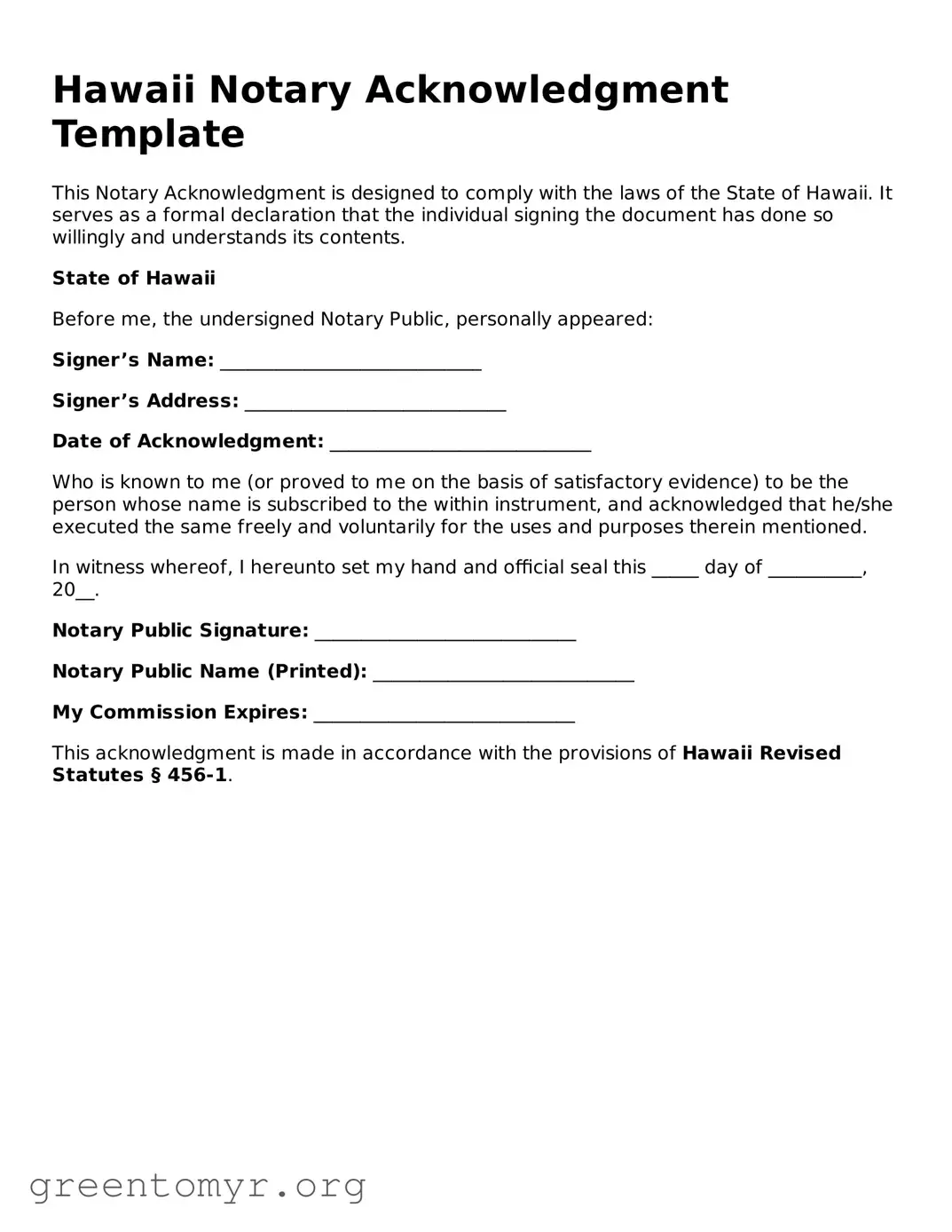
Hawaii Notary Acknowledgment Template
This Notary Acknowledgment is designed to comply with the laws of the State of Hawaii. It serves as a formal declaration that the individual signing the document has done so willingly and understands its contents.
State of Hawaii
Before me, the undersigned Notary Public, personally appeared:
Signer’s Name: ____________________________
Signer’s Address: ____________________________
Date of Acknowledgment: ____________________________
Who is known to me (or proved to me on the basis of satisfactory evidence) to be the person whose name is subscribed to the within instrument, and acknowledged that he/she executed the same freely and voluntarily for the uses and purposes therein mentioned.
In witness whereof, I hereunto set my hand and official seal this _____ day of __________, 20__.
Notary Public Signature: ____________________________
Notary Public Name (Printed): ____________________________
My Commission Expires: ____________________________
This acknowledgment is made in accordance with the provisions of Hawaii Revised Statutes § 456-1.
| Fact Name | Details |
|---|---|
| Purpose | The Hawaii Notary Acknowledgement form is used to verify the identity of the signer and to confirm that the signing took place willingly and without coercion. |
| Governing Law | This form is governed by Hawaii Revised Statutes, Chapter 456, which outlines the powers and duties of notaries public in Hawaii. |
| Signature Requirement | The signer must personally appear before the notary public at the time of signing the document. |
| Notary Seal | A notary public must affix their official seal to the form to validate the acknowledgement. |
| Record Keeping | Notaries are required to keep a record of all acknowledgements performed in a journal, which may be subject to inspection. |
| Validity | The acknowledgement remains valid as long as it is executed according to the laws of Hawaii and meets all necessary requirements. |
After obtaining the Hawaii Notary Acknowledgement form, it is essential to fill it out accurately to ensure proper documentation. Follow the steps below carefully to complete the form.
Once the form is completed, ensure all information is clear and legible. The next step involves submitting the form as required, depending on the specific needs of the transaction.
The Hawaii Notary Acknowledgement form is a document used to verify that a person has willingly signed a document in the presence of a notary public. This form serves as proof that the signer’s identity has been confirmed and that they understood the contents of the document before signing.
A Notary Acknowledgement is often required for various legal documents, such as:
It is essential to check if a specific document requires notarization to ensure its validity.
To complete the form, follow these steps:
Make sure to bring valid identification, such as a driver's license or passport, to verify your identity.
A notary public is an official authorized by the state to perform notarial acts. Their primary responsibilities include:
The notary helps prevent fraud and ensures that the signing process is legitimate.
Yes, notaries in Hawaii may charge a fee for their services. The maximum fee is set by state law, but it can vary depending on the notary. It’s a good idea to ask about fees before your appointment to avoid surprises.
Not all documents require a Notary Acknowledgement. While many legal documents benefit from notarization, some may not need it at all. Always check the specific requirements for the document you are working with to ensure compliance.
The validity of a Notary Acknowledgement typically depends on the document it accompanies. Generally, the acknowledgment remains valid as long as the underlying document is valid. However, if the document has an expiration date or specific conditions, those will dictate the acknowledgment's validity.
Filling out the Hawaii Notary Acknowledgment form can seem straightforward, but many people make common mistakes that can lead to delays or complications. One frequent error is failing to provide the correct date. The date is crucial as it indicates when the acknowledgment took place. If the date is missing or incorrect, it may raise questions about the validity of the document.
Another mistake often seen is not properly identifying the signer. The form requires the notary to confirm the identity of the person signing the document. If the name on the form does not match the identification provided, the acknowledgment may be deemed invalid. Always double-check that the name is spelled correctly and matches the ID.
People sometimes forget to include the appropriate notarial wording. This wording is essential because it confirms that the signer appeared before the notary and acknowledged their signature. Omitting this wording can lead to confusion about the purpose of the document and may render it unenforceable.
Additionally, some individuals neglect to sign the form themselves. While it may seem obvious, the signer must physically sign the document in front of the notary. If the notary has to sign without the signer's signature being present, the acknowledgment cannot be completed properly.
Another common oversight is using the wrong notary seal. Hawaii has specific requirements for notary seals, and using an outdated or incorrect seal can invalidate the acknowledgment. Always ensure that the seal is current and meets the state's specifications.
People may also fail to provide a complete address for the signer. This information is often required to establish the identity and location of the person signing the document. Without a complete address, the acknowledgment may not hold up if challenged.
Lastly, neglecting to check for additional requirements specific to the type of document being notarized can lead to issues. Certain documents may have unique stipulations that must be met for the acknowledgment to be valid. Always review the document's requirements thoroughly before completing the form.
In Hawaii, the Notary Acknowledgment form is often used in conjunction with several other documents. These documents help ensure that transactions are legally binding and properly recorded. Here is a list of some common forms that may accompany the Notary Acknowledgment.
Each of these documents plays a significant role in various legal transactions. When combined with the Notary Acknowledgment form, they help facilitate smooth and secure processes. Always consider consulting with a legal professional when dealing with these forms to ensure compliance with state laws.
The Notary Acknowledgement form serves a specific purpose in verifying the identity of individuals signing documents. Several other documents share similarities with it in terms of function and intent. Below is a list of nine documents that are comparable to the Notary Acknowledgement form:
When filling out the Hawaii Notary Acknowledgment form, it is important to follow certain guidelines to ensure accuracy and compliance. Below is a list of things you should and shouldn't do.
Understanding the Hawaii Notary Acknowledgment form is crucial for anyone needing notarization in the state. However, several misconceptions can lead to confusion. Here’s a list of common misunderstandings:
Clearing up these misconceptions can help ensure that you navigate the notarization process smoothly and effectively in Hawaii.
When filling out and using the Hawaii Notary Acknowledgment form, it is important to keep a few key points in mind. These takeaways will help ensure that the process is smooth and effective.