The Hawaii Notice to Quit form is an essential document for landlords and tenants navigating the rental landscape in Hawaii. This form serves as a formal request for a tenant to vacate the rental property, often due to lease violations or non-payment of rent. It outlines the specific reasons for the eviction and provides a timeline for the tenant to respond or leave. Landlords must ensure that the notice is delivered correctly, adhering to state regulations to avoid potential legal complications. Tenants, on the other hand, should understand their rights and the implications of receiving such a notice. Properly utilizing the Notice to Quit can help facilitate a smoother transition for both parties, making it crucial to grasp its contents and requirements. With clear communication and adherence to legal guidelines, landlords and tenants can navigate this challenging process more effectively.
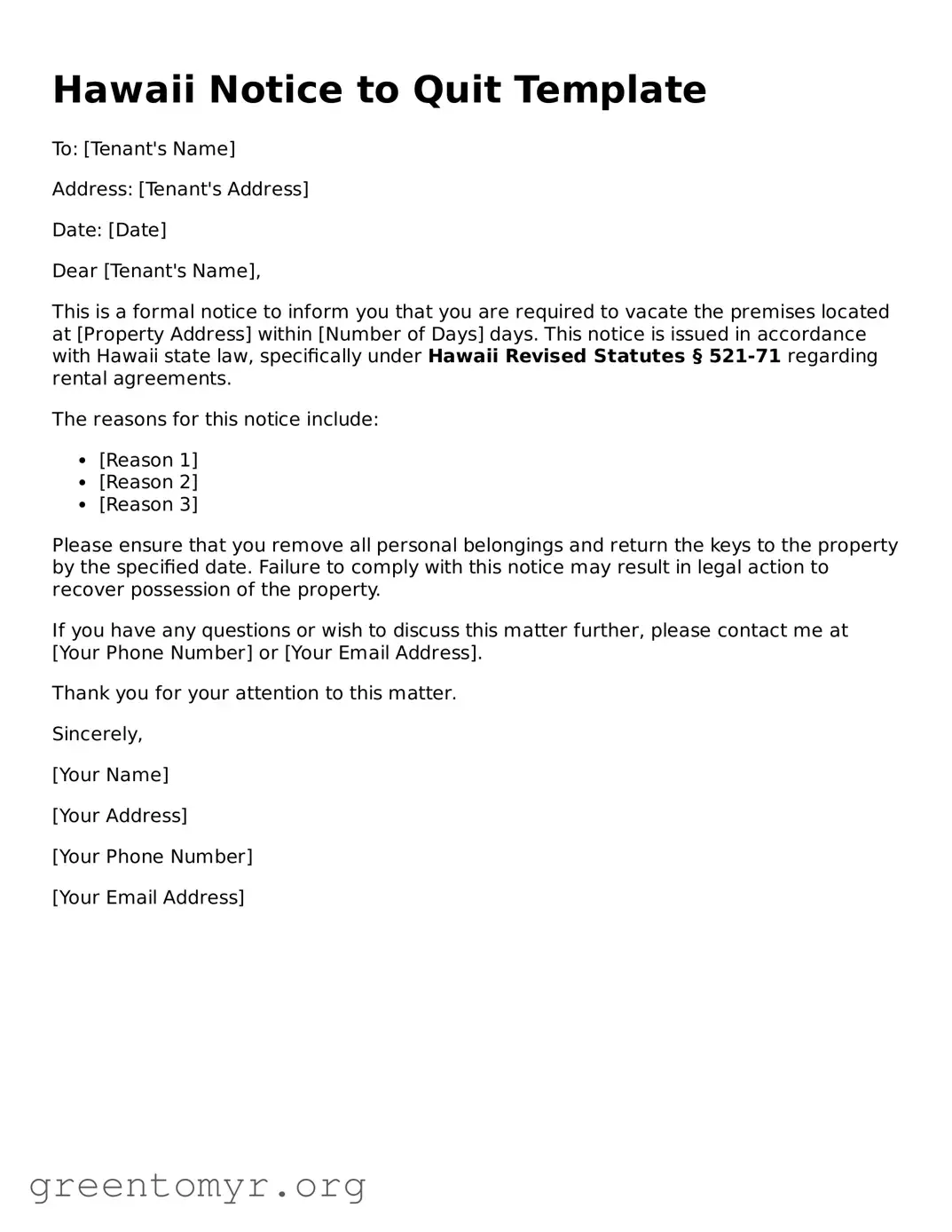
Hawaii Notice to Quit Template
To: [Tenant's Name]
Address: [Tenant's Address]
Date: [Date]
Dear [Tenant's Name],
This is a formal notice to inform you that you are required to vacate the premises located at [Property Address] within [Number of Days] days. This notice is issued in accordance with Hawaii state law, specifically under Hawaii Revised Statutes § 521-71 regarding rental agreements.
The reasons for this notice include:
Please ensure that you remove all personal belongings and return the keys to the property by the specified date. Failure to comply with this notice may result in legal action to recover possession of the property.
If you have any questions or wish to discuss this matter further, please contact me at [Your Phone Number] or [Your Email Address].
Thank you for your attention to this matter.
Sincerely,
[Your Name]
[Your Address]
[Your Phone Number]
[Your Email Address]
| Fact Name | Description |
|---|---|
| Purpose | The Hawaii Notice to Quit form is used by landlords to formally notify tenants to vacate the rental property. |
| Governing Law | This form is governed by Hawaii Revised Statutes § 521-68. |
| Notice Period | Typically, a 5-day notice is required for non-payment of rent, while a 10-day notice is used for other lease violations. |
| Delivery Methods | The notice can be delivered in person, sent via certified mail, or posted on the property. |
| Tenant Rights | Tenants have the right to respond to the notice and may seek legal advice if they believe the notice is unjust. |
| Form Requirements | The form must include the tenant's name, address, reason for eviction, and the date by which they must vacate. |
| Legal Consequences | If the tenant does not comply, the landlord may proceed with eviction proceedings in court. |
| Record Keeping | Landlords should keep a copy of the notice and proof of delivery for their records. |
After you have obtained the Hawaii Notice to Quit form, you will need to fill it out accurately to ensure that it serves its intended purpose. Following these steps will guide you through the process of completing the form correctly.
Once the form is completed and delivered, keep a copy for your records. This will be important if any further action is needed regarding the rental agreement or tenant eviction process.
The Hawaii Notice to Quit form is a legal document that a landlord uses to formally notify a tenant to vacate a rental property. This notice is typically issued when a tenant has violated the terms of their lease agreement or has not paid rent. The form outlines the reasons for the eviction and provides a specific timeframe for the tenant to leave the premises.
A landlord should use a Notice to Quit when they wish to terminate a tenancy for specific reasons, such as:
It is important to follow the proper legal procedures to ensure the eviction process is valid.
The required notice period in Hawaii can vary based on the reason for eviction:
Landlords must ensure they provide the correct amount of notice to comply with state laws.
Yes, tenants have the right to contest a Notice to Quit. If a tenant believes the notice is unjustified, they can respond in writing or seek legal advice. In many cases, tenants can present their case in court if the landlord proceeds with eviction. It is advisable for tenants to keep records of all communications with their landlord.
If a tenant does not vacate the property by the deadline specified in the Notice to Quit, the landlord may initiate eviction proceedings. This typically involves filing a complaint in court and may lead to a hearing where both parties can present their arguments. If the court rules in favor of the landlord, a judgment for eviction may be issued.
While a Notice to Quit is often the first step in the eviction process, it is not the same as an eviction notice. The Notice to Quit serves as a warning to the tenant, whereas an eviction notice is a formal court order that allows law enforcement to remove the tenant from the property. The eviction process involves legal proceedings that follow the issuance of a Notice to Quit.
A Hawaii Notice to Quit should include the following information:
Including this information helps ensure the notice is clear and legally binding.
A Hawaii Notice to Quit form can be obtained from various sources, including:
It is essential to use a form that complies with Hawaii state laws to avoid any issues during the eviction process.
Filling out the Hawaii Notice to Quit form can be straightforward, but there are common mistakes that individuals often make. One frequent error is failing to provide accurate tenant information. This includes the tenant's full name and the correct rental address. Incomplete or incorrect details can lead to delays or complications in the eviction process.
Another mistake is not specifying the reason for the notice. The form requires a clear explanation of why the notice is being issued, such as non-payment of rent or lease violations. Omitting this information can render the notice ineffective and may prolong the situation.
People sometimes overlook the importance of the date on the form. The notice must include the date it is issued, as well as the deadline for the tenant to vacate the property. If these dates are incorrect or missing, it can create confusion and may affect the legal standing of the notice.
Lastly, individuals may forget to sign the form. A signature is necessary to validate the notice. Without it, the document may be considered invalid, which could result in further complications down the line. Ensuring all required information is complete and accurate is essential for the process to proceed smoothly.
The Hawaii Notice to Quit form is a crucial document for landlords seeking to terminate a tenancy. However, several other forms and documents are often used in conjunction with it to ensure a smooth process. Below is a list of these related documents.
Understanding these documents can help landlords and tenants navigate the process more effectively. Each plays a vital role in ensuring that both parties are informed and their rights are protected.
The Notice to Quit form serves as an important document in the realm of landlord-tenant relationships. It signals the beginning of the eviction process and informs tenants that they must vacate the premises. Several other documents share similarities with the Notice to Quit, each playing a role in property management and tenant rights. Here are seven documents that are akin to the Notice to Quit:
Understanding these documents can empower both landlords and tenants to navigate their rights and responsibilities more effectively. Each serves a unique function but shares the common goal of clarifying the terms of occupancy and ensuring compliance with lease agreements.
When filling out the Hawaii Notice to Quit form, it's essential to follow certain guidelines to ensure the process is handled correctly. Here are eight things you should and shouldn't do:
Misconceptions about the Hawaii Notice to Quit form can lead to confusion for both landlords and tenants. Understanding these misconceptions is crucial for ensuring compliance with the law and protecting the rights of all parties involved. Below are six common misconceptions:
Notice to Quit is an Eviction Notice. Many people believe that a Notice to Quit is the same as an eviction notice. In reality, a Notice to Quit is a formal request for a tenant to vacate the premises, which may be a precursor to eviction proceedings if the tenant does not comply.
All Notices to Quit are the Same. Not all Notices to Quit are created equal. The specific content and requirements of the notice can vary based on the reason for termination, such as non-payment of rent or lease violations. Understanding the differences is essential for proper legal compliance.
A Notice to Quit Can Be Issued Without Cause. Some individuals mistakenly believe that landlords can issue a Notice to Quit without any valid reason. However, in Hawaii, a landlord must have a lawful reason to terminate a tenancy, such as failure to pay rent or lease violations.
Tenants Have No Rights After Receiving a Notice to Quit. It is a common misconception that tenants lose all rights once they receive a Notice to Quit. In fact, tenants have the right to contest the notice and may have defenses available to them, depending on the circumstances.
Delivery Method of the Notice is Irrelevant. Some believe that how a Notice to Quit is delivered does not matter. However, the law requires that the notice be served in a specific manner, such as through personal delivery or by mail, to be considered valid.
A Notice to Quit Automatically Leads to Eviction. There is a misconception that receiving a Notice to Quit automatically results in eviction. In reality, a landlord must follow legal procedures, including filing for eviction in court, before a tenant can be legally removed from the property.
Clarifying these misconceptions can help ensure that both landlords and tenants understand their rights and responsibilities, fostering a more equitable rental environment in Hawaii.
When dealing with the Hawaii Notice to Quit form, it is essential to understand its purpose and the proper procedures involved. Below are key takeaways to consider: