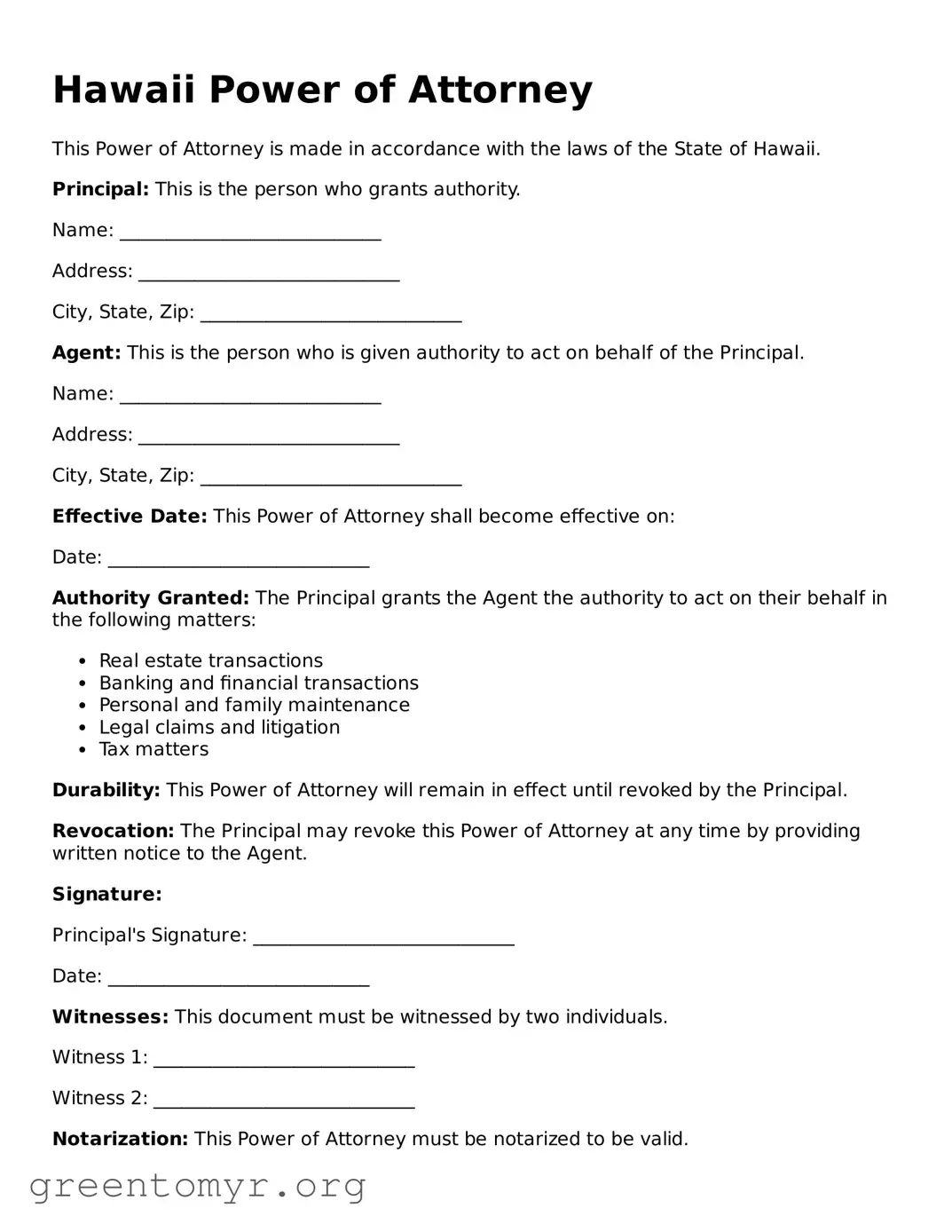
The Hawaii Power of Attorney form serves as a crucial legal document that allows individuals to designate someone else to make decisions on their behalf. This form is particularly important for those who may become incapacitated or unable to manage their affairs due to health issues or other circumstances. In Hawaii, the Power of Attorney can cover a wide range of decisions, including financial matters, healthcare choices, and property management. By completing this form, the principal, or the person granting authority, can specify the extent of the agent's powers, ensuring that their wishes are respected. It is essential to understand that the Power of Attorney can be either durable, remaining effective even if the principal becomes incapacitated, or non-durable, which ceases to be valid under such conditions. Additionally, the form must be signed and notarized to be legally binding, reflecting the importance of proper execution in safeguarding the principal's interests. Overall, the Hawaii Power of Attorney form provides a structured way for individuals to ensure their preferences are honored, even when they cannot voice them directly.
Hawaii Power of Attorney
This Power of Attorney is made in accordance with the laws of the State of Hawaii.
Principal: This is the person who grants authority.
Name: ____________________________
Address: ____________________________
City, State, Zip: ____________________________
Agent: This is the person who is given authority to act on behalf of the Principal.
Name: ____________________________
Address: ____________________________
City, State, Zip: ____________________________
Effective Date: This Power of Attorney shall become effective on:
Date: ____________________________
Authority Granted: The Principal grants the Agent the authority to act on their behalf in the following matters:
Durability: This Power of Attorney will remain in effect until revoked by the Principal.
Revocation: The Principal may revoke this Power of Attorney at any time by providing written notice to the Agent.
Signature:
Principal's Signature: ____________________________
Date: ____________________________
Witnesses: This document must be witnessed by two individuals.
Witness 1: ____________________________
Witness 2: ____________________________
Notarization: This Power of Attorney must be notarized to be valid.
Notary Public: ____________________________
Date: ____________________________
| Fact Name | Description |
|---|---|
| Definition | The Hawaii Power of Attorney form allows an individual to appoint someone else to make decisions on their behalf. |
| Governing Law | Hawaii Revised Statutes, Chapter 551E governs the Power of Attorney in Hawaii. |
| Types | There are different types of Power of Attorney forms, including durable and non-durable options. |
| Durable Power of Attorney | A durable Power of Attorney remains effective even if the principal becomes incapacitated. |
| Non-Durable Power of Attorney | A non-durable Power of Attorney is effective only for a specified period or until the principal becomes incapacitated. |
| Signing Requirements | The form must be signed by the principal and acknowledged by a notary public or two witnesses. |
| Revocation | The principal can revoke the Power of Attorney at any time, as long as they are competent. |
| Agent's Authority | The agent's authority can be broad or limited, depending on what the principal specifies in the form. |
| Health Care Decisions | A separate Health Care Power of Attorney form is recommended for medical decisions. |
| Importance | A Power of Attorney can be crucial for managing financial and legal matters when the principal is unable to do so. |
Once you have the Hawaii Power of Attorney form in hand, it’s important to complete it accurately to ensure it serves its intended purpose. Follow these steps carefully to fill out the form correctly.
After completing these steps, ensure that all parties involved understand their roles and responsibilities. This proactive approach will help avoid any confusion in the future.
A Power of Attorney (POA) in Hawaii is a legal document that allows one person, known as the principal, to designate another person, known as the agent or attorney-in-fact, to make decisions on their behalf. This can include financial decisions, healthcare choices, or other legal matters. The principal retains the right to revoke or change the POA at any time, as long as they are mentally competent.
Hawaii recognizes several types of Power of Attorney, including:
To create a Power of Attorney in Hawaii, follow these steps:
Yes, in Hawaii, a Power of Attorney must be signed in the presence of a notary public to be legally valid. This notarization helps to verify the identity of the principal and ensures that the document is executed voluntarily.
Absolutely. As long as you are mentally competent, you can revoke a Power of Attorney at any time. To do this, you should create a written revocation document, sign it, and provide copies to your agent and any institutions that have a copy of the original POA.
If you become incapacitated without a Power of Attorney in place, your loved ones may need to go through a court process to obtain guardianship or conservatorship. This can be time-consuming and costly. Setting up a POA in advance can help avoid these complications.
Yes, you can name multiple agents in your Power of Attorney. You can specify whether they must act together (jointly) or if they can act independently. However, having multiple agents can sometimes complicate decision-making, so it’s essential to consider this carefully.
A Power of Attorney created in Hawaii is generally valid in other states, but it’s important to check the specific laws of the state where it will be used. Some states may have different requirements or forms, so consulting with a local attorney is advisable if you plan to use your POA outside of Hawaii.
Choosing an agent is a significant decision. Consider the following:
When filling out the Hawaii Power of Attorney form, many individuals inadvertently make mistakes that can undermine their intentions. One common error is failing to clearly define the powers being granted. The form allows for a range of authorities, from managing financial affairs to making healthcare decisions. Without specificity, the appointed agent may not have the authority to act as intended, leading to confusion or disputes.
Another frequent mistake involves not properly identifying the agent. It is crucial to provide accurate and complete information about the person designated to act on behalf of the principal. Omitting details such as the agent's full name or contact information can create complications. In some cases, this may even result in the agent being unable to fulfill their role when needed.
Many people also overlook the importance of signatures. Both the principal and the agent must sign the document for it to be valid. Neglecting to obtain the necessary signatures can render the Power of Attorney ineffective. Additionally, witnesses may be required, depending on the specific powers being granted, so it’s essential to check the form's requirements carefully.
Another mistake is failing to date the document. A Power of Attorney should be dated to establish when the authority begins. Without a date, questions may arise about the validity of the document, especially if it is ever challenged in court. This simple step can prevent unnecessary legal complications down the line.
Lastly, individuals sometimes forget to keep copies of the completed form. After signing and dating, it is important to distribute copies to relevant parties, including the agent and any institutions that may need to rely on the document. Without copies, the agent may face difficulties proving their authority, which could lead to delays in critical decision-making.
When preparing a Power of Attorney in Hawaii, there are several other documents that may be useful. Each serves a specific purpose and can help ensure that your legal and financial matters are handled smoothly. Here’s a list of forms and documents often used alongside the Hawaii Power of Attorney form:
Having these documents prepared and organized can help streamline the process and ensure that your wishes are honored. It’s important to review each document carefully and understand its implications. Seek assistance if needed to ensure everything is in order.
Filling out a Power of Attorney form in Hawaii is an important task that requires attention to detail. Here are ten essential tips to guide you through the process:
By following these guidelines, you can ensure that your Power of Attorney form is filled out correctly, safeguarding your interests and intentions.
Understanding the Hawaii Power of Attorney form is crucial for anyone considering this legal document. However, several misconceptions can lead to confusion. Here are five common misconceptions:
Many people believe that any Power of Attorney form will work in any state. This is not true. Each state has its own requirements and forms. In Hawaii, specific language and provisions are necessary to ensure the document is valid.
While many associate Power of Attorney with financial decisions, it can also cover healthcare and other personal matters. In Hawaii, you can create separate forms for different purposes, including medical decisions.
This is a significant misconception. A Power of Attorney can be revoked or modified at any time as long as the principal is mentally competent. It’s essential to follow the proper procedures to ensure the changes are legally binding.
While it is advisable to seek legal advice, individuals can create a Power of Attorney on their own using the appropriate forms. However, it’s important to ensure that all legal requirements are met to avoid issues later.
This is not accurate for all types of Power of Attorney. In Hawaii, a durable Power of Attorney remains in effect even if the principal becomes incapacitated, allowing the agent to continue making decisions on their behalf.
Being aware of these misconceptions can help individuals make informed decisions regarding their Power of Attorney needs. Always consider consulting with a legal professional to ensure your documents are valid and meet your specific needs.
When filling out and using the Hawaii Power of Attorney form, it is important to keep several key points in mind: