When couples decide to marry, they often consider how to protect their assets and clarify their financial responsibilities. One effective tool for achieving this is a prenuptial agreement, commonly known as a prenup. In Hawaii, this legal document outlines the rights and obligations of each spouse regarding property, debts, and financial support in the event of a divorce or separation. The Hawaii Prenuptial Agreement form serves as a framework for these discussions, allowing couples to specify how they wish to manage their assets, whether acquired before or during the marriage. It can address issues such as the division of property, spousal support, and even the management of debts. Importantly, both parties must fully disclose their financial situations for the agreement to be valid. This transparency fosters trust and ensures that both individuals are making informed decisions. By engaging in this process, couples can establish a solid foundation for their marriage, alleviating potential conflicts and misunderstandings in the future.
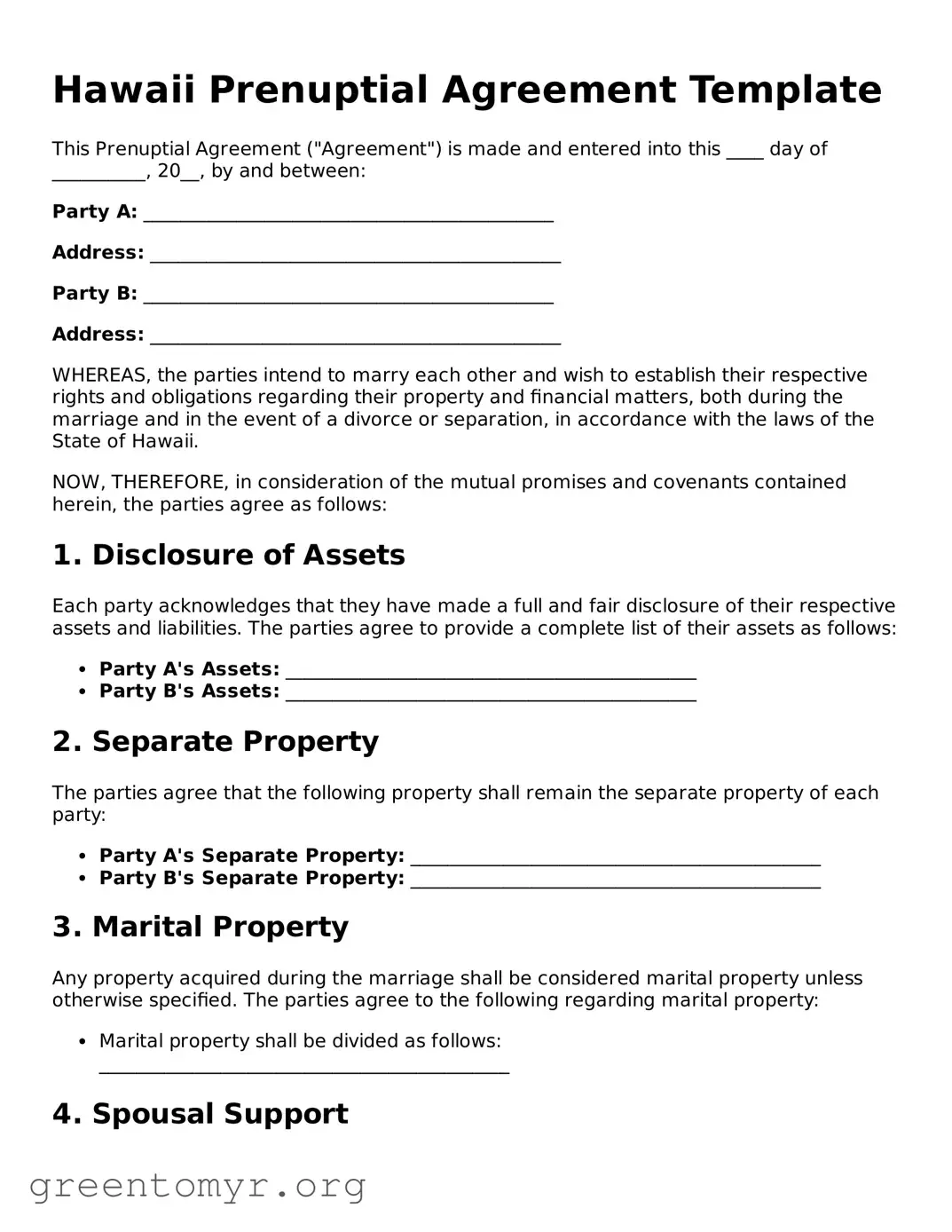
Hawaii Prenuptial Agreement Template
This Prenuptial Agreement ("Agreement") is made and entered into this ____ day of __________, 20__, by and between:
Party A: ____________________________________________
Address: ____________________________________________
Party B: ____________________________________________
Address: ____________________________________________
WHEREAS, the parties intend to marry each other and wish to establish their respective rights and obligations regarding their property and financial matters, both during the marriage and in the event of a divorce or separation, in accordance with the laws of the State of Hawaii.
NOW, THEREFORE, in consideration of the mutual promises and covenants contained herein, the parties agree as follows:
1. Disclosure of Assets
Each party acknowledges that they have made a full and fair disclosure of their respective assets and liabilities. The parties agree to provide a complete list of their assets as follows:
2. Separate Property
The parties agree that the following property shall remain the separate property of each party:
3. Marital Property
Any property acquired during the marriage shall be considered marital property unless otherwise specified. The parties agree to the following regarding marital property:
4. Spousal Support
The parties agree on the following terms regarding spousal support in the event of divorce:
5. Governing Law
This Agreement shall be governed by and construed in accordance with the laws of the State of Hawaii.
6. Amendments
This Agreement may only be amended or modified by a written agreement signed by both parties.
7. Severability
If any provision of this Agreement is found to be unenforceable or invalid, the remaining provisions shall continue in full force and effect.
IN WITNESS WHEREOF, the parties have executed this Prenuptial Agreement as of the day and year first above written.
Party A Signature: ___________________________ Date: ________________
Party B Signature: ___________________________ Date: ________________
Witness Signature: ___________________________ Date: ________________
| Fact Name | Description |
|---|---|
| Governing Law | The Hawaii Prenuptial Agreement is governed by Hawaii Revised Statutes, Chapter 572B. |
| Definition | A prenuptial agreement is a contract between two individuals before marriage that outlines the division of assets and responsibilities in the event of divorce or separation. |
| Enforceability | To be enforceable, the agreement must be in writing and signed by both parties. |
| Full Disclosure | Both parties are required to fully disclose their financial situations, including assets and debts, for the agreement to be valid. |
| Legal Representation | It is highly recommended that both parties seek independent legal advice to ensure that their rights are protected. |
| Modification | The agreement can be modified or revoked at any time, provided both parties agree to the changes in writing. |
| Judicial Review | A court may review the agreement for fairness and may refuse to enforce it if it finds it to be unconscionable. |
| Effective Date | The prenup typically becomes effective upon marriage, but it can include provisions for other events as agreed by both parties. |
Filling out the Hawaii Prenuptial Agreement form is an important step for couples considering marriage. This document outlines the financial rights and responsibilities of each party in the event of a divorce or separation. It is essential to complete the form accurately to ensure that both parties are protected and their wishes are clearly stated.
A Hawaii Prenuptial Agreement is a legal document that couples create before getting married. It outlines how assets and debts will be divided in the event of divorce or separation. This agreement helps clarify financial rights and responsibilities, providing both parties with a clear understanding of their financial situation. It can cover various topics, including property ownership, spousal support, and management of debts.
There are several reasons to consider a prenuptial agreement:
For a prenuptial agreement to be valid in Hawaii, it must meet several requirements:
Yes, a prenuptial agreement can be modified or revoked after marriage. Both parties must agree to any changes, and the new terms should be documented in writing and signed by both individuals. It’s advisable to consult with a legal professional to ensure that the modifications comply with state laws and are enforceable.
Filling out a prenuptial agreement form in Hawaii can be a straightforward process, but several common mistakes can complicate matters. One frequent error is failing to provide complete and accurate information about assets and debts. It is crucial for both parties to fully disclose their financial situations. Incomplete information can lead to disputes later on.
Another common mistake is not seeking independent legal advice. Each party should have their own attorney review the agreement. This ensures that both individuals understand their rights and obligations. Relying solely on one attorney can create conflicts of interest and may leave one party at a disadvantage.
People often overlook the importance of clarity in the language of the agreement. Ambiguous terms can lead to confusion and misinterpretation. Clear definitions of key terms and conditions help avoid misunderstandings down the line. It is essential to use straightforward language to express intentions clearly.
Additionally, some individuals may not consider the implications of changing circumstances. A prenuptial agreement should account for potential future changes, such as the birth of children or significant changes in income. Failing to include provisions for these scenarios can render the agreement less effective.
Another mistake is neglecting to review and update the agreement periodically. Life circumstances change, and so should the prenuptial agreement. Regular reviews ensure that the document remains relevant and reflects the current financial situation and intentions of both parties.
Many people also forget to sign the agreement in front of witnesses. In Hawaii, having witnesses can add an extra layer of validity to the document. Not adhering to this requirement may lead to challenges in enforcing the agreement later.
Additionally, some individuals may rush through the process without fully understanding the implications of the agreement. Taking the time to carefully consider the terms and their consequences is essential. A rushed approach can lead to regret and disputes in the future.
Another mistake is failing to address spousal support provisions adequately. Many prenuptial agreements include terms regarding alimony or spousal support, but these terms must be clearly defined. Vague language can lead to complications if the marriage ends.
Lastly, individuals sometimes underestimate the importance of notarization. While notarization may not be legally required, it can provide an additional layer of authenticity and help prevent future disputes regarding the agreement's validity.
When preparing for marriage, many couples consider a prenuptial agreement to clarify financial expectations and protect individual assets. However, this document often goes hand in hand with several other important forms and agreements. Here’s a brief overview of four common documents that are frequently used alongside a Hawaii Prenuptial Agreement.
Understanding these documents can empower couples to make informed decisions about their financial futures. Each form serves a unique purpose and can help clarify expectations, ultimately fostering a healthier relationship built on transparency and mutual respect.
Postnuptial Agreement: Similar to a prenuptial agreement, a postnuptial agreement is created after a couple gets married. Both documents outline the division of assets and responsibilities in the event of a divorce. The key difference lies in the timing of their creation.
Separation Agreement: A separation agreement is used when a couple decides to live apart. This document details how they will handle their finances, property, and responsibilities during the separation. Like a prenuptial agreement, it aims to clarify expectations and protect both parties.
Divorce Settlement Agreement: This document is created during the divorce process. It outlines how assets and debts will be divided. While a prenuptial agreement is made before marriage, a divorce settlement agreement is focused on resolving matters after the marriage has ended.
Living Together Agreement: Often used by couples who choose to cohabitate without marrying, this agreement addresses similar concerns about asset division and responsibilities. It provides clarity and protection, much like a prenuptial agreement does for married couples.
Will: While a will primarily deals with the distribution of assets after death, it shares similarities with a prenuptial agreement in that both documents require careful consideration of how assets will be managed and distributed. They reflect the individual’s intentions regarding their property.
When filling out the Hawaii Prenuptial Agreement form, it's important to be careful and thorough. Here are some things to keep in mind:
Many people have misconceptions about prenuptial agreements, especially when it comes to the Hawaii Prenuptial Agreement form. Understanding these myths can help couples make informed decisions. Here are eight common misconceptions:
This is a common belief, but prenuptial agreements can benefit anyone. They provide clarity about financial matters, regardless of income level.
While discussing finances before marriage might feel awkward, a prenuptial agreement can actually strengthen a relationship by encouraging open communication.
In Hawaii, prenuptial agreements must be in writing and signed by both parties, but notarization is not strictly required. However, having a notary can help avoid disputes later.
This is a misconception. Courts typically do not enforce provisions regarding child custody and support in prenuptial agreements, as these matters are decided based on the best interests of the child.
This is not true. Couples can modify or revoke a prenuptial agreement at any time, provided both parties agree to the changes in writing.
While they do address divorce, prenuptial agreements can also clarify financial responsibilities during marriage, helping couples navigate their finances more effectively.
In Hawaii, prenuptial agreements are enforceable as long as they meet certain legal requirements. Courts generally uphold them unless there is evidence of coercion or unfairness.
While legal assistance can help, many couples find that creating a prenuptial agreement is a straightforward process. It can be a worthwhile investment in future peace of mind.
By dispelling these misconceptions, couples can approach prenuptial agreements with a clearer understanding of their benefits and importance.
When considering a prenuptial agreement in Hawaii, it’s important to understand the essential aspects of the process. Here are ten key takeaways to keep in mind:
Understanding these key points can help ensure that the process of creating and using a prenuptial agreement in Hawaii is smooth and beneficial for both parties.