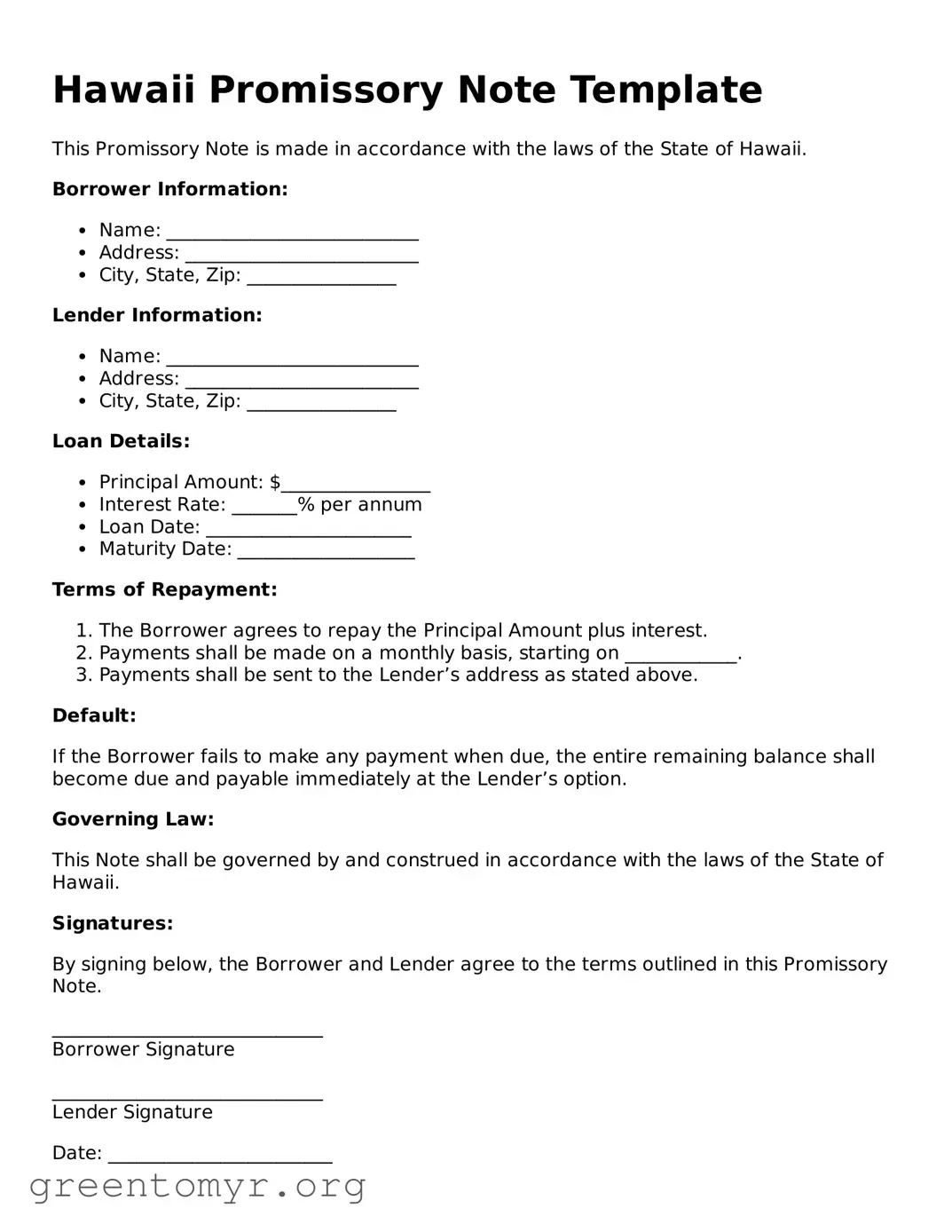
When engaging in financial transactions, particularly those involving loans, a clear and legally binding agreement is essential. In Hawaii, the Promissory Note form serves as a vital tool for individuals and businesses alike, outlining the terms under which money is borrowed and the conditions for repayment. This form typically includes critical details such as the principal amount, interest rate, payment schedule, and any applicable late fees. It also specifies the rights and responsibilities of both the borrower and the lender, ensuring that each party understands their obligations. By establishing these parameters, the Promissory Note not only protects the lender’s investment but also provides the borrower with a structured repayment plan, fostering transparency and accountability in financial dealings. Understanding the nuances of this form can empower individuals to navigate their financial commitments with confidence, making it a fundamental aspect of responsible borrowing in the Aloha State.
Hawaii Promissory Note Template
This Promissory Note is made in accordance with the laws of the State of Hawaii.
Borrower Information:
Lender Information:
Loan Details:
Terms of Repayment:
Default:
If the Borrower fails to make any payment when due, the entire remaining balance shall become due and payable immediately at the Lender’s option.
Governing Law:
This Note shall be governed by and construed in accordance with the laws of the State of Hawaii.
Signatures:
By signing below, the Borrower and Lender agree to the terms outlined in this Promissory Note.
_____________________________
Borrower Signature
_____________________________
Lender Signature
Date: ________________________
| Fact Name | Description |
|---|---|
| Definition | A Hawaii Promissory Note is a written promise to pay a specific amount of money to a designated person or entity at a specified time. |
| Governing Law | The Hawaii Promissory Note is governed by Hawaii Revised Statutes, Chapter 490, which covers the Uniform Commercial Code. |
| Requirements | The note must include the amount to be paid, the interest rate (if any), the payment schedule, and the signatures of the parties involved. |
| Types | Promissory notes can be secured or unsecured, depending on whether collateral is involved. |
| Enforceability | A properly executed promissory note is legally enforceable in a court of law, provided it meets all state requirements. |
| Default Consequences | If the borrower defaults, the lender has the right to pursue legal action to recover the owed amount. |
After obtaining the Hawaii Promissory Note form, it is important to complete it accurately to ensure clarity and enforceability. Following the steps below will guide you through the process of filling out the form correctly.
A Hawaii Promissory Note is a written agreement where one party promises to pay a specific amount of money to another party at a defined time. This document outlines the terms of the loan, including the interest rate, payment schedule, and any penalties for late payments.
Individuals and businesses often use a Promissory Note. For example, a person might use it when lending money to a friend or family member. Similarly, businesses may issue Promissory Notes when borrowing funds from banks or private lenders.
A typical Promissory Note includes the following information:
Yes, a properly executed Promissory Note is legally binding in Hawaii. Both parties must agree to the terms, and the document should be signed and dated. This ensures that the agreement is enforceable in a court of law if necessary.
Notarization is not required for a Promissory Note to be valid in Hawaii. However, having the document notarized can provide additional legal protection and help verify the identities of the parties involved.
If the borrower does not repay the loan as agreed, the lender may take legal action. This could include filing a lawsuit to recover the owed amount. The specific consequences depend on the terms outlined in the Promissory Note.
Yes, a Promissory Note can be modified if both parties agree to the changes. It is advisable to document any modifications in writing and have both parties sign the updated agreement to ensure clarity and avoid future disputes.
You can find a Hawaii Promissory Note form online through various legal document websites. Additionally, local legal offices or libraries may have templates available. It’s important to ensure that the form complies with Hawaii laws.
When filling out the Hawaii Promissory Note form, individuals often overlook critical details that can lead to complications down the line. One common mistake is failing to accurately state the loan amount. The amount should be clear and precise. If it is written incorrectly, it could lead to disputes about how much is owed. Always double-check the figures before finalizing the document.
Another frequent error involves the interest rate. Some people neglect to include this essential detail or miscalculate it. An interest rate that is too high or too low can create confusion and may not comply with state regulations. It's vital to ensure that the interest rate is clearly stated and aligns with Hawaii's legal limits.
Additionally, signatories often forget to include the date of the agreement. This date is crucial as it marks the beginning of the loan period. Without it, the terms of repayment may become ambiguous. Both parties should ensure that the date is clearly indicated to avoid any misunderstandings.
Finally, many individuals overlook the importance of signatures. Both the borrower and lender must sign the document for it to be legally binding. Failing to obtain the necessary signatures can render the agreement void. Therefore, it is essential to confirm that all required parties have signed the form before it is submitted.
When entering into a financial agreement in Hawaii, a Promissory Note is often accompanied by various other documents. Each of these documents serves a specific purpose and helps clarify the terms of the agreement between the parties involved. Below is a list of common forms and documents that are frequently used alongside a Hawaii Promissory Note.
Understanding these documents can help ensure that both parties are clear on their rights and responsibilities. It is advisable to review each document carefully and consider seeking professional guidance if needed.
When filling out the Hawaii Promissory Note form, it's important to follow certain guidelines to ensure accuracy and compliance. Here are some things you should and shouldn't do:
Following these guidelines will help ensure that your Promissory Note is completed correctly and will be accepted without issues.
When it comes to the Hawaii Promissory Note form, several misconceptions often arise. Understanding these can help individuals navigate the complexities of financial agreements more effectively. Here are seven common misconceptions:
This is not true. While the basic concept of a promissory note is similar, each state has its own requirements and formats. The Hawaii Promissory Note form has specific provisions that cater to local laws.
While verbal agreements can be binding, a written promissory note provides clear evidence of the terms. In Hawaii, having a written note is crucial for enforceability.
This is a misconception. Individuals can also create promissory notes for personal loans. The key is that both parties agree to the terms.
Promissory notes can be used for any amount, large or small. They are a flexible tool for various lending situations.
In fact, parties can amend the terms of a promissory note, but this must be done in writing and agreed upon by both parties.
While a promissory note is a promise to pay, it does not guarantee that the borrower will repay the loan. It serves as a legal document outlining the obligation.
While legal action is an option if a borrower defaults, many disputes can be resolved through negotiation or mediation, which can be less costly and time-consuming.
By clearing up these misconceptions, individuals can make more informed decisions regarding their financial agreements in Hawaii.
Filling out and using a Hawaii Promissory Note form requires careful attention to detail. Here are some key takeaways to keep in mind:
Understanding these key elements can help ensure that the promissory note is filled out correctly and serves its intended purpose effectively.