Content Navigation

The Hawaii Quitclaim Deed form serves as a vital legal instrument for property owners looking to transfer their interests in real estate without making any warranties regarding the title. This type of deed is particularly useful in situations where the transferor may not hold a clear title or when the parties involved have a level of trust that negates the need for extensive assurances. Typically, the form includes essential details such as the names of the grantor and grantee, a description of the property being transferred, and the date of the transaction. It is important to note that while a quitclaim deed can facilitate a swift transfer of property rights, it does not protect the grantee against potential claims or liens on the property. In Hawaii, the execution of this deed requires adherence to specific state laws, including notarization and proper recording with the Bureau of Conveyances to ensure the transfer is legally recognized. Understanding the nuances of this form can help individuals navigate property transfers more effectively, whether in familial situations, divorce settlements, or other personal arrangements.

Hawaii Quitclaim Deed Example

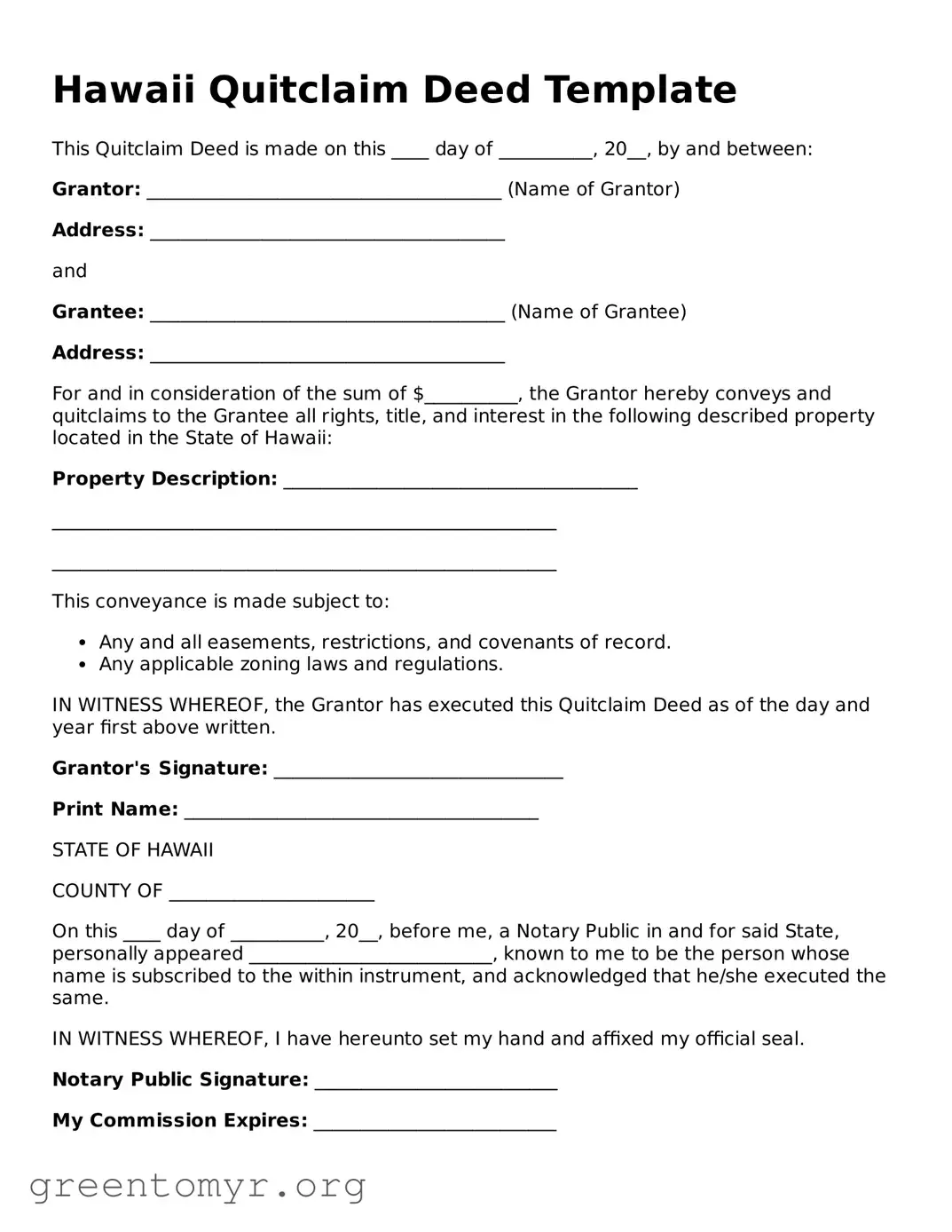
Hawaii Quitclaim Deed Template

This Quitclaim Deed is made on this ____ day of __________, 20__, by and between:

Grantor: ______________________________________ (Name of Grantor)

Address: ______________________________________

and

Grantee: ______________________________________ (Name of Grantee)

Address: ______________________________________

For and in consideration of the sum of $__________, the Grantor hereby conveys and quitclaims to the Grantee all rights, title, and interest in the following described property located in the State of Hawaii:

Property Description: ______________________________________

______________________________________________________

______________________________________________________

This conveyance is made subject to:

  • Any and all easements, restrictions, and covenants of record.
  • Any applicable zoning laws and regulations.

IN WITNESS WHEREOF, the Grantor has executed this Quitclaim Deed as of the day and year first above written.

Grantor's Signature: _______________________________

Print Name: ______________________________________

STATE OF HAWAII

COUNTY OF ______________________

On this ____ day of __________, 20__, before me, a Notary Public in and for said State, personally appeared __________________________, known to me to be the person whose name is subscribed to the within instrument, and acknowledged that he/she executed the same.

IN WITNESS WHEREOF, I have hereunto set my hand and affixed my official seal.

Notary Public Signature: __________________________

My Commission Expires: __________________________

PDF Form Features

Fact Name Description
Purpose A Hawaii Quitclaim Deed transfers ownership of property from one party to another without guaranteeing the title's validity.
Governing Law This deed is governed by Hawaii Revised Statutes, Chapter 501.
Requirements The form must be signed by the grantor and notarized to be legally effective.
Filing After signing, the deed must be recorded with the Bureau of Conveyances in Hawaii.

Guide to Using Hawaii Quitclaim Deed

After you have completed the Hawaii Quitclaim Deed form, you will need to ensure that it is signed and notarized before submitting it to the appropriate county office for recording. This step is crucial for the document to be legally recognized and to protect your interests.

  1. Obtain the Hawaii Quitclaim Deed form. This can typically be found online or at a local office supply store.
  2. Begin by filling in the date at the top of the form. This should reflect the date you are completing the deed.
  3. Next, provide the name and address of the grantor, which is the person transferring the property. Make sure to include their full legal name.
  4. Fill in the name and address of the grantee, the person receiving the property. Again, use their full legal name.
  5. Describe the property being transferred. Include the property’s address and any relevant legal description, such as the parcel number or lot number.
  6. Indicate the consideration, or the amount paid for the property. If no payment is made, you can write "love and affection" or "nominal" as appropriate.
  7. Sign the form in the designated area. The grantor must sign the document in front of a notary public.
  8. Have the document notarized. The notary will verify your identity and witness your signature.
  9. Make copies of the completed and notarized Quitclaim Deed for your records.
  10. Submit the original Quitclaim Deed to the appropriate county office for recording. This step often requires a small fee.

Get Answers on Hawaii Quitclaim Deed

What is a Quitclaim Deed?

A quitclaim deed is a legal document used to transfer ownership of real estate from one person to another. Unlike other types of deeds, a quitclaim deed does not guarantee that the person transferring the property has clear title to it. Essentially, it conveys whatever interest the grantor has in the property, if any.

When should I use a Quitclaim Deed?

You might consider using a quitclaim deed in several situations, such as:

  • Transferring property between family members.
  • Adding or removing a spouse from the title after marriage or divorce.
  • Transferring property into a trust.
  • Clearing up title issues when the ownership is unclear.

How do I complete a Quitclaim Deed in Hawaii?

To complete a quitclaim deed in Hawaii, follow these steps:

  1. Obtain the quitclaim deed form. You can find it online or at a local legal stationery store.
  2. Fill in the names of the grantor (the person giving up the property) and the grantee (the person receiving the property).
  3. Include a description of the property being transferred, such as its address or legal description.
  4. Sign the form in front of a notary public.
  5. File the completed deed with the county recorder's office where the property is located.

Do I need a lawyer to create a Quitclaim Deed?

While it's not legally required to have a lawyer, consulting one is often a good idea. A lawyer can help ensure that the deed is filled out correctly and that you understand the implications of transferring property. This is especially important if there are potential disputes or complications involved.

Is a Quitclaim Deed the same as a Warranty Deed?

No, a quitclaim deed and a warranty deed are different. A warranty deed provides a guarantee that the grantor holds clear title to the property and has the right to transfer it. In contrast, a quitclaim deed offers no such assurances. It simply transfers whatever interest the grantor may have, if any.

Are there any tax implications when using a Quitclaim Deed?

Generally, transferring property via a quitclaim deed may not trigger immediate tax consequences. However, it’s essential to consult a tax professional to understand any potential implications, especially if the property has appreciated in value or if there are other factors at play.

Can a Quitclaim Deed be revoked?

Once a quitclaim deed is executed and recorded, it cannot be revoked unilaterally. However, the grantor can create a new deed to transfer the property back, but this would require the consent of both parties involved. Always consult with a legal professional for guidance in such situations.

How do I find a Quitclaim Deed form for Hawaii?

You can find a quitclaim deed form for Hawaii through various sources, including:

  • The official Hawaii state government website.
  • Local county recorder's office.
  • Legal stationery stores.
  • Online legal services that provide downloadable forms.

Common mistakes

Completing a Hawaii Quitclaim Deed form can be straightforward, but several common mistakes can lead to complications. One frequent error is not including the correct legal description of the property. The legal description must accurately reflect the property boundaries and characteristics. Omitting or misrepresenting this information can result in disputes or challenges to the deed's validity.

Another mistake is failing to properly identify the parties involved. The grantor (the person transferring the property) and the grantee (the person receiving the property) must be clearly identified. If names are misspelled or incomplete, it could create confusion and potentially invalidate the deed.

Signatures are crucial on the Quitclaim Deed form. A common oversight is neglecting to obtain the necessary signatures. The grantor must sign the deed, and in some cases, the grantee's signature may also be required. Without these signatures, the deed cannot be executed legally.

Many individuals forget to have the deed notarized. In Hawaii, a Quitclaim Deed must be notarized to be valid. Failing to have the document notarized can lead to issues when trying to record the deed with the county.

Another error involves not including the date of execution. The date indicates when the deed was signed. Leaving this field blank can create confusion regarding when the transfer of ownership actually took place.

People often overlook the recording requirements. After completing the Quitclaim Deed, it must be filed with the appropriate county office. Failing to record the deed can leave the property transfer unprotected, making it difficult to prove ownership in the future.

Additionally, individuals sometimes do not consider tax implications. Transferring property through a Quitclaim Deed may have tax consequences that should be understood beforehand. Ignoring these implications can lead to unexpected financial liabilities.

Lastly, some people do not seek legal advice when needed. While it is possible to fill out a Quitclaim Deed independently, consulting with a legal professional can help avoid mistakes and ensure that the deed complies with all relevant laws and regulations.

Documents used along the form

A Hawaii Quitclaim Deed is a legal document used to transfer ownership of real property from one party to another. When completing this process, several other forms and documents may be needed to ensure a smooth transfer. Below is a list of commonly used forms that often accompany the Quitclaim Deed.

  • Title Search Report: This document provides information about the property’s ownership history and any liens or encumbrances that may exist. It helps the parties understand the current status of the title before the transfer occurs.
  • Property Transfer Tax Declaration: This form is required by the state to report the sale price of the property and calculate any applicable transfer taxes. It must be submitted along with the Quitclaim Deed to the county.
  • Affidavit of Value: This affidavit confirms the fair market value of the property being transferred. It may be necessary for tax purposes and helps establish the basis for any future tax assessments.
  • Notice of Transfer: This document informs the local tax authority of the change in ownership. It ensures that tax records are updated to reflect the new owner’s information.
  • Power of Attorney: If the property owner is unable to sign the Quitclaim Deed in person, a Power of Attorney may be needed. This document grants another individual the authority to act on behalf of the owner in the property transfer.
  • Escrow Agreement: In some transactions, an escrow agreement may be used to outline the terms of the sale and the responsibilities of each party. This document helps facilitate a smooth transfer and ensures that all conditions are met before finalizing the transaction.

These documents play an essential role in the property transfer process in Hawaii. Ensuring that all necessary forms are completed and submitted can help avoid delays and complications during the transfer of ownership.

Similar forms

A Quitclaim Deed is a legal document used to transfer ownership of real property. It is often compared to several other documents that serve similar purposes in real estate transactions. Below is a list of nine documents that share similarities with a Quitclaim Deed:

  • Warranty Deed: This document provides a guarantee that the seller has clear title to the property and the right to sell it. Unlike a Quitclaim Deed, a Warranty Deed offers protection to the buyer against future claims on the property.
  • Grant Deed: A Grant Deed also transfers property ownership, but it includes assurances that the property has not been sold to anyone else and is free from undisclosed encumbrances. This is a step up in security compared to a Quitclaim Deed.
  • Special Warranty Deed: This document is similar to a Warranty Deed, but it only guarantees the title for the period during which the seller owned the property. It provides less protection than a full Warranty Deed but more than a Quitclaim Deed.
  • Deed of Trust: This document secures a loan with real property. While it does not transfer ownership outright, it is used in transactions involving mortgages, making it a crucial part of property financing.
  • Lease Agreement: Though primarily a rental contract, a Lease Agreement can grant certain rights to use the property, similar to how a Quitclaim Deed transfers ownership rights, albeit temporarily.
  • Life Estate Deed: This document allows a person to transfer property to another while retaining the right to live in it for their lifetime. Like a Quitclaim Deed, it involves a change in ownership but maintains certain rights for the grantor.
  • Affidavit of Heirship: Used in situations where a property owner has passed away, this document helps establish the heirs' rights to the property. It serves a similar purpose to a Quitclaim Deed in transferring ownership without a formal probate process.
  • Power of Attorney: While not a deed, a Power of Attorney allows someone to act on behalf of another in real estate transactions. It can facilitate the transfer of property rights, similar to a Quitclaim Deed.
  • Bill of Sale: This document is used to transfer ownership of personal property, including fixtures attached to real estate. While it does not pertain to real property directly, it serves a similar function in transferring ownership rights.

Dos and Don'ts

When filling out the Hawaii Quitclaim Deed form, it is important to follow specific guidelines to ensure accuracy and compliance. Here is a list of things you should and shouldn't do:

  • Do ensure that all names are spelled correctly.
  • Do provide a clear description of the property being transferred.
  • Do include the date of the transfer.
  • Do sign the form in the presence of a notary public.
  • Do check that the form is filled out completely before submission.
  • Don't leave any blank spaces on the form.
  • Don't forget to include any required fees for recording the deed.
  • Don't use abbreviations for names or property descriptions.
  • Don't forget to provide your contact information.
  • Don't assume the form is valid without proper notarization.

By following these guidelines, you can help ensure that your Quitclaim Deed is processed smoothly and correctly.

Misconceptions

When it comes to the Hawaii Quitclaim Deed form, there are several misconceptions that can lead to confusion. Here are ten common misunderstandings:

  1. It transfers ownership completely. Many believe that a quitclaim deed transfers full ownership rights. In reality, it transfers whatever interest the grantor has in the property, which may not be complete.
  2. It guarantees a clear title. A quitclaim deed does not guarantee that the title is free of liens or other claims. The buyer should conduct a title search to ensure there are no issues.
  3. It is only used between family members. While often used among family, quitclaim deeds can be utilized in various situations, including sales and transfers between unrelated parties.
  4. It is the same as a warranty deed. Unlike a warranty deed, which provides guarantees about the title, a quitclaim deed offers no such assurances. It simply conveys the interest held by the grantor.
  5. It must be notarized to be valid. Although notarization is highly recommended for the deed to be accepted by the county, it is not a legal requirement for the deed to be valid.
  6. It can be used to remove someone from a title. A quitclaim deed can transfer interest, but it does not automatically remove someone from the title. Legal advice may be necessary to ensure proper removal.
  7. It is a complicated legal document. The quitclaim deed is relatively straightforward. It typically requires basic information about the parties involved and the property.
  8. It can be used for all property types. Quitclaim deeds are commonly used for real estate but may not be appropriate for all types of property transfers. Always check local regulations.
  9. It is only valid in Hawaii. Quitclaim deeds are used across the United States, though the specific requirements and implications can vary by state.
  10. Once signed, it cannot be revoked. A quitclaim deed can be revoked, but the process may involve additional legal steps. It's important to consult with a professional for guidance.

Understanding these misconceptions can help individuals navigate property transfers more effectively and make informed decisions regarding quitclaim deeds in Hawaii.

Key takeaways

When filling out and using the Hawaii Quitclaim Deed form, it is essential to understand its purpose and the steps involved. Here are some key takeaways to keep in mind:

  • The Quitclaim Deed is used to transfer ownership of real property from one party to another without guaranteeing that the title is clear.
  • Ensure that all parties involved in the transaction are clearly identified on the form, including full names and addresses.
  • Include a legal description of the property being transferred. This description should be precise to avoid any confusion in the future.
  • The form must be signed by the grantor (the person transferring the property) in the presence of a notary public.
  • Once completed, the Quitclaim Deed should be filed with the Bureau of Conveyances in Hawaii to make the transfer official.
  • It is advisable to consult with a legal professional if there are any uncertainties about the process or the implications of the deed.