In the beautiful state of Hawaii, managing the affairs of a loved one who has passed away can be a daunting task, especially when it comes to settling their estate. For families dealing with the loss of a relative, the Hawaii Small Estate Affidavit form offers a streamlined and efficient way to transfer assets without the need for formal probate proceedings. This form is particularly beneficial for estates that fall below a certain value threshold, allowing heirs to access the deceased's property, bank accounts, and other assets with relative ease. By using the Small Estate Affidavit, individuals can affirm their relationship to the deceased and their entitlement to the assets in question. The process is designed to be straightforward, requiring only basic information about the deceased, the heirs, and the assets involved. Additionally, the form must be signed under oath, ensuring that the information provided is accurate and truthful. Understanding the nuances of this affidavit can significantly alleviate the stress associated with settling a small estate, allowing families to focus on healing and remembrance during a difficult time.
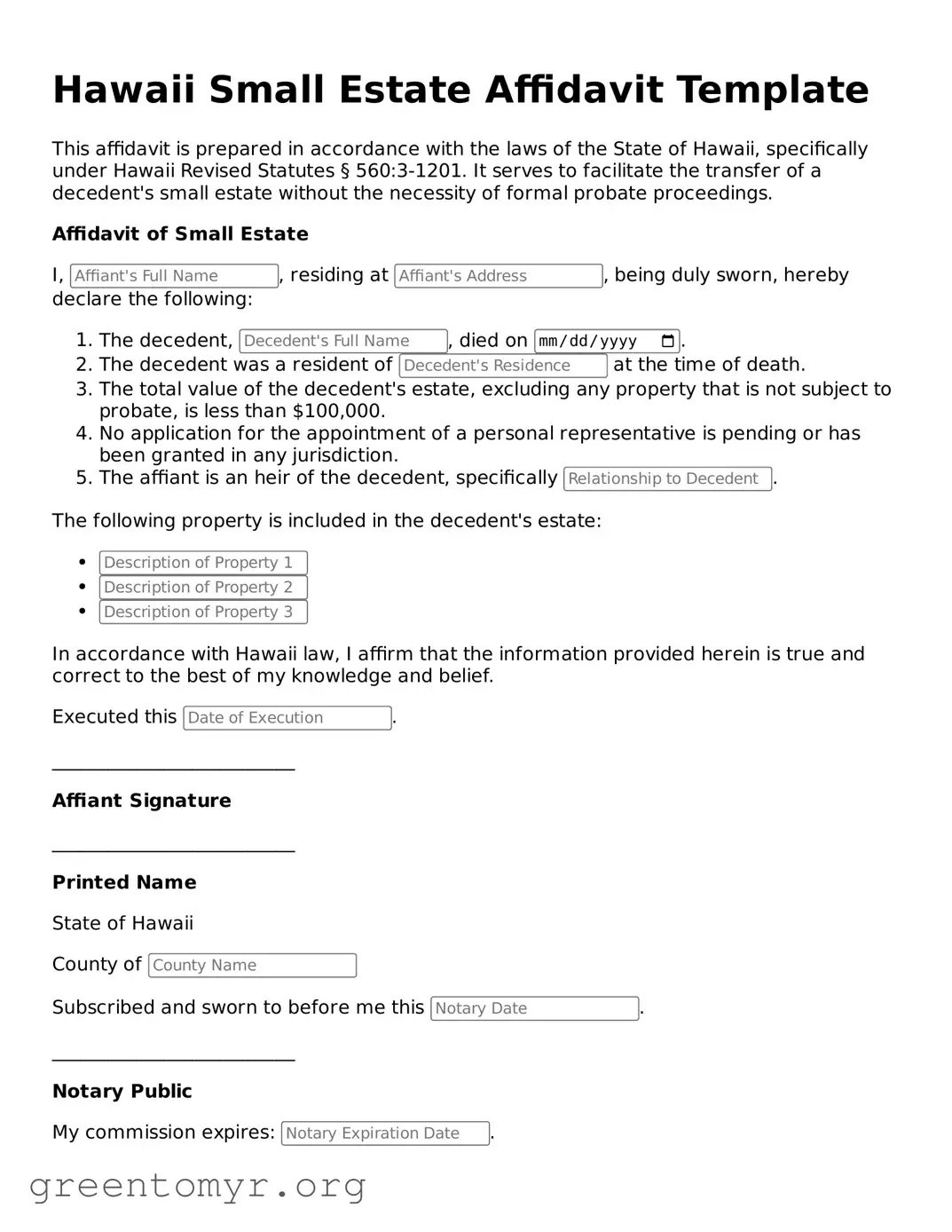
Hawaii Small Estate Affidavit Template
This affidavit is prepared in accordance with the laws of the State of Hawaii, specifically under Hawaii Revised Statutes § 560:3-1201. It serves to facilitate the transfer of a decedent's small estate without the necessity of formal probate proceedings.
Affidavit of Small Estate
I, , residing at , being duly sworn, hereby declare the following:
The following property is included in the decedent's estate:
In accordance with Hawaii law, I affirm that the information provided herein is true and correct to the best of my knowledge and belief.
Executed this .
__________________________
Affiant Signature
__________________________
Printed Name
State of Hawaii
County of
Subscribed and sworn to before me this .
__________________________
Notary Public
My commission expires: .
| Fact Name | Description |
|---|---|
| Purpose | The Hawaii Small Estate Affidavit allows individuals to claim the assets of a deceased person without going through formal probate, provided the estate meets certain criteria. |
| Eligibility | To use this affidavit, the total value of the estate must not exceed $100,000, excluding real property. |
| Governing Law | The use of the Small Estate Affidavit in Hawaii is governed by Hawaii Revised Statutes § 560:3-1201. |
| Required Information | The affidavit must include details such as the decedent's name, date of death, and a list of assets being claimed. |
| Filing Process | The completed affidavit should be filed with the relevant financial institutions or asset holders to transfer the assets to the heirs. |
| Timeframe | Heirs can typically access the assets more quickly than through formal probate, often within a few weeks of filing the affidavit. |
After gathering the necessary documents and information, you are ready to fill out the Hawaii Small Estate Affidavit form. This process will help you declare the assets of a deceased person without going through a lengthy probate process. Follow these steps carefully to ensure everything is completed correctly.
After submitting the form, you may need to wait for a response from the court. Keep an eye on any correspondence, as you may be required to provide additional information or documentation.
The Hawaii Small Estate Affidavit is a legal document that allows individuals to claim assets of a deceased person without going through the formal probate process. This form is typically used when the total value of the estate is below a certain threshold, making the process simpler and more efficient for heirs.
Generally, any individual who is a beneficiary or heir to the estate can use the Small Estate Affidavit. This includes spouses, children, parents, and siblings of the deceased. It is essential that the person filing the affidavit has a legitimate claim to the estate's assets.
In Hawaii, the total value of the estate must be less than $100,000 to qualify for the Small Estate Affidavit. This limit applies to the gross value of all assets, excluding certain types of property such as real estate and assets held in a trust.
To complete the Small Estate Affidavit, follow these steps:
No, you do not need to file the Small Estate Affidavit with the court. Instead, the affidavit is presented directly to the institutions or individuals that hold the deceased's assets. However, keeping a copy for your records is advisable.
The Small Estate Affidavit can be used to claim various types of assets, including:
However, it cannot be used for real estate or assets held in a trust.
There is no specific deadline for filing the Small Estate Affidavit. However, it is recommended to complete the process promptly to ensure that the estate's assets are distributed in a timely manner. Delays could complicate matters or lead to additional legal issues.
If the estate exceeds the $100,000 limit, the Small Estate Affidavit cannot be used. In this case, the estate will likely need to go through the formal probate process, which can be more complex and time-consuming. Consulting with a legal expert in estate matters is advisable in such situations.
Yes, multiple heirs can file a Small Estate Affidavit, but they must agree on how to divide the assets. Each heir can submit a separate affidavit, or they can file a joint affidavit detailing how the assets will be shared among them.
If the deceased had debts, those debts must be settled before distributing any assets to heirs. The Small Estate Affidavit does not absolve the estate from its obligations. It is crucial to address any outstanding debts to avoid potential legal issues in the future.
Filling out the Hawaii Small Estate Affidavit form can seem straightforward, but many individuals make common mistakes that can lead to delays or complications in the process. One of the most frequent errors is failing to provide accurate information about the deceased. It’s essential to ensure that the name, date of birth, and date of death are correct. Any discrepancies can raise questions and potentially invalidate the affidavit.
Another mistake involves misunderstanding the eligibility criteria for using the Small Estate Affidavit. In Hawaii, the estate must not exceed a certain value, and it’s crucial to know this threshold. If the total value of the estate exceeds the limit, you may need to pursue a different legal process, such as probate. Ignoring this can lead to wasted time and resources.
People often overlook the importance of signatures. The affidavit must be signed by all heirs or beneficiaries. If even one signature is missing, the document may be deemed incomplete. It’s not just about filling out the form; it’s about ensuring that everyone entitled to the estate agrees and has put their name on the line.
Additionally, many individuals forget to include supporting documents. The Small Estate Affidavit typically requires attachments such as a death certificate and a list of assets. Without these documents, the affidavit may be rejected, causing frustration and delays in settling the estate.
Another common pitfall is neglecting to check for the correct notarization. The affidavit must be notarized to be considered valid. If the document is not properly notarized, it can create significant hurdles in the estate settlement process. Always ensure that a notary public has witnessed the signing.
Finally, many individuals fail to keep copies of the completed affidavit and any submitted documents. Having a record of what was filed is crucial, as it can help in case of disputes or if further action is needed later. Keeping organized records can save time and stress down the line.
When dealing with the Hawaii Small Estate Affidavit, there are a few other forms and documents that may be necessary to ensure a smooth process. Each of these documents plays a role in clarifying the estate's distribution and the authority of the individuals involved. Here’s a brief overview of those documents:
Having these documents prepared and organized will help streamline the process of settling the estate. It’s always a good idea to ensure everything is in order to avoid delays and complications.
When filling out the Hawaii Small Estate Affidavit form, it is important to approach the process with care and attention to detail. Below are some essential dos and don’ts to consider.
By adhering to these guidelines, individuals can navigate the process more smoothly and honor the memory of their loved ones with respect and diligence.
Understanding the Hawaii Small Estate Affidavit can be crucial for families navigating the complexities of estate management. Unfortunately, several misconceptions often cloud this process. Here are nine common misunderstandings about the Small Estate Affidavit form:
Being informed about these misconceptions can empower individuals to make better decisions regarding estate management in Hawaii. Understanding the Small Estate Affidavit is essential for a smoother transition during a challenging time.
When dealing with the Hawaii Small Estate Affidavit form, there are several important considerations to keep in mind. This form can simplify the process of transferring assets when someone passes away, particularly for smaller estates. Here are key takeaways to guide you through the process:
Understanding these key points can help ease the burden during a difficult time, ensuring that the estate is handled in accordance with the wishes of the deceased.