In the beautiful state of Hawaii, planning for the future often involves thoughtful decisions about property and assets. One useful tool that has gained attention is the Transfer-on-Death Deed (TODD). This legal document allows property owners to designate a beneficiary who will receive their real estate upon their death, bypassing the often lengthy and costly probate process. The TODD is particularly appealing because it enables individuals to maintain control over their property during their lifetime while ensuring a smooth transition to their chosen heirs. Importantly, the form must be properly executed and recorded to be effective, which includes providing clear identification of the property and the beneficiaries. Furthermore, the TODD can be revoked or altered at any time before the owner's passing, offering flexibility to adapt to changing circumstances. Understanding the nuances of this deed can empower individuals to make informed decisions about their estate planning, ultimately providing peace of mind for both themselves and their loved ones.
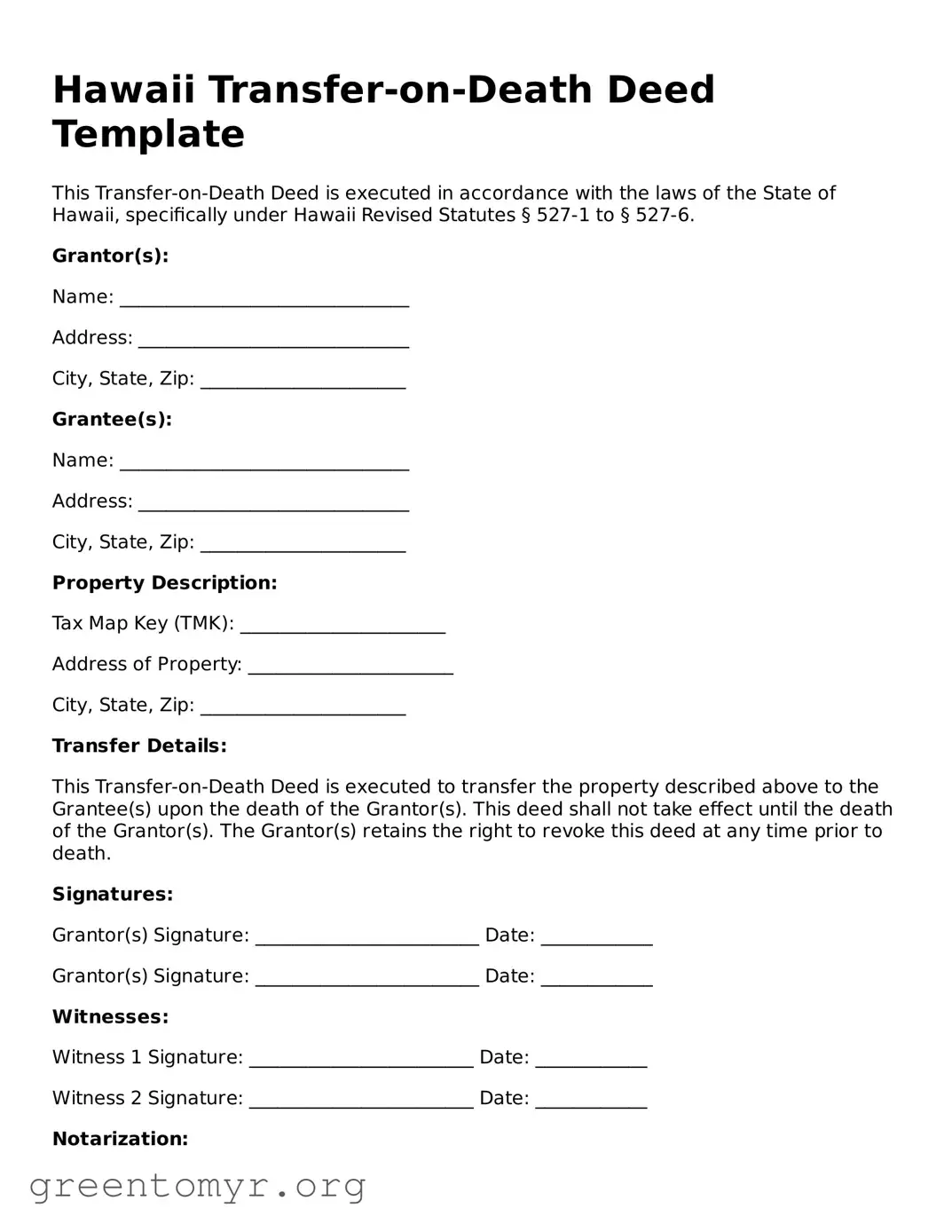
Hawaii Transfer-on-Death Deed Template
This Transfer-on-Death Deed is executed in accordance with the laws of the State of Hawaii, specifically under Hawaii Revised Statutes § 527-1 to § 527-6.
Grantor(s):
Name: _______________________________
Address: _____________________________
City, State, Zip: ______________________
Grantee(s):
Name: _______________________________
Address: _____________________________
City, State, Zip: ______________________
Property Description:
Tax Map Key (TMK): ______________________
Address of Property: ______________________
City, State, Zip: ______________________
Transfer Details:
This Transfer-on-Death Deed is executed to transfer the property described above to the Grantee(s) upon the death of the Grantor(s). This deed shall not take effect until the death of the Grantor(s). The Grantor(s) retains the right to revoke this deed at any time prior to death.
Signatures:
Grantor(s) Signature: ________________________ Date: ____________
Grantor(s) Signature: ________________________ Date: ____________
Witnesses:
Witness 1 Signature: ________________________ Date: ____________
Witness 2 Signature: ________________________ Date: ____________
Notarization:
State of Hawaii
County of ___________________________
On this ____ day of ____________, 20__, before me, a Notary Public, personally appeared ______________________, known to me to be the person(s) whose name(s) is/are subscribed to the within instrument and acknowledged that he/she/they executed the same.
Notary Public Signature: ________________________ My Commission Expires: ____________
| Fact Name | Details |
|---|---|
| Definition | A Transfer-on-Death Deed allows a property owner to transfer real estate to a beneficiary upon their death without going through probate. |
| Governing Law | The Transfer-on-Death Deed in Hawaii is governed by Hawaii Revised Statutes § 526B. |
| Eligibility | Any individual who owns real property in Hawaii can create a Transfer-on-Death Deed. |
| Beneficiary Designation | Property owners can designate one or more beneficiaries in the deed. |
| Revocation | The deed can be revoked by the property owner at any time before their death. |
| Filing Requirements | The deed must be recorded with the Bureau of Conveyances in Hawaii to be effective. |
| No Immediate Transfer | Ownership of the property does not transfer until the death of the property owner. |
| Impact on Creditors | Transfer-on-Death Deeds do not shield the property from creditors; debts may still need to be settled. |
| Legal Assistance | While legal assistance is not required, consulting with an attorney is advisable to ensure proper execution. |
Once you have the Hawaii Transfer-on-Death Deed form in hand, it’s time to fill it out accurately. This deed allows you to designate a beneficiary for your property, ensuring a smooth transfer upon your passing. Follow these steps carefully to complete the form.
After submitting the form, keep a copy for your records. This ensures that you have proof of the transfer-on-death designation. It’s also a good idea to inform your beneficiary about the deed and its implications.
A Transfer-on-Death Deed (TOD Deed) is a legal document that allows property owners in Hawaii to designate beneficiaries who will receive their property upon their death. This deed enables the transfer of real estate without the need for probate, simplifying the process for heirs and ensuring a smoother transition of ownership.
Any individual who owns real property in Hawaii can utilize a Transfer-on-Death Deed. This includes homeowners, landowners, and individuals holding title to real estate. However, the property must be solely owned by the individual and not held in joint tenancy or as part of a trust.
To create a TOD Deed, follow these steps:
Yes, there are a few limitations to consider:
If you decide to revoke or change your Transfer-on-Death Deed, you can do so at any time while you are alive. To revoke the deed, you must create a new document stating your intention to revoke the previous deed and file it with the same county office where the original deed was recorded.
A Transfer-on-Death Deed typically does not affect property taxes during the owner's lifetime. However, upon the owner's death, the property may be subject to estate taxes, depending on the overall value of the estate. It is advisable to consult with a tax professional for specific guidance related to your situation.
Yes, you can name multiple beneficiaries in a Transfer-on-Death Deed. When doing so, it is important to specify how the property will be divided among them. You can choose to have the property transferred equally or designate different percentages to each beneficiary.
No, a Transfer-on-Death Deed is not the same as a will. While both documents deal with the transfer of property after death, a TOD Deed specifically transfers real estate outside of probate, whereas a will encompasses all aspects of an estate and must go through the probate process. A TOD Deed is a more streamlined option for transferring real estate directly to beneficiaries.
While it is not legally required to have a lawyer to create a Transfer-on-Death Deed, consulting with one can provide valuable insights. A legal professional can ensure that the document is completed correctly and meets all necessary requirements, ultimately helping to avoid potential issues in the future.
Filling out the Hawaii Transfer-on-Death Deed form can seem straightforward, but many people make common mistakes that can complicate the process. One frequent error is failing to include the correct legal description of the property. This description must be precise and should match the information found in the property’s title. If the description is vague or incorrect, it can lead to disputes or even invalidate the deed.
Another common mistake involves not properly signing the deed. All required parties must sign the document in front of a notary. Omitting a signature or failing to notarize the document can render it ineffective. It is essential to ensure that every person named in the deed has provided their signature to avoid complications in the future.
People often overlook the importance of providing clear identification of the beneficiaries. The form requires specific details about the individuals who will inherit the property. Missing or incorrect information about the beneficiaries can lead to confusion or disputes among heirs, which can ultimately delay the transfer process.
Additionally, many individuals neglect to record the deed with the appropriate county office after completing it. Recording the deed is crucial for it to be legally effective. Without this step, the transfer may not be recognized, and the property could remain part of the deceased’s estate, leading to unnecessary complications during probate.
Lastly, failing to review the entire document before submission is a mistake that can have significant consequences. Typos, incorrect dates, or incomplete information can all lead to issues down the line. Taking the time to carefully review the form can prevent future headaches and ensure that the transfer occurs smoothly.
When considering a Hawaii Transfer-on-Death Deed, it’s essential to understand that several other forms and documents may be necessary to ensure a smooth transfer of property upon death. These documents help clarify intentions, protect rights, and streamline the legal process. Below is a list of commonly used forms that often accompany the Transfer-on-Death Deed.
Understanding these documents can help facilitate a smoother transition of property and ensure that your wishes are honored. Each form plays a distinct role in the estate planning process, making it vital to consider them when preparing for the future.
The Transfer-on-Death Deed (TOD Deed) is a legal document that allows an individual to transfer property upon their death without going through probate. Several other documents serve similar purposes in estate planning and property transfer. Below are five documents that share similarities with the Transfer-on-Death Deed:
Filling out a Transfer-on-Death (TOD) Deed form in Hawaii can be a straightforward process if you keep a few important things in mind. Here’s a list of what to do and what to avoid to ensure that your deed is completed correctly.
By following these guidelines, you can navigate the process of filling out the Hawaii Transfer-on-Death Deed form with confidence and clarity.
The Hawaii Transfer-on-Death Deed (TOD) is a useful tool for estate planning, but many people hold misconceptions about it. Here are ten common misunderstandings:
Understanding these misconceptions can help individuals make informed decisions about their estate planning needs in Hawaii.
Filling out and using the Hawaii Transfer-on-Death Deed form can be straightforward if you keep a few key points in mind. Here are some essential takeaways:
By following these key points, you can effectively navigate the process of using the Transfer-on-Death Deed in Hawaii.