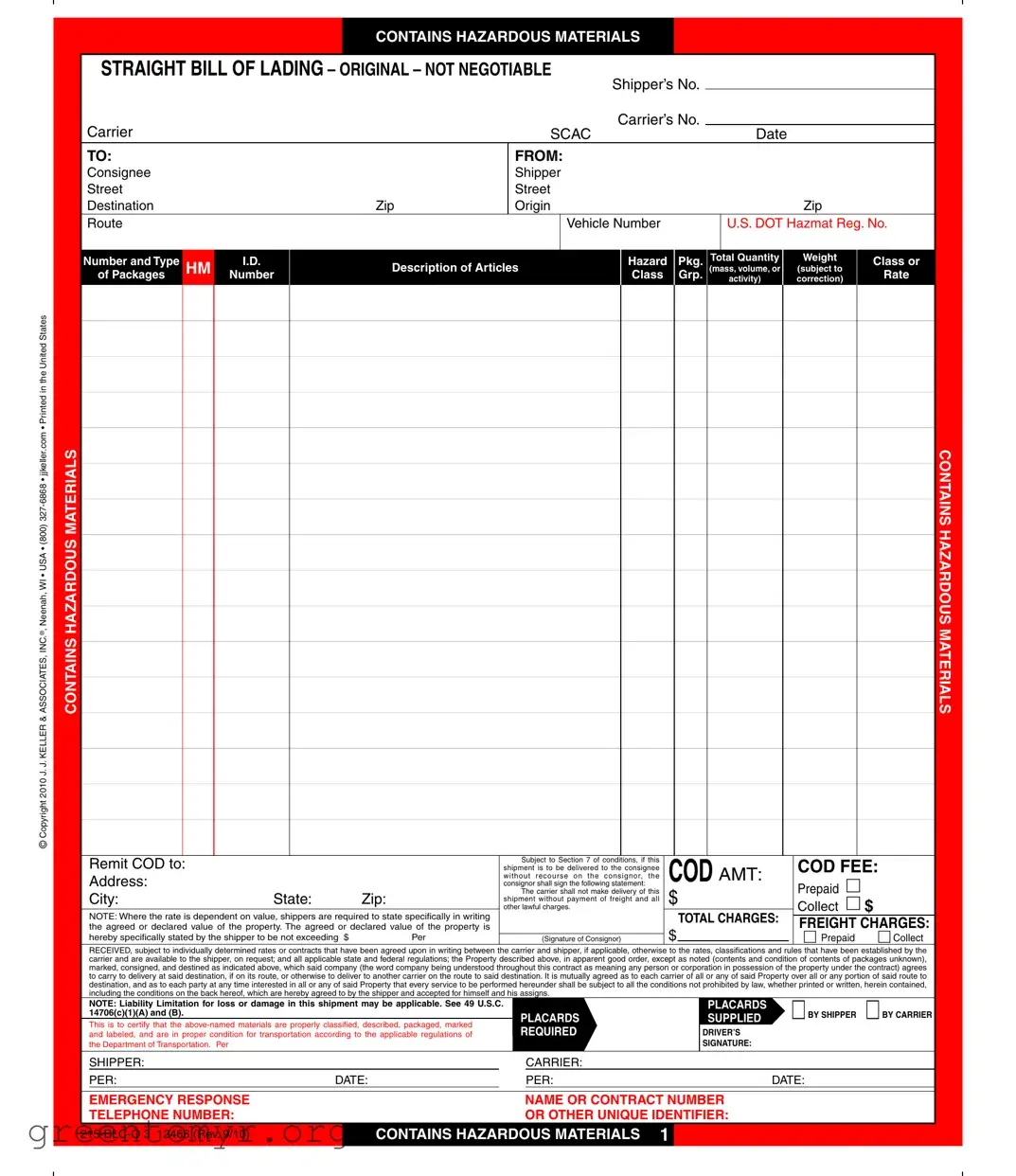
The Hazard Bill of Lading is an essential document for transporting hazardous materials, ensuring safety and compliance throughout the shipping process. This form serves as a contract between the shipper and the carrier, detailing critical information such as the nature of the hazardous materials, the quantity being shipped, and the specific routes to be taken. It includes vital sections that outline responsibilities, liability limitations, and payment terms, which are crucial for both parties. The form also mandates that shippers certify that the materials are properly classified and packaged, adhering to regulations set forth by the Department of Transportation. Additionally, it addresses the procedures for claims in case of loss or damage, emphasizing the importance of timely communication. By utilizing this form, all parties involved can navigate the complexities of hazardous material transportation with greater assurance and clarity.
®, Neenah, WI • USA • (800) |
HAZARDOUS MATERIALS |
ASSOCIATES, INC. |
CONTAINS |
© Copyright 2010 J. J. KELLER & |
|
CONTAINS HAZARDOUS MATERIALS
STRAIGHT BILL OF LADING – ORIGINAL – NOT NEGOTIABLE
|
|
|
|
|
|
Shipper’s No. |
|
|
|
|
|
Carrier |
|
|
|
|
|
Carrier’s No. |
|
|
|
|
|
|
|
|
SCAC |
|
|
Date |
|
|
|||
TO: |
|
|
|
FROM: |
|
|
|
|
|
|
|
Consignee |
|
|
|
Shipper |
|
|
|
|
|
|
|
Street |
|
|
|
Street |
|
|
|
|
|
|
|
Destination |
|
|
Zip |
Origin |
|
|
|
|
Zip |
|
|
Route |
|
|
|
|
|
Vehicle Number |
|
|
U.S. DOT Hazmat Reg. No. |
||
|
|
|
|
|
|
|
|
|
|
|
|
Number and Type |
HM |
I.D. |
Description of Articles |
Hazard |
Pkg. |
Total Quantity |
Weight |
Class or |
|||
of Packages |
Number |
Class |
Grp. |
(mass, volume, or |
(subject to |
Rate |
|||||
|
|
|
|
|
activity) |
correction) |
|||||
|
|
|
|
|
|
|
|
|
|
||
CONTAINS HAZARDOUS MATERIALS
Remit COD to: |
|
|
Subject to Section 7 of conditions, if this |
COD AMT: |
COD FEE: |
||||
|
|
shipment is to be delivered to the consignee |
|||||||
Address: |
|
|
without recourse on the consignor, the |
|
□ |
|
|||
|
|
consignor shall sign the following statement: |
Prepaid |
|
|||||
City: |
State: |
Zip: |
The carrier shall not make delivery of this |
$ |
|
|
|||
shipment without payment of freight and all |
|
Collect |
□ $ |
|
|||||
|
|
|
other lawful charges. |
|
|
|
|
||
NOTE: Where the rate is dependent on value, shippers are required to state specifically in writing |
|
TOTAL CHARGES: |
|
||||||
|
|
FREIGHT CHARGES: |
|||||||
the agreed or declared value of the property. The agreed or declared value of the property is |
|
$ |
|
|
|||||
hereby specifically stated by the shipper to be not exceeding $ |
Per |
(Signature of Consignor) |
|
|
□ Prepaid |
□ Collect |
|||
|
|
||||||||
RECEIVED, subject to individually determined rates or contracts that have been agreed upon in writing between the carrier and shipper, if applicable, otherwise to the rates, classifications and rules that have been established by the carrier and are available to the shipper, on request; and all applicable state and federal regulations; the Property described above, in apparent good order, except as noted (contents and condition of contents of packages unknown), marked, consigned, and destined as indicated above, which said company (the word company being understood throughout this contract as meaning any person or corporation in possession of the property under the contract) agrees to carry to delivery at said destination, if on its route, or otherwise to deliver to another carrier on the route to said destination. It is mutually agreed as to each carrier of all or any of said Property over all or any portion of said route to destination, and as to each party at any time interested in all or any of said Property that every service to be performed hereunder shall be subject to all the conditions not prohibited by law, whether printed or written, herein contained, including the conditions on the back hereof, which are hereby agreed to by the shipper and accepted for himself and his assigns.
|
NOTE: Liability Limitation for loss or damage in this shipment may be applicable. See 49 U.S.C. |
|
|
PLACARDS |
□ BY SHIPPER |
□ BY CARRIER |
||
|
14706(c)(1)(A) and (B). |
|
|
PLACARDS |
SUPPLIED |
|||
|
This is to certify that the |
|
|
|||||
|
REQUIRED |
DRIVER’S |
|
|
||||
|
and labeled, and are in proper condition for transportation according to the applicable regulations of |
|
|
|||||
|
the Department of Transportation. Per |
|
|
|
|
SIGNATURE: |
|
|
|
|
|
|
|
|
|
|
|
|
SHIPPER: |
|
|
|
CARRIER: |
|
|
|
|
PER: |
DATE: |
|
PER: |
|
DATE: |
|
|
|
|
|
|
|
|
|
|
|
|
EMERGENCY RESPONSE |
|
|
NAME OR CONTRACT NUMBER |
|
|
||
|
TELEPHONE NUMBER: |
|
|
OR OTHER UNIQUE IDENTIFIER: |
|
|
||
CONTAINS HAZARDOUS MATERIALS 1

TERMS AND CONDITIONS
By giving the carrier the property described in this bill of lading (the “Property”), you agree to all of the terms of this bill of lading.
Section 1 Limitations of Liability
(a)The carrier or party in possession of the Property shall be liable as at common law for any loss of or damage to such Property, except as hereinafter provided.
(b)The carrier shall not be liable for loss of, damage to or delay in delivery of the Property:
(i)caused by an act of God, the public enemy, the authority of law, or any act or default by you and/or the owner of the Property, or for natural shrinkage.
(ii)occurring while the Property is stopped and held in transit at your request or that of any other party entitled to make such request.
(iii)resulting from a defect or vice in the Property, or from riots or strikes.
(c)To the extent permitted under the Carmark Amendment, the liability of the carrier for the Property may be limited to a value established by written or electronic declaration by you or by written agreement between the carrier and you. In all cases not prohibited by law, where a lower value than actual value has been represented in writing by the shipper or has been agreed upon in writing as the released value of the Property as determined by the classification or tariffs upon which the rate is based, such lower value plus freight charges if paid shall be the maximum amount to be recovered, whether or not such loss or damage occurs from negligence.
Section 2 Filing of Claims
(a)Claims against the carrier for loss of or damage to the Property must be filed in writing with the carrier issuing this bill of lading within nine months after delivery of the Property (or, in case of export traffic, within nine months after delivery at port of export) or, in case of failure to make delivery, then within nine months after a reasonable time for delivery has elapsed. All causes of action must be instituted within two years following the date when written notice is given by the carrier to you that the carrier has disallowed the claim or any part or parts thereof specified in the notice. If your claim or action is not filed or instituted properly in accordance with the foregoing provisions, the carrier shall not be liable, and such claims may not be paid.
(b)The carrier shall have the full benefit of any insurance that may have been effected upon or on account of the Property in the event that the carrier is liable for loss of or damage to the Property.
Section 3 Method of Transportation
Except as expressly agreed in writing by the parties to this bill of lading, the carrier is not bound to transport the Property by any particular motor vehicle, or in time for any particular market or otherwise than with reasonable dispatch. The carrier shall have the right in case of physical necessity to forward said Property by any carrier or route between the point of shipment and the point of destination.
Section 4 Responsibility for Property
(a)If the Property is not removed by the party entitled to receive it within the free time allowed by tariffs or classifications upon which the rate is based, (such free time to be computed as therein provided), the carrier may notify the receiving party of the arrival of the Property at the destination or at the port of export (if intended for export). The carrier, in its discretion, may store the Property in a public or licensed warehouse at the place of delivery or other available place, at the cost of the owner. The stored Property will be subject to a lien for all freight and other lawful charges, including a reasonable charge for storage. The carrier’s responsibility shall be that of a warehouseman only.
(b)Except as provided in subparagraph 4(c) below, if the Property is refused by consignee or the party entitled to receive it, or said consignee or party entitled to receive it fails to receive it within 15 days after notice of arrival shall have been duly sent or given, the carrier may sell the Property at public auction to the highest bidder, at such place as may be designated by the carrier. Prior to any such sale, the carrier shall use commercially reasonable efforts to notify you that the Property has been refused or remains unclaimed, as the case may be, and that it will be subject to sale under the terms of the bill of lading if you do not arrange for an alternative disposition.
(c)If the Property is perishable and is refused by the consignee or party entitled to receive it at the destination location, or said consignee or party entitled to receive it shall fail to receive it promptly, the carrier, may, in its discretion, to prevent deterioration or further deterioration, sell the same to the best advantage at private or public sale. Prior to selling the Property, the carrier shall use commercially reasonable efforts to notify you of the refusal of the Property or the failure to receive it, and request instructions regarding disposition of the Property.
(d)If the procedure described in subsection (b) and (c) is not commercially reasonable, the carrier may, at its option, sell the Property under such circumstances and in such manner as may be authorized by law.
(e)The carrier shall apply the proceeds of any sale made under this section to the payment of freight, demurrage, storage, and any other lawful charges and the expense of notice, advertisement, sale, and other necessary expense and of caring for and maintaining the Property, if proper care of the same requires special expense. If following payment of the preceding there is a balance, such balance shall be paid to the owner of the Property sold hereunder.
(f)If you direct the carrier to deliver the Property to a location where there is no regularly appointed freight agent, the carrier shall not be liable for any loss or damage to Property occurring at such location after the Property has been unloaded at such location.
Section 5 Valuable Items
(a)The carrier’s liability in connection with the Property is limited to the lesser of the amount of your actual damages or the declared value stipulated by the carrier on the face of this bill of lading plus any freight charges paid by you.
(b)The carrier shall not be liable in any way for any documents, specie, or for any articles of extraordinary value not specifically rated in the published classifications or tariffs unless a special agreement to do so and a stipulated value of the articles are endorsed on this bill of lading.
Section 6 Joint Liability for Hazardous Goods
You, and if you are an agent, any owner of the Property, shall be joint and severally liable for and indemnify the carrier against all loss or damage caused by the shipment of explosives, dangerous or hazardous goods, without giving prior written notice to the carrier of their nature. At the discretion of the carrier, any such goods may be warehoused at your and the owner’s risk and expense or destroyed without compensation.
Section 7 Freight Charges and Payment
(a)You are primarily responsible for the freight and all other lawful charges, unless you stipulate in writing in the space provided for that purpose on the face of this bill of lading that the carrier shall not make delivery without requiring payment of such charges and the carrier makes delivery without requiring such payment. If you provide erroneous information that results in the shipment being reconsigned or diverted to a location other than the location identified in the original bill of lading, you shall be liable for such additional charges. The respective liability of you and the consignee for additional charges provided for herein shall be pursuant to 49 U.S.C. § 13706.
(b)Nothing in this bill of lading shall limit the right of the carrier to require the prepayment or guarantee of charges at time of shipment. If upon inspection the carrier determines that the articles shipped are not those described in this bill of lading, the freight charges must be paid upon the articles actually shipped.
Section 8 Effect of Shipper Signature
If this bill of lading is issued on the order of the shipper, or his agent, in exchange or in substitution for another bill of lading, the shipper’s signature to the prior bill of lading as to the statement of value or otherwise, or election of common law or bill of lading liability, in or in connection with such prior bill of lading, shall be considered a part of this bill of lading as fully as if the same were written or made in or in connection with this bill of lading.
Section 9 Transport by Water
If all or any part of the Property is carried by water over any part of said route, and any loss of or damage to the Property occurs while it is in the custody of the carrier providing the water carriage, the liability of such carrier shall be determined by that carrier’s bill of lading and by the laws and regulations applicable to transportation by water. Such water carriage shall be performed subject to all of the terms and provisions of, and all the exemptions from liability contained in the Harter Act or the Carriage of Goods By Sea Act, as applicable.
©Copyright 2009 J. J. KELLER & ASSOCIATES, INC.®, Neenah, WI • USA • (800)
| Fact Name | Description |
|---|---|
| Type of Document | This form is a Hazardous Materials Straight Bill of Lading, which is not negotiable. |
| Governing Law | The form is governed by federal regulations and applicable state laws, including 49 U.S.C. § 13706. |
| Liability Limitations | The carrier's liability for loss or damage may be limited, as outlined in the terms and conditions of the bill. |
| Emergency Response Information | Emergency response contact details must be provided, including a name or contract number and a telephone number. |
Filling out the Hazard Bill of Lading form is an essential step for anyone involved in the transportation of hazardous materials. This form ensures that all necessary information is documented correctly to comply with regulations and facilitate safe transport. Below are the steps to guide you through the process of completing the form.
Once the form is completed, review it carefully to ensure that all information is accurate. This will help avoid delays or issues during transportation. After verification, the form should be submitted to the carrier for processing. Proper completion of this form is crucial for the safe and compliant transport of hazardous materials.
The Hazard Bill of Lading form serves as a shipping document that outlines the details of hazardous materials being transported. It provides essential information about the shipment, including the shipper's and consignee's addresses, the description of the hazardous materials, and the terms of transportation. This document ensures compliance with federal and state regulations regarding the safe handling and transport of hazardous materials.
Key information required on the form includes:
Providing accurate information is crucial for ensuring safe transport and compliance with legal requirements.
Liability for loss or damage to the property is generally determined by common law, but it can be limited under certain conditions. The carrier may not be liable for loss or damage caused by factors such as acts of God or defects in the property. Shippers should declare the value of the property on the form, as this may affect the carrier's liability in case of loss or damage.
If there is a claim for loss or damage, it must be filed in writing with the carrier within nine months after delivery or within a reasonable time after a failure to deliver. Claims not filed properly may not be honored. It is advisable to keep records and documentation related to the shipment to support the claim.
Yes, shippers of hazardous materials have specific responsibilities. They must provide prior written notice to the carrier regarding the nature of the hazardous goods. Failure to do so may result in joint liability for any loss or damage caused by the shipment. Additionally, the carrier may choose to warehouse or destroy hazardous materials at the shipper's expense if necessary.
Completing the Hazard Bill of Lading form can be a challenging task. Many individuals make mistakes that can lead to delays or complications in shipping hazardous materials. One common error is failing to accurately describe the hazardous materials being shipped. A precise description is crucial, as it ensures that all parties involved understand the nature of the materials and can handle them safely.
Another frequent mistake is neglecting to provide the correct weight or quantity of the hazardous materials. This information is essential for calculating shipping costs and ensuring compliance with regulations. Inaccuracies in weight or quantity can result in additional charges or even legal issues.
Many people also overlook the importance of including the correct emergency response information. This information is vital in case of an incident during transport. Without it, emergency responders may struggle to manage the situation effectively, putting lives at risk.
Additionally, some individuals fail to sign the form where required. A signature is not just a formality; it signifies that the shipper agrees to the terms and conditions outlined in the bill of lading. Without a signature, the document may be considered incomplete and could lead to disputes later on.
Another common oversight is not checking the applicable regulations for hazardous materials transport. Regulations can vary by state and type of material, and failing to adhere to these can result in fines or other penalties. It is essential to stay informed about the specific requirements that apply to your shipment.
Lastly, many individuals do not keep a copy of the completed bill of lading for their records. Retaining a copy is important for tracking the shipment and addressing any issues that may arise during transit. Without a copy, resolving disputes or filing claims can become much more difficult.
The Hazard Bill of Lading form is an essential document in the transportation of hazardous materials. It outlines the details of the shipment and ensures compliance with safety regulations. In addition to this form, several other documents may be required to facilitate the safe and legal transport of hazardous materials. Below is a list of related forms and documents commonly used in conjunction with the Hazard Bill of Lading.
These documents play a critical role in ensuring the safe transport of hazardous materials. They provide necessary information for compliance, safety, and emergency response, protecting both the public and the environment during transportation activities.
The Hazard Bill of Lading form is crucial for the transportation of hazardous materials. It ensures that all parties involved are aware of the nature of the goods being transported and the associated responsibilities. Several other documents serve similar purposes in the logistics and shipping industries. Below are five documents that share similarities with the Hazard Bill of Lading form:
Understanding these documents and their similarities is essential for anyone involved in shipping hazardous materials. Each serves a distinct purpose but shares the common goal of ensuring safe and efficient transportation.
When filling out the Hazard Bill of Lading form, it's essential to follow specific guidelines to ensure accuracy and compliance. Here are five things to do and avoid:
This form can be used for both hazardous and non-hazardous materials. It is designed to provide detailed information about the shipment regardless of the material type.
The shipper retains some responsibility, particularly if the shipment contains hazardous materials. Liability can extend to damages caused by improper packaging or failure to disclose the nature of the materials.
Carrier liability is limited under specific conditions, such as acts of God or defects in the property. The terms of the bill of lading outline these limitations.
A signature from the consignor is essential. It signifies acceptance of the terms and conditions outlined in the bill of lading.
Claims for loss or damage must be filed within a specified time frame, usually nine months. This ensures that any issues are addressed promptly.
Shippers are required to declare the value of the property, especially if the rate is dependent on that value. Failure to do so can limit recovery in case of loss.
Different types of hazardous materials may have specific regulations and requirements. The bill of lading must accurately reflect the nature of the materials being shipped.
The carrier must follow specific legal and contractual obligations. They cannot refuse delivery arbitrarily; there must be valid reasons outlined in the bill of lading.
The bill of lading serves as a legal document throughout the shipping process. It outlines responsibilities and rights for both the shipper and the carrier.
This form is governed by federal regulations concerning hazardous materials. Compliance with these regulations is essential for legal transport.
Filling out the Hazard Bill of Lading form correctly is essential for shipping hazardous materials. Here are some key takeaways to keep in mind: