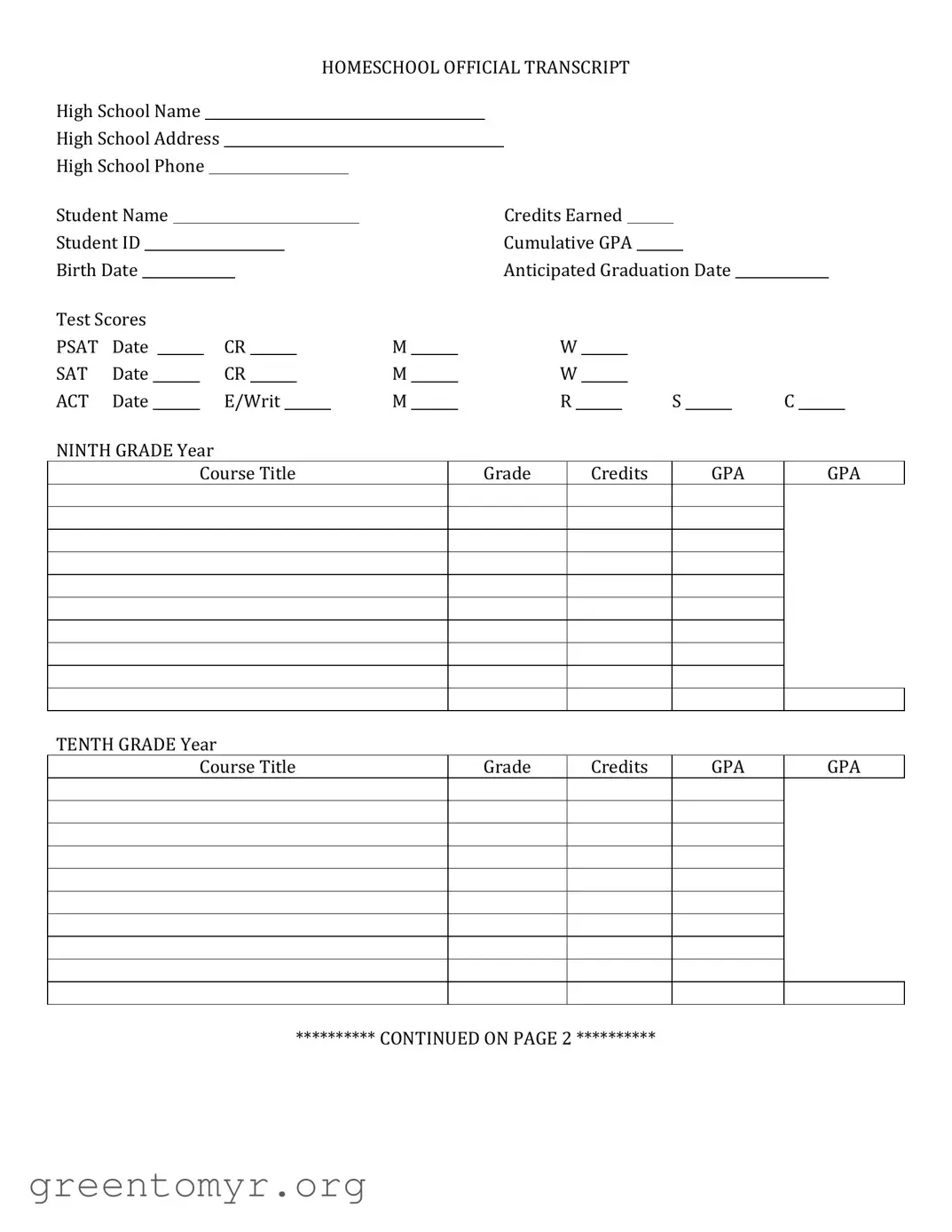
The High School Transcript form serves as a crucial document in a student's academic journey, encapsulating their educational achievements and performance throughout their high school years. This form typically includes essential information such as the student's name, date of birth, and graduation date, along with a comprehensive list of courses taken, grades earned, and credits received. Additionally, it may provide details on standardized test scores, class rankings, and any honors or awards achieved. The transcript not only reflects a student's academic history but also plays a pivotal role in college admissions, scholarship applications, and job opportunities. Understanding the components and significance of the High School Transcript form is vital for students, parents, and educators alike, as it ensures that accurate and complete information is conveyed to prospective institutions or employers. By being informed about what the form entails, stakeholders can better navigate the often complex processes related to higher education and career advancement.

HOMESCHOOL OFFICIAL TRANSCRIPT
High School Name
High School Address
High School Phone
Student Name
Student ID
Birth Date
Test Scores |
|
|
|
|
|
|
|
|
|
PSAT |
Date |
|
|
|
CR |
|
|
|
M |
SAT |
Date |
|
|
|
CR |
|
|
|
M |
ACT |
Date |
|
|
|
E/Writ |
|
|
M |
|
NINTH GRADE Year
Course Title
Credits Earned
Cumulative GPA
Anticipated Graduation Date
W
W
RS
Grade Credits GPA
C
GPA
TENTH GRADE Year Course Title
Grade
Credits
GPA
GPA
********** CONTINUED ON PAGE 2 **********

PAGE 2
ELEVENTH GRADE Year
Course Title
Grade
Credits
GPA
GPA
TWELVTH GRADE Year Course Title
Grade
Credits
GPA
GPA
*indicates community college courses for college credit – see college transcript
********** END OF ACADEMIC TRANSCRIPT **********
Date Issued
This transcript is provided in accordance with the State of North Carolina Department of Education regulations for graduation. I do hereby acknowledge that all information provided herein is accurate.
Signature of the Administrator of High School
Date
| Fact Name | Description |
|---|---|
| Definition | A high school transcript is an official record of a student's academic performance and achievements during their high school years. |
| Contents | Typically includes courses taken, grades received, GPA, and standardized test scores. |
| Purpose | Used for college admissions, job applications, and scholarship opportunities. |
| Format | Usually provided in a printed format or as a secure electronic document. |
| Request Process | Students must request their transcripts through their high school’s registrar or designated office. |
| State-Specific Forms | Some states have specific forms or requirements for transcript requests, governed by state education laws. |
| Governing Laws | In California, for example, Education Code Section 49061 governs the maintenance and release of student records. |
| Confidentiality | Transcripts are considered confidential and are protected under privacy laws. |
| Timeframe for Processing | Processing times for transcript requests can vary, often taking several days to weeks. |
Filling out the High School Transcript form is an important step in your academic journey. Once completed, this form will help you provide essential information about your educational background. Follow these steps carefully to ensure accuracy and completeness.
After completing the form, you may need to submit it to your school or the relevant institution. Ensure you follow any specific submission guidelines they may have.
A high school transcript is an official document that summarizes a student's academic performance throughout their high school years. It typically includes information such as the courses taken, grades received, and credits earned. Additionally, it may contain details about standardized test scores, attendance records, and any honors or awards received.
High school transcripts are often required for various purposes, including college admissions, scholarship applications, and job applications. They provide a comprehensive overview of a student's academic achievements, helping institutions and employers assess qualifications and readiness for further education or employment.
To request a high school transcript, you typically need to contact your school's registrar or the administrative office. Many schools have a specific process for transcript requests, which may include filling out a form, providing identification, and sometimes paying a fee. Some schools also offer online request options for convenience.
A high school transcript generally includes:
The processing time for receiving a high school transcript can vary based on the school's policies and the method of request. Generally, it may take anywhere from a few days to a couple of weeks. During peak times, such as the end of the school year or college application season, it may take longer.
Yes, former students can usually obtain copies of their transcripts, regardless of when they graduated. However, the process may differ depending on the school's record-keeping policies. It is advisable to contact the school directly for information on how to request a transcript for alumni.
Yes, high school transcripts are considered confidential documents. Schools typically have policies in place to protect students' privacy. Only authorized individuals, such as the student, parents or guardians (if the student is a minor), and designated institutions can access the transcript. Consent may be required for release to third parties.
If you discover an error on your transcript, it is important to address it promptly. Contact your school's registrar or administration office to report the issue. They will provide guidance on the steps needed to correct the error, which may involve submitting documentation or a formal request for correction.
While not all employers require a high school transcript for job applications, some may ask for it, particularly for entry-level positions or internships. It is advisable to have a copy available in case it is requested, as it can help demonstrate your educational background and qualifications.
Filling out a high school transcript form can be a straightforward task, but many people make common mistakes that can lead to delays or issues down the line. Understanding these pitfalls can help ensure the process goes smoothly. Here are seven mistakes to watch out for.
First, many students forget to include all relevant coursework. It’s important to list every class taken, including electives and advanced placement courses. Omitting any classes can lead to an incomplete transcript, which may not reflect the student's full academic record.
Second, failing to double-check grades is another frequent error. Students often assume their grades are correct without verifying them against their report cards. This oversight can result in submitting inaccurate information, which could affect college admissions or scholarship opportunities.
Third, not providing the correct contact information for the school can cause problems. If the school needs to verify the transcript or if there are any questions, having outdated or incorrect contact details can lead to unnecessary delays. Always ensure that the school's phone number and email address are current.
Fourth, some individuals neglect to sign the transcript form. A signature is often required to validate the document. Skipping this step can lead to the form being rejected or considered incomplete.
Fifth, using an incorrect format can also be a stumbling block. Each institution may have specific requirements for how the transcript should be presented. It’s crucial to follow these guidelines closely to avoid any complications.
Sixth, students sometimes forget to include important extracurricular activities and achievements. While the primary focus is on academic performance, colleges also look for well-rounded candidates. Listing clubs, sports, and volunteer work can enhance a transcript and provide a fuller picture of a student’s capabilities.
Finally, procrastination can lead to rushed submissions. Waiting until the last minute to fill out the form can result in careless mistakes. It’s best to start early, allowing ample time to review and correct any errors before submission.
When applying for college or jobs, a high school transcript is often required. However, several other documents may accompany this form to provide a complete picture of a student's achievements and qualifications. Here’s a list of commonly used forms and documents that you might encounter alongside the high school transcript:
Each of these documents plays a vital role in the application process, providing a fuller picture of a student's background and aspirations. Being prepared with these forms can enhance the chances of success in college admissions or job applications.
The High School Transcript is an essential document that provides a summary of a student's academic achievements. It shares similarities with several other important documents in the educational and professional landscape. Here are four documents that are comparable to the High School Transcript:
Understanding these documents can help students and parents navigate the educational system more effectively. Each serves a unique purpose but shares the common goal of documenting academic progress and achievements.
When filling out a High School Transcript form, attention to detail is crucial. Here are some important dos and don'ts to keep in mind:
By following these guidelines, you can help ensure that your transcript is processed smoothly and accurately.
Misconceptions about the High School Transcript form can lead to confusion for students and parents. Below are some common misunderstandings, along with clarifications to help provide clarity.
When filling out and using the High School Transcript form, there are several important points to keep in mind. Here are key takeaways to ensure the process goes smoothly:
By following these guidelines, you can help ensure that your high school transcript is processed efficiently and correctly.