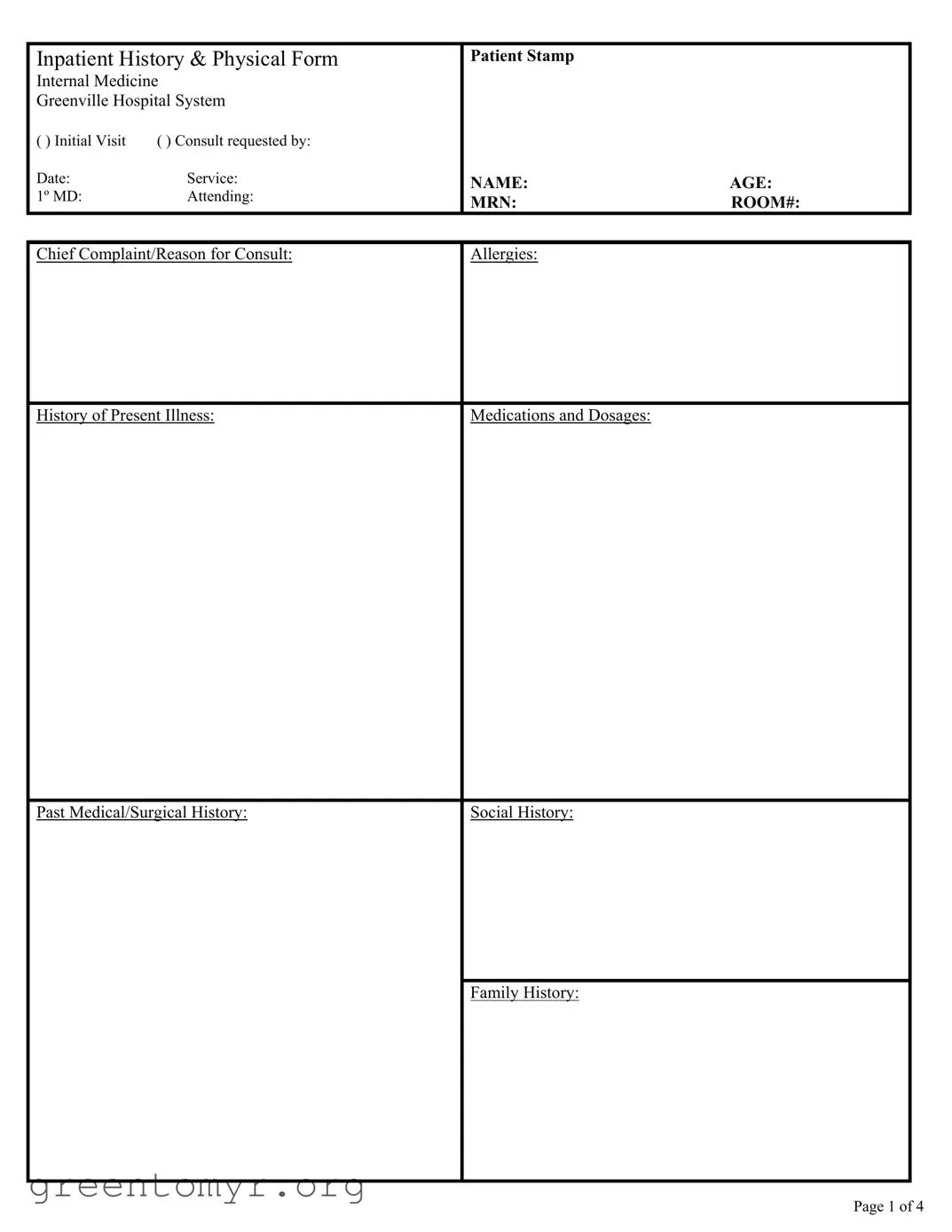
The History and Physical (H&P) form serves as a cornerstone in patient assessment, capturing essential details that guide medical professionals in diagnosing and treating patients effectively. This comprehensive document begins with vital patient information, including name, age, and medical record number, ensuring that every detail is linked to the correct individual. At the heart of the H&P is the chief complaint, which succinctly outlines the reason for the patient's visit. Following this, the history of present illness provides a narrative of the symptoms, while a section on allergies alerts healthcare providers to potential risks. The form also includes a thorough review of the patient's medical and surgical history, social circumstances, and family background, all of which contribute to a holistic understanding of the patient's health. A comprehensive review of systems (ROS) is conducted, examining various bodily systems to identify any additional issues that may not have been initially reported. This is complemented by a physical examination that assesses everything from vital signs to specific organ systems, ensuring a well-rounded view of the patient's current health status. Finally, the assessment and plan section synthesizes the findings, guiding the next steps in patient care. Each component of the H&P form plays a crucial role in establishing a clear and complete picture of the patient’s health, ultimately enhancing the quality of care they receive.

Inpatient History & Physical Form |
Patient Stamp |
|
||
Internal Medicine |
|
|
||
Greenville Hospital System |
|
|
||
( ) Initial Visit |
( ) Consult requested by: |
|
|
|
Date: |
Service: |
NAME: |
AGE: |
|
1º MD: |
Attending: |
|||
MRN: |
ROOM#: |
|||
|
|
|||
Chief Complaint/Reason for Consult:
Allergies:
History of Present Illness:
Medications and Dosages:
Past Medical/Surgical History:
Social History:
Family History:
Page 1 of 4

Comprehensive Review of Systems
ROS NOT OBTAINABLE BECAUSE
Patient Stamp
Constitutional: |
|
Genitourinary: |
|
|
YES NO |
DESCRIBE |
YES NO |
DESCRIBE |
|
Fever, sweats or chills |
|
Dysuria, frequency or urgency |
||
|
Menstrual irregularities |
|
||
Fatigue, anorexia, weight loss or gain |
|
|||
LMP ___________________ |
||||
Weakness |
|
|||
|
Frequent UTI’s |
|
||
|
|
|
||
|
|
Pain/Hematuria |
|
|
Skin: |
|
Musculoskelatal: |
Rashes, no skin breakdown |
|
Muscle aches, arthralgias or arthritis |
|
|
|
|
|
Neurologic: |
|
|
Mental status changes |
Head: |
|
|
|
Headaches |
|
Headache |
|
|
|
Dizziness |
|
Visual changes |
|
|
|
Weakness or numbness |
|
Earache, sinus problems, sore throat |
|
|
|
Seizures |
|
Cough, snoring or mouth ulcers |
|
|
|
Ataxia |
|
|
|
|
|
|
Hematopoietic: |
|
|
Lymphadenopathy |
|
|
Bleeding tendencies |
|
|
|
Cardiovascular: |
|
Psychiatric: |
Chest pain or palpitations |
|
History of anxiety or depression |
Syncope |
|
Hallucinations/Delusions |
Edema |
|
|
|
|
|
|
|
Endocrine: |
|
|
History of diabetes |
|
|
History of thyroid problems |
|
|
|
|
|
Other Symptoms: |
Respiratory: |
|
|
Shortness of breath |
|
|
Cough or sputum production |
|
|
Dyspnea on exertion orthopnea |
|
|
Pleuritic chest pain |
|
|
|
|
|
Gastrointestinal: |
|
|
Heartburn, dysphagia |
|
|
Nausea or vomiting |
|
|
Diarrhea or constipation |
|
|
Melena or BRBPR |
|
|
Hematemesis |
|
|
Abdominal pain |
|
|
Page 2 of 4

Patient Stamp
Physical Exam |
|
|
Labs and Studies |
||
Vitals: |
|
|
|
CBC: |
|
Wt: |
Temp: |
BP: |
P: |
|
|
HT: |
Resp: |
Sat: |
|
|
|
Constitutional: |
nl general appearance |
|
|
|
|
|
|
|
|
|
|
Head: |
|
|
BMP: |
|
|
|
|
PERRLA |
|
|
|
|
|
EOMI |
|
|
|
|
|
nl sclera |
|
|
|
|
|
Vision |
|
|
|
Ears, Nose, Mouth & Throat: |
|
CXR: |
|
||
|
|
nl inspection of nasal |
|
|
|
|
|
mucosa, septum, turbinates, |
|
|
|
|
|
teeth, gums & oropharynx |
|
|
|
|
|
nl ear canal and T |
|
|
|
|
|
|
|
|
|
Neck: |
|
nl neck appearance & |
|
EKG: |
|
|
|
jugular veins |
|
|
|
|
|
Thyroid not palpable, |
|
|
|
|
|
|
|
|
|
Lymph Nodes |
|
nl neck, supraclavicular |
|
|
|
|
|
or axillary adenopathy |
|
|
|
|
|
|
|
|
|
Skin/Extremities: |
Rashes, lesions or ulcers |
|
|
|
|
|
|
Digits & nails |
|
|
|
|
|
Edema |
|
|
|
Breast Evaluation: |
No skin changes |
|
|
|
|
|
|
No nipple discharge |
|
|
|
|
|
No lumps/masses |
|
|
|
|
|
Fibrocystic changes |
|
|
|
Respiratory: |
|
Chest symmetric, nl chest |
|
|
|
|
|
Expansion & respiratory effort |
|
|
|
|
|
nl auscultation |
|
|
|
|
|
nl chest percussion & |
|
|
|
|
|
palpation |
|
|
|
Cardiovascular: |
Reg rhythm |
|
|
|
|
|
|
No murmur, gallop or rub |
|
|
|
|
|
Periph vasc no by ovserv & |
|
|
|
|
|
palpation |
|
|
|
Gastrointestinal: |
No tenderness or masses |
|
|
|
|
|
|
Liver & spleen not felt |
|
|
|
|
|
nl bowel sounds |
|
|
|
|
|
Heme negative stool |
|
|
|
Musculoskeletal: |
nl muscle strength, movement & |
Neurologic: |
Alert and oriented |
||
|
|
tone, no focal atrophy |
|
|
nl reflexes upper and lower |
|
|
nl gait & station |
|
|
extremities |
|
|
|
|
|
Cranial nerves intact |
no pelvic exam |
|
Psychiatric: |
|
||
|
|
nl testes |
|
|
nl mood/affect |
Page 3of 4

Patient Stamp
Assessment:
Plan:
Attending HPI:
Attending PE:
Attending Assessment and Plan:
Resident signature: |
MD |
PGY1, PGY2, PGY3 Date: |
Pager: |
/1439 |
|
Resident name printed: |
Dictated by: |
Intern Pager: |
/1872 |
||
Attending signature: |
|
Date: |
|
. |
|
Attending: Ansari Atkisson Bowers Bruch Call Chang Cochrane Curran Ferraro Fuller Gilroy Hayes Kelly Knight Latham McCraw McFarland Meyer
Page 4 of 4
| Fact Name | Description |
|---|---|
| Purpose | The History and Physical (H&P) form is designed to document a patient's medical history and physical examination findings. This information is crucial for diagnosis and treatment planning. |
| Components | The H&P form typically includes sections for patient demographics, chief complaint, history of present illness, medications, past medical history, social and family history, and a comprehensive review of systems. |
| Legal Requirements | In many states, the H&P form is required to comply with healthcare regulations, ensuring that patient information is accurately recorded and accessible for ongoing care. |
| State-Specific Forms | Each state may have its own specific requirements for H&P forms, governed by laws such as the Health Insurance Portability and Accountability Act (HIPAA) and state medical practice acts. |
| Patient Privacy | Patient confidentiality is a priority. H&P forms must be handled in accordance with privacy laws to protect sensitive health information. |
| Standardization | Standardized H&P forms help ensure consistency in the documentation process, which can improve communication among healthcare providers and enhance patient care. |
| Review of Systems | The review of systems (ROS) section allows healthcare providers to gather comprehensive information about various body systems, aiding in the identification of potential health issues. |
| Assessment and Plan | The final section of the H&P form includes the healthcare provider's assessment of the patient's condition and a plan for further evaluation or treatment, guiding the next steps in care. |
Completing the History and Physical form is an essential step in ensuring that healthcare providers have a comprehensive understanding of a patient’s medical background and current health status. After filling out this form, the healthcare team will review the information to provide appropriate care tailored to the patient’s needs.
The History and Physical form is a comprehensive document used by healthcare providers to gather essential information about a patient's medical history and current health status. It includes details such as the patient's chief complaint, medical history, medications, and a physical examination. This form is crucial for ensuring that the medical team has all the necessary information to provide appropriate care.
The H&P form consists of several sections, including:
The H&P form is vital for several reasons. It helps healthcare providers understand the patient's health background, identify potential issues, and develop an effective treatment plan. Accurate and thorough documentation ensures continuity of care and improves patient outcomes.
An incomplete H&P form may lead to gaps in patient care. Missing information can hinder diagnosis and treatment, potentially resulting in adverse outcomes. Healthcare providers may need to gather additional information, which could delay care. It is crucial for the form to be thorough and accurate to avoid such issues.
Completing the History and Physical (H&P) form is a crucial step in ensuring accurate patient care. However, many individuals make common mistakes that can lead to incomplete or inaccurate information. Awareness of these pitfalls can improve the quality of the documentation process.
One frequent mistake is failing to provide complete patient information. Essential details such as the patient’s name, age, and medical record number (MRN) are often overlooked. Without this basic information, healthcare providers may struggle to identify the patient correctly, which can lead to errors in treatment and care.
Another common error involves neglecting to list allergies. Allergies can significantly impact treatment decisions, particularly in prescribing medications. If a patient fails to mention allergies or does not provide detailed descriptions, it may result in adverse reactions that could have been easily avoided.
Many people also make the mistake of inadequately describing the history of present illness. This section is vital for understanding the patient's current condition. Vague descriptions or omitting key symptoms can hinder a provider's ability to diagnose and treat effectively. Clear and thorough documentation is essential.
Additionally, individuals often skip the medications and dosages section or provide incomplete information. It is crucial to list all current medications, including over-the-counter drugs and supplements. Missing this information can lead to dangerous drug interactions or ineffective treatment plans.
Another mistake is incomplete social and family history. This section can provide critical context for a patient’s health. Factors such as lifestyle choices, family health history, and social determinants of health can influence treatment decisions. Omitting this information can leave healthcare providers without a full understanding of potential risks.
Finally, many individuals overlook the importance of the review of systems. This part of the form is designed to capture a comprehensive overview of the patient's health. Failing to check all relevant systems may result in missed diagnoses or conditions that require attention. Each section should be approached with diligence to ensure nothing is overlooked.
In summary, attention to detail is paramount when filling out the History and Physical form. By avoiding these common mistakes, individuals can contribute to a more effective healthcare experience for themselves and others.
The History and Physical (H&P) form is an essential document in patient care, providing a comprehensive overview of a patient's medical history and current health status. Alongside the H&P, several other forms and documents are commonly utilized to ensure a thorough understanding of the patient's condition and to facilitate effective treatment. Here’s a list of these documents, each playing a crucial role in the healthcare process.
These documents, when used in conjunction with the History and Physical form, create a comprehensive framework for patient care. Together, they help healthcare providers deliver safe, effective, and personalized treatment, ensuring that patients receive the best possible care throughout their healthcare journey.
Filling out the History and Physical (H&P) form is an essential step in providing comprehensive patient care. To ensure that the process is smooth and effective, here are five things to keep in mind.
On the flip side, there are also things you should avoid when completing the H&P form:
Understanding the History and Physical (H&P) form is crucial for effective patient care, yet several misconceptions persist. Here are seven common misunderstandings about this essential document:
Clarifying these misconceptions can improve the understanding and utilization of the History and Physical form, ultimately leading to better patient outcomes.
Ensure all patient information is complete, including name, age, and medical record number (MRN).
Clearly document the chief complaint and reason for consult to guide further evaluation.
List all medications and dosages the patient is currently taking to avoid potential drug interactions.
Include a thorough history of present illness to provide context for the patient’s current condition.
Complete the Review of Systems (ROS) section, noting any symptoms that may impact the diagnosis.
Conduct a comprehensive physical exam, documenting findings clearly for each body system.
Summarize the assessment and plan concisely, ensuring clarity for future reference by other healthcare providers.
Sign and date the form, ensuring that all necessary signatures are obtained from both the attending and resident.