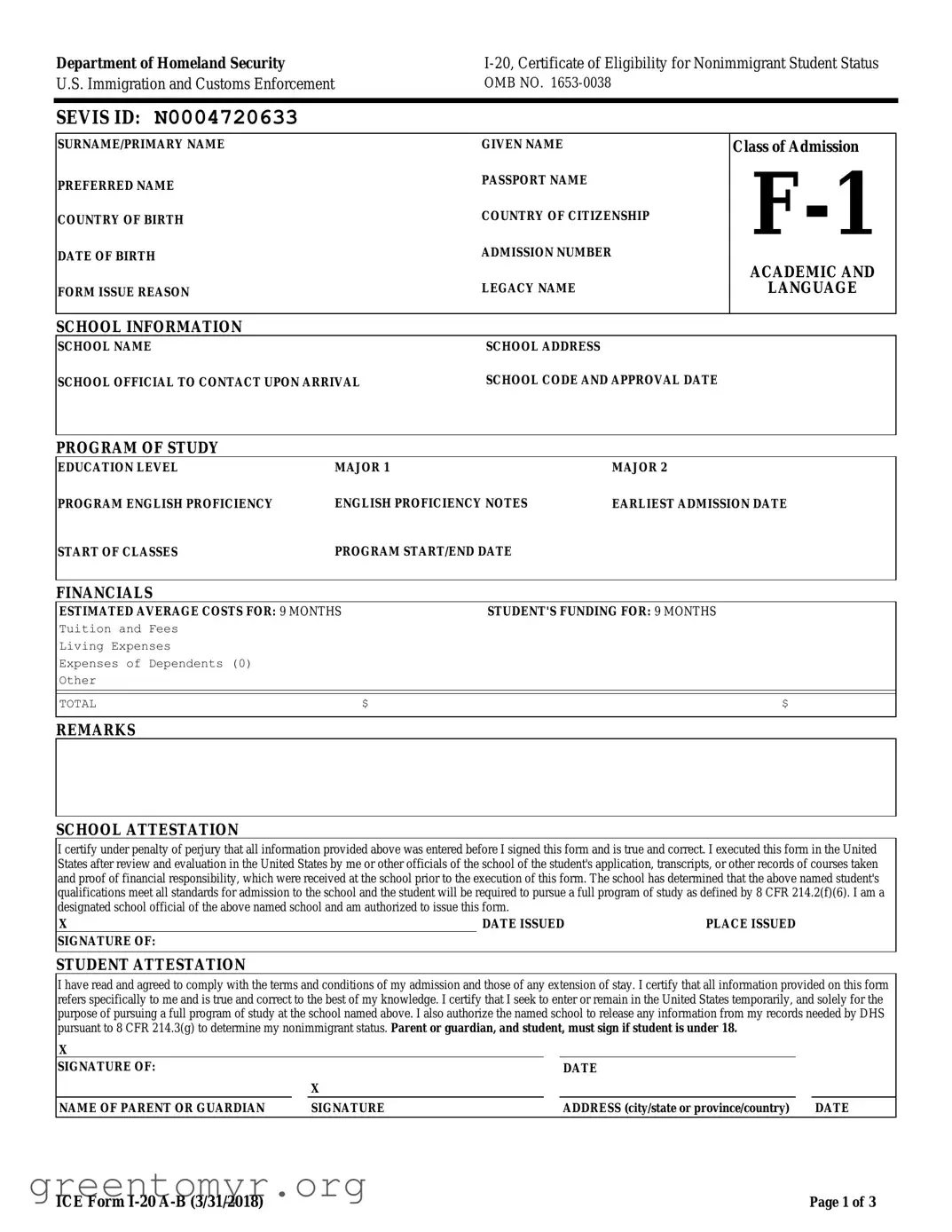
The I-20 form, officially known as the Certificate of Eligibility for Nonimmigrant Student Status, plays a crucial role for international students wishing to study in the United States. This document is issued by a designated school official and serves as proof that a student has been accepted into a recognized academic program. Key information on the form includes the student's personal details, such as name, date of birth, and country of citizenship, along with specifics about the school, program of study, and financial obligations. The I-20 also outlines the student's eligibility to apply for an F-1 visa, which allows them to enter the U.S. for educational purposes. It is essential for students to keep their I-20 form on hand at all times, as it is required for various processes, including visa applications and re-entry into the U.S. after travel. Additionally, the form contains important attestation sections where both the student and the school official certify the accuracy of the information provided. Understanding the I-20 form is vital for maintaining legal status and ensuring a smooth educational experience in the United States.
Department of Homeland Security |
|
U.S. Immigration and Customs Enforcement |
OMB NO. |
|
|
SEVIS ID: N0004720633
SURNAME/PRIMARY NAME |
GIVEN NAME |
Class of Admission |
PREFERRED NAME |
|
PASSPORT NAME |
|
|
|
|
|
||
|
|
|
|
|
COUNTRY OF BIRTH |
|
COUNTRY OF CITIZENSHIP |
|
|
|
|
|
|
|
DATE OF BIRTH |
|
ADMISSION NUMBER |
|
|
|
|
|
ACADEMIC AND |
|
|
|
|
|
|
FORM ISSUE REASON |
|
LEGACY NAME |
|
LANGUAGE |
|
|
|
|
|
SCHOOL INFORMATION |
|
|
|
|
SCHOOL NAME |
|
SCHOOL ADDRESS |
|
|
SCHOOL OFFICIAL TO CONTACT UPON ARRIVAL |
SCHOOL CODE AND APPROVAL DATE |
|
||
|
|
|
|
|
PROGRAM OF STUDY |
|
|
|
|
EDUCATION LEVEL |
MAJOR 1 |
|
MAJOR 2 |
|
PROGRAM ENGLISH PROFICIENCY |
ENGLISH PROFICIENCY NOTES |
EARLIEST ADMISSION DATE |
||
START OF CLASSES |
PROGRAM START/END DATE |
|
|
|
|
|
|
|
|
FINANCIALS |
|
|
|
|
ESTIMATED AVERAGE COSTS FOR: 9 MONTHS |
STUDENT'S FUNDING FOR: 9 MONTHS |
|
||
Tuition and Fees |
|
|
|
|
Living Expenses |
|
|
|
|
Expenses of Dependents (0) |
|
|
|
|
Other |
|
|
|
|
|
|
|
|
|
TOTAL |
$ |
|
|
$ |
REMARKS
SCHOOL ATTESTATION
I certify under penalty of perjury that all information provided above was entered before I signed this form and is true and correct. I executed this form in the United States after review and evaluation in the United States by me or other officials of the school of the student's application, transcripts, or other records of courses taken and proof of financial responsibility, which were received at the school prior to the execution of this form. The school has determined that the above named student's qualifications meet all standards for admission to the school and the student will be required to pursue a full program of study as defined by 8 CFR 214.2(f)(6). I am a designated school official of the above named school and am authorized to issue this form.
X |
DATE ISSUED |
PLACE ISSUED |
SIGNATURE OF: |
|
|
STUDENT ATTESTATION
I have read and agreed to comply with the terms and conditions of my admission and those of any extension of stay. I certify that all information provided on this form refers specifically to me and is true and correct to the best of my knowledge. I certify that I seek to enter or remain in the United States temporarily, and solely for the purpose of pursuing a full program of study at the school named above. I also authorize the named school to release any information from my records needed by DHS pursuant to 8 CFR 214.3(g) to determine my nonimmigrant status. Parent or guardian, and student, must sign if student is under 18.
X |
|
|
|
|
|
|
SIGNATURE OF: |
|
|
|
DATE |
||
|
|
X |
|
|
|
|
NAME OF PARENT OR GUARDIAN |
|
SIGNATURE |
|
ADDRESS (city/state or province/country) DATE |
||
ICE Form |
Page 1 of 3 |
Department of Homeland Security |
|
U.S. Immigration and Customs Enforcement |
OMB NO. |
|
|
SEVIS ID: N0004720633 |
NAME: Student Sample |
|||
EMPLOYMENT AUTHORIZATIONS |
|
|
|
|
TYPE |
STATUS |
START DATE |
END DATE |
|
CPT |
PART TIME |
APPROVED |
01 JULY 2016 |
15 JULY 2016 |
|
|
|
|
|
EMPLOYER INFORMATION |
|
|
|
|
|
|
|
|
|
TYPE |
|
AUTHORIZATION DATES |
|
|
CPT |
|
01 JULY 2016 - 15 JULY 2016 |
|
|
EMPLOYER NAME |
START DATE |
END DATE |
CITY & STATE |
|
SEVP applied labs |
01 JULY 2016 |
15 JULY 2016 |
Arlington, VA |
|
|
|
|
|
|
CHANGE OF |
|
|
|
|
|
|
|
|
|
|
|
|
|
|
AUTHORIZED REDUCED COURSE LOAD |
|
|
|
|
|
|
|
|
|
|
|
|
|
|
CURRENT SESSION DATES |
|
|
|
|
|
|
|
|
|
CURRENT SESSION START DATE |
|
CURRENT SESSION END DATE |
|
|
01 JUNE 2016 |
|
30 JUNE 2016 |
|
|
TRAVEL ENDORSEMENT
This page, when properly endorsed, may be used for
SCHOOL OFFICIAL |
|
TITLE |
|
SIGNATURE |
|
DATE ISSUED |
|
PLACE ISSUED |
|
|
|
|
X |
|
|
|
|
|
|
|
|
|
|
|
|
|
|
|
|
|
X |
|
|
|
|
|
|
|
|
|
|
|
|
|
|
|
|
|
X |
|
|
|
|
|
|
|
|
|
|
|
|
|
|
|
|
|
X |
|
|
|
|
|
|
|
|
|
|
|
|
|
ICE Form |
Page 2 of 3 |

Department of Homeland Security |
|
U.S. Immigration and Customs Enforcement |
OMB NO. |
|
|
INSTRUCTIONS TO STUDENTS
STUDENT ATTESTATION. You should read everything on this page carefully. Be sure that you understand the terms and conditions concerning your admission and stay in the United States as a nonimmigrant student before signing the student attestation on page 1 of the Form
FORM
VISA APPLICATION. You must give this Form
ADMISSION. When you enter the United States, you must present the following documents to the officer at the port of entry: 1) a Form
4)evidence of support for tuition and fees and living expenses while you are in the United States. The agent should return all documents to you before you leave the inspection area.
REPORT TO SCHOOL NAMED ON YOUR FORM
EMPLOYMENT. Unlawful employment in the United States is a reason for terminating your
PERIOD OF STAY. You may remain in the United States while taking a full course of study or during authorized employment after your program.
EXTENSION OF PROGRAM. If you cannot complete the education program by the program end date on page 1 of your Form
SCHOOL TRANSFER. To transfer schools, first notify the DSO at the school you are attending of your plan to transfer, then obtain a Form
NOTICE OF ADDRESS. When you arrive in the United States, you must report your U.S. address to your DSO. If you move, you must notify your DSO of your new address within 10 days of the change of address. The DSO will update SEVIS with your new address.
REENTRY.
AUTHORIZATION TO RELEASE INFORMATION BY SCHOOL. DHS requires your school to provide DHS with your name, country of birth, current address, immigration status, and certain other information on a regular basis or upon request. Your signature on the Form
PENALTY. To maintain your nonimmigrant student status, you must: 1) remain a
INSTRUCTIONS TO SCHOOLS
Failure to comply with 8 CFR 214.3(k) and 8 CFR 214.4 when issuing Forms I- 20 will subject you and your school to criminal prosecution. If you issue this form improperly, provide false information, or fail to submit required reports, DHS may withdraw its certification of your school for attendance by nonimmigrant students.
ISSUANCE OF FORM
1)plans to apply to enter the United States in
ENDORSEMENT OF PAGE 2 FOR REENTRY. If there have been no substantive changes in information, DSOs may endorse page 2 of the Form
RECORDKEEPING. DHS may request information concerning the student's immigration status for various reasons. DSOs should retain all evidence of academic ability and financial resources on which admission was based, until SEVIS shows the student's record completed or terminated.
AUTHORITY FOR COLLECTING INFORMATION. Authority for collecting the information on this and related student forms is contained in 8 U.S.C. 1101 and 1184. The Department of State and DHS use this information to determine eligibility for the benefits requested.The law provides severe penalties for knowingly and willfully falsifying or concealing a material fact, or using any false document in the submission of this form.
REPORTING BURDEN. U.S. Immigration and Customs Enforcement collects this information as part of its agency mission under the Department of Homeland Security. The estimated average time to review the instructions, search existing data sources, gather and maintain the needed data, and complete and review the collection of information is 30 minutes (.50 hours) per response. An agency may not conduct or sponsor, and a person is not required to respond to an information collection unless a form displays a currently valid OMB Control number. Send comments regarding this burden estimate or any other aspect of this collection of information, including suggestions for reducing this burden, to: Office of the Chief Information Officer/Forms Management Branch, U.S. Immigration and Customs Enforcement. 801 I Street NW Stop 5800, Washington, DC 20536- 5800. Do not send the form to this address.
ICE Form |
Page 3 of 3 |
| Fact Name | Description |
|---|---|
| Purpose | The I-20 form certifies eligibility for nonimmigrant student status in the U.S. |
| SEVIS ID | Each I-20 includes a unique SEVIS ID number for tracking student status. |
| Program Requirements | Students must pursue a full course of study as defined by U.S. regulations. |
| Employment Authorization | Students may work on-campus or apply for off-campus employment with proper authorization. |
| Validity for Re-entry | The I-20 must be properly endorsed for re-entry into the U.S. after temporary absence. |
| Governing Laws | Regulations are primarily governed by 8 CFR 214.2(f) and 8 CFR 214.3. |
Completing the I-20 form is a crucial step in your journey as a nonimmigrant student in the United States. This document serves as proof of your acceptance into a U.S. educational institution and is essential for your visa application. Follow these steps carefully to ensure that all information is accurately provided.
After completing the I-20 form, it will be reviewed and signed by your DSO. Once issued, you will need to present this document during your visa application process. Keep it safe, as you will need it for your entry into the United States and to maintain your student status.
The I-20 form, officially known as the Certificate of Eligibility for Nonimmigrant Student Status, is a crucial document for international students in the United States. It is issued by a designated school official (DSO) and signifies that a student has been accepted into a full-time academic program. This form allows students to apply for an F-1 visa, which permits them to study in the U.S. The I-20 includes important information such as the student's personal details, the program of study, and the estimated costs of tuition and living expenses.
Any international student wishing to study in the United States on an F-1 visa must obtain an I-20 form. This includes students who are applying to a new school, transferring from another institution, or changing their nonimmigrant status to F-1. Additionally, dependents of F-1 students, such as spouses and children under 21, may also require an I-20 form to enter or remain in the U.S. as F-2 dependents.
If you lose your I-20 form, it is important to act quickly. You should contact the designated school official (DSO) at your school immediately to request a replacement. The DSO will verify your status and issue a new I-20. Always keep a copy of your I-20 form in a safe place and carry it with you when traveling, as it is a key document for your student status in the U.S.
The I-20 form is essential for applying for an F-1 visa. When you apply for your visa at a U.S. consulate or embassy, you must present your I-20 form along with other required documents, such as a valid passport and evidence of financial support. The I-20 form indicates to the consular officer that you have been accepted into a legitimate academic program and that you meet the necessary requirements to study in the United States.
If you fail to enroll in the school indicated on your I-20 by the program start date, you may lose your student status. This could lead to deportation from the United States. It is crucial to report to your designated school official (DSO) upon your arrival and to attend classes as scheduled. If you have valid reasons for not being able to enroll on time, discuss your situation with your DSO as soon as possible to explore your options.
Filling out the I-20 form can be a complex process, and mistakes can have serious consequences for nonimmigrant students. One common error is providing incorrect personal information. This includes misspellings of names or incorrect dates of birth. Such inaccuracies can lead to delays or complications in visa processing. Always double-check this information to ensure it matches your official documents.
Another frequent mistake involves misunderstanding the program start and end dates. Students often misinterpret these dates, leading to issues with maintaining their student status. It is crucial to clearly understand the academic calendar of the institution and ensure that the dates entered on the form are accurate and reflect the actual program schedule.
Financial information is also a critical area where errors can occur. Many students underestimate the total costs associated with their education, including tuition and living expenses. Providing inaccurate financial details can result in visa denials. It is important to review the estimated average costs thoroughly and provide a realistic picture of your funding sources.
Additionally, some students fail to sign the form or neglect to have their parent or guardian sign if they are under 18. This oversight can render the form invalid. Always ensure that all required signatures are obtained before submission to avoid unnecessary delays.
Lastly, students may overlook the importance of the school’s attestation section. This part certifies that the school has reviewed the student’s qualifications. If this section is not completed correctly, it could jeopardize the student’s eligibility for the F-1 visa. Make sure that the designated school official has filled out this section properly and that all necessary approvals are in place.
The I-20 form is a crucial document for nonimmigrant students wishing to study in the United States. Alongside the I-20, several other forms and documents are often required to ensure a smooth transition into the educational environment. Below is a list of these important documents, each serving a specific purpose in the immigration and educational process.
Having these documents prepared and organized will facilitate your journey as a nonimmigrant student in the United States. Each form plays a vital role in ensuring compliance with immigration regulations and securing your educational goals.
The I-20 form, officially known as the Certificate of Eligibility for Nonimmigrant Student Status, is a critical document for international students in the United States. It serves various purposes and has similarities with several other important documents in the immigration and education sectors. Here’s a list of documents that share similarities with the I-20 form:
Understanding these documents and their similarities to the I-20 form is essential for international students navigating the U.S. immigration system. Each document plays a role in ensuring compliance with regulations and maintaining student status during their educational journey.
When filling out the I-20 form, it is crucial to be meticulous and informed. Here are five important things to do and avoid:
Understanding the I-20 form is crucial for nonimmigrant students in the U.S. However, several misconceptions can lead to confusion and potential issues. Here are ten common misconceptions about the I-20 form:
Being aware of these misconceptions can help ensure a smoother experience for nonimmigrant students navigating their educational journey in the United States.
Key Takeaways for Filling Out and Using the I-20 Form: