Content Navigation

In the realm of legal proceedings, ensuring that all parties involved are properly notified is crucial. One important tool in this process is the Illinois Affidavit of Service form. This document serves as proof that a legal notice, such as a summons or complaint, has been delivered to the intended recipient. It includes essential details such as the date and method of service, the name of the individual served, and the address where the service took place. Additionally, the form requires the signature of the person who performed the service, affirming that the information provided is accurate. Understanding how to correctly fill out and file this affidavit can significantly impact the progression of a legal case, making it a vital component for anyone navigating the Illinois legal system.

Illinois Affidavit of Service Example

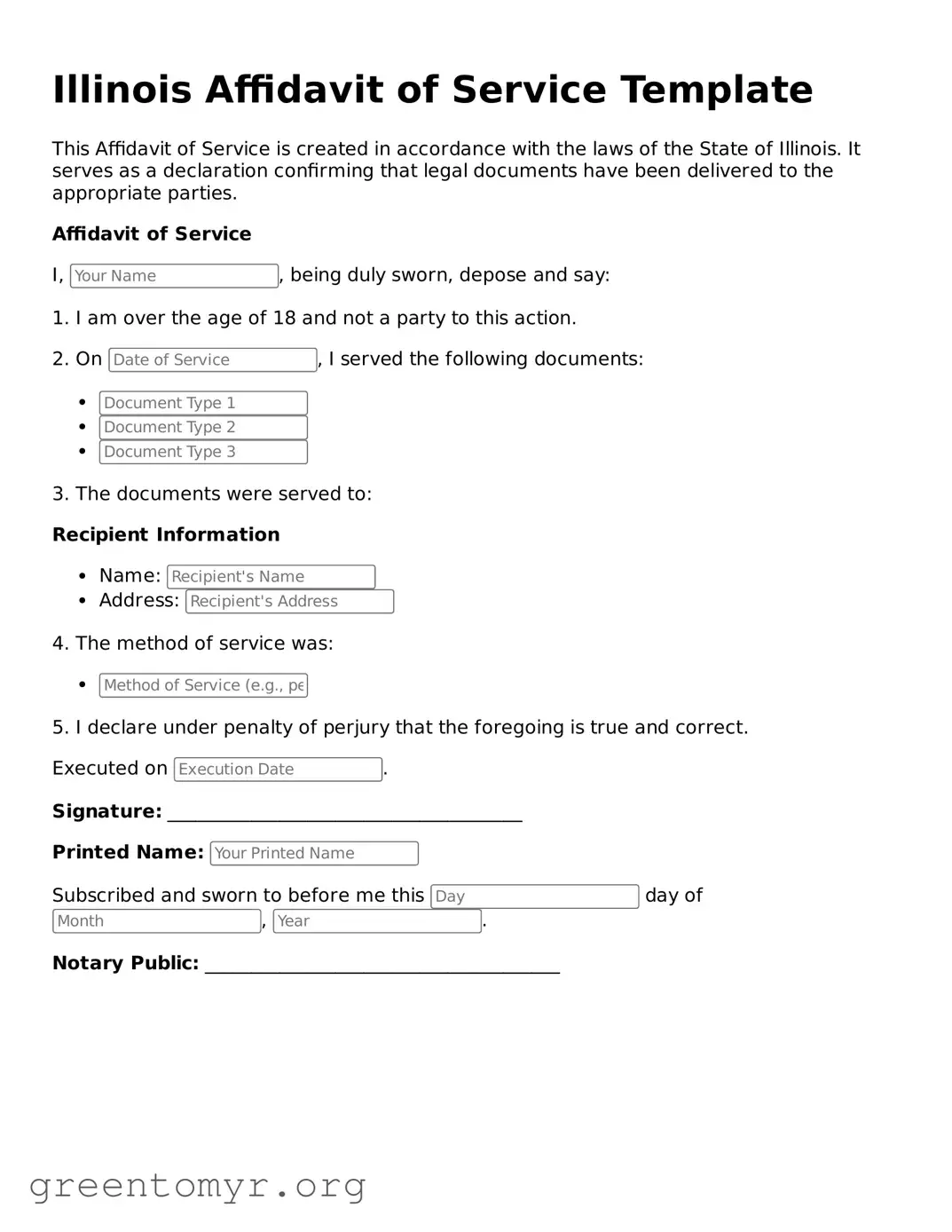
Illinois Affidavit of Service Template

This Affidavit of Service is created in accordance with the laws of the State of Illinois. It serves as a declaration confirming that legal documents have been delivered to the appropriate parties.

Affidavit of Service

I, , being duly sworn, depose and say:

1. I am over the age of 18 and not a party to this action.

2. On , I served the following documents:

3. The documents were served to:

Recipient Information

  • Name:
  • Address:

4. The method of service was:

5. I declare under penalty of perjury that the foregoing is true and correct.

Executed on .

Signature: ______________________________________

Printed Name:

Subscribed and sworn to before me this day of , .

Notary Public: ______________________________________

PDF Form Features

Fact Name Description
Purpose The Illinois Affidavit of Service form is used to confirm that legal documents have been delivered to the appropriate parties.
Governing Law This form is governed by the Illinois Code of Civil Procedure, specifically 735 ILCS 5/2-203.
Who Can Serve Any adult who is not a party to the case can serve the documents and complete the affidavit.
Filing Requirement The completed affidavit must be filed with the court to prove that service has been made.
Types of Documents This affidavit can be used for various legal documents, including summons, complaints, and subpoenas.
Signature Requirement The server must sign the affidavit in front of a notary public to validate the document.
Deadline for Filing The affidavit should be filed with the court promptly after service is completed, typically within a few days.
Consequences of Non-Compliance If the affidavit is not filed, the court may not recognize that service was properly completed, which can delay the case.
Format The form must be completed accurately, including details such as the date of service and the address where documents were served.

Guide to Using Illinois Affidavit of Service

After obtaining the Illinois Affidavit of Service form, it’s important to fill it out accurately to ensure that the document serves its purpose in your legal proceedings. Follow these steps to complete the form correctly.

  1. Begin by writing the name of the court at the top of the form. This is where your case is being heard.
  2. Next, fill in the case number. If you do not have a case number yet, you may need to obtain one from the court.
  3. Provide the names of the parties involved in the case. List the plaintiff and the defendant clearly.
  4. Indicate the date on which the service was made. This is crucial for tracking the timeline of your case.
  5. In the section for the person served, write the name of the individual who received the documents. Be sure to spell their name correctly.
  6. Specify the address where the service took place. This should be the exact location where the documents were delivered.
  7. Detail the method of service. Indicate whether it was done in person, by mail, or another method.
  8. Sign the affidavit at the bottom of the form. Your signature confirms that the information provided is true and accurate.
  9. Finally, date your signature. This shows when you completed the affidavit.

Once you have filled out the form, review it for any errors or omissions. Ensuring accuracy is key to the effectiveness of the affidavit. After that, you can file it with the appropriate court or provide it to the necessary parties as required.

Get Answers on Illinois Affidavit of Service

What is an Illinois Affidavit of Service?

An Illinois Affidavit of Service is a legal document that confirms a person has been served with court papers. This could include documents like a summons or complaint. The affidavit serves as proof that the required party received the documents, which is crucial for the court process to move forward.

Who needs to fill out the Affidavit of Service?

The Affidavit of Service is typically filled out by the individual who delivers the legal documents. This person is often referred to as the “server.” It can be a professional process server or someone else who is not involved in the case and is over 18 years old.

How do I complete the Affidavit of Service?

Completing the Affidavit of Service involves a few key steps:

  1. Identify the documents served and the date of service.
  2. Provide the name and address of the person served.
  3. Include your own name and address as the server.
  4. Sign the affidavit in front of a notary public, if required.

Make sure all information is accurate to avoid any issues later on.

Do I need to notarize the Affidavit of Service?

In many cases, the Affidavit of Service must be notarized. Notarization adds a layer of authenticity to the document. However, some jurisdictions may allow the server to sign the affidavit without a notary. Always check local rules to ensure compliance.

What happens if I don’t file the Affidavit of Service?

If the Affidavit of Service is not filed, the court may not proceed with your case. This is because the court needs proof that the other party has been properly notified. Without this document, your case could be delayed or dismissed.

Can I serve documents myself?

Yes, you can serve documents yourself, as long as you meet certain criteria. You must be at least 18 years old and not a party to the case. However, many people choose to hire a professional process server to ensure everything is done correctly and to avoid any potential issues.

How long do I have to serve the documents?

The time frame for serving documents varies depending on the type of case. Generally, you should serve documents as soon as possible after filing your case. Some rules may require service within a specific number of days. It’s important to check the local court rules for your specific situation.

What if the person I’m serving refuses to accept the documents?

If the person refuses to accept the documents, you can still complete the service. You may leave the documents in a location where they can be found or have someone else serve them. In some cases, you may need to follow specific procedures, like using certified mail or seeking a court order for alternative service. Always consult local rules for guidance.

Common mistakes

Completing the Illinois Affidavit of Service form can be straightforward, but several common mistakes can lead to complications. One frequent error is failing to provide accurate details about the recipient. It is crucial to ensure that the name and address are correct. Any discrepancies can cause delays or even render the service invalid.

Another common mistake involves the signature of the server. The form requires the server’s signature to validate the service. If this signature is missing or illegible, the court may question the authenticity of the service. Always double-check that the server has signed the document clearly and appropriately.

Additionally, people often overlook the date of service. This date is essential for tracking timelines in legal proceedings. If the date is not filled out or is incorrect, it can lead to confusion about when the service was completed. Ensure that the date is accurate and reflects when the service actually took place.

Lastly, individuals sometimes neglect to file the affidavit with the court after completing it. Submitting the affidavit is a critical step in the process. Without this submission, there is no official record of service, which can undermine the entire legal action. Always remember to file the affidavit promptly to maintain the integrity of the service process.

Documents used along the form

When navigating the legal process in Illinois, the Affidavit of Service is a crucial document that verifies a party has been properly notified of legal proceedings. However, it often works in conjunction with several other forms and documents. Understanding these related documents can help ensure that you have everything you need for a smooth legal experience.

  • Summons: This document notifies the defendant of the legal action being taken against them. It includes essential details such as the court's name, the parties involved, and the timeframe for the defendant to respond.
  • Complaint: The complaint outlines the plaintiff's case and the specific claims being made. It serves as the foundation for the legal action, detailing the facts and legal basis for the lawsuit.
  • Proof of Service: This document confirms that the summons and complaint were delivered to the defendant. It provides evidence that the defendant has been properly served, which is vital for the court's jurisdiction.
  • Motion: A motion is a request made to the court for a specific ruling or order. Various motions can be filed throughout a case, such as a motion to dismiss or a motion for summary judgment.
  • Notice of Appearance: This form is filed by an attorney to formally announce their representation of a party in a legal case. It ensures that all parties are aware of who is representing whom.
  • Answer: The answer is the defendant's formal response to the complaint. It addresses the claims made and may include defenses or counterclaims against the plaintiff.
  • Certificate of Service: This document certifies that copies of certain documents have been provided to all parties involved in the case. It is essential for maintaining transparency and communication throughout the legal process.

Having these documents prepared and organized can significantly enhance your legal proceedings. By understanding their purposes and interconnections, you can ensure that you are adequately equipped to move forward in your case with confidence.

Similar forms

  • Proof of Service: This document confirms that a party has delivered legal documents to another party. It serves a similar purpose by verifying that the intended recipient has received the documents, ensuring proper legal procedure.
  • Certificate of Service: Like the Affidavit of Service, this certificate provides evidence that a party has served documents to another party. It is often used in court to demonstrate compliance with service requirements.
  • Return of Service: This document is filed by the process server to confirm that they have successfully delivered the documents. It is similar in function, providing a record of service completion.
  • Service of Process: This term refers to the procedure of delivering legal documents to a party. While it encompasses the act itself, the Affidavit of Service serves as proof that this act has been completed.
  • Notice of Service: This document informs the court and the involved parties that service has been completed. It parallels the Affidavit of Service in that it communicates the completion of service.
  • Summons: A summons notifies a defendant of legal action against them. While it is a separate document, it often accompanies an Affidavit of Service to confirm that the defendant was properly notified.
  • Service Acknowledgment: This is a document signed by the recipient, acknowledging that they have received the legal documents. It serves a similar purpose to the Affidavit of Service by providing proof of delivery.
  • Delivery Receipt: This document confirms that a package or document has been received. While it is typically used for general deliveries, it shares the same principle of confirming receipt as the Affidavit of Service.
  • Court Filing Confirmation: This document verifies that a party has filed certain documents with the court. It is similar in that it serves to confirm that a necessary step in the legal process has been completed.

Dos and Don'ts

When filling out the Illinois Affidavit of Service form, it’s important to ensure that you do it correctly. Here are some guidelines to help you navigate the process smoothly.

  • Do read the instructions carefully.
  • Do provide accurate information about the person being served.
  • Do include the date and time of service.
  • Do sign the affidavit in front of a notary public.
  • Do keep a copy for your records.
  • Don't leave any sections blank.
  • Don't use outdated forms; always check for the latest version.
  • Don't forget to include your contact information.
  • Don't submit the form without verifying the details.
  • Don't rush through the process; take your time to ensure accuracy.

Misconceptions

When it comes to the Illinois Affidavit of Service form, there are several misconceptions that can lead to confusion. Understanding these can help ensure that the process goes smoothly. Here’s a list of ten common misconceptions:

  1. Anyone can serve documents. While it may seem straightforward, only certain individuals, such as a process server or a sheriff, are authorized to serve legal documents in Illinois.
  2. Affidavit of Service is optional. This form is crucial. It provides proof that the documents were served, which is often required by the court.
  3. Service can be done at any time. There are specific rules about when documents can be served. For example, serving someone late at night or on holidays may not be allowed.
  4. Once served, the recipient cannot contest. Just because someone has been served does not mean they cannot challenge the case or the validity of the service.
  5. The Affidavit of Service must be filed immediately. While it should be filed with the court, there is usually a timeframe within which it must be submitted after service.
  6. All types of documents require an Affidavit of Service. Not every document needs this form. It's primarily used for summons, complaints, and other legal notices.
  7. Service by mail is sufficient. In many cases, personal service is required. Simply mailing the documents may not meet legal requirements.
  8. Affidavit of Service is the same as a proof of service. While they are related, they are not the same. The affidavit is a sworn statement that service occurred, while proof of service may refer to the actual delivery method.
  9. Once the affidavit is signed, it cannot be changed. If there is an error, it can be amended. However, it’s important to do this correctly to avoid complications.
  10. It’s a simple form with no legal implications. This form carries significant weight. Incorrect information can lead to delays or even dismissals in legal proceedings.

Being aware of these misconceptions can help individuals navigate the legal process more effectively. Understanding the importance of the Affidavit of Service and the rules surrounding it can prevent unnecessary complications.

Key takeaways

When completing and utilizing the Illinois Affidavit of Service form, keep the following key takeaways in mind:

  1. Accurate Information: Ensure all details entered on the form are correct. This includes the names of the parties involved and the date of service.
  2. Signature Requirement: The affidavit must be signed by the person who performed the service. A witness may also be required in certain cases.
  3. Filing Deadline: Submit the affidavit within the specified timeframe after service has been completed to avoid delays in the legal process.
  4. Keep Copies: Always retain a copy of the completed affidavit for your records. This can be important for future reference.
  5. Jurisdiction Matters: Ensure that the affidavit is filed in the correct court that has jurisdiction over the case.
  6. Follow Local Rules: Familiarize yourself with any local court rules regarding the affidavit of service, as they may vary by jurisdiction.