When entering into a commercial lease in Illinois, both landlords and tenants must navigate a variety of important considerations that impact their business operations. The Illinois Commercial Lease Agreement form serves as a crucial document that outlines the terms and conditions of the rental arrangement. This form typically includes details such as the duration of the lease, the amount of rent, and the payment schedule. Additionally, it addresses responsibilities regarding maintenance, utilities, and repairs, ensuring both parties understand their obligations. Specific provisions related to security deposits, termination rights, and the use of the property also play a vital role in protecting the interests of both the landlord and the tenant. By clearly defining these elements, the lease agreement helps to foster a healthy landlord-tenant relationship and provides a framework for resolving any potential disputes that may arise during the lease term.
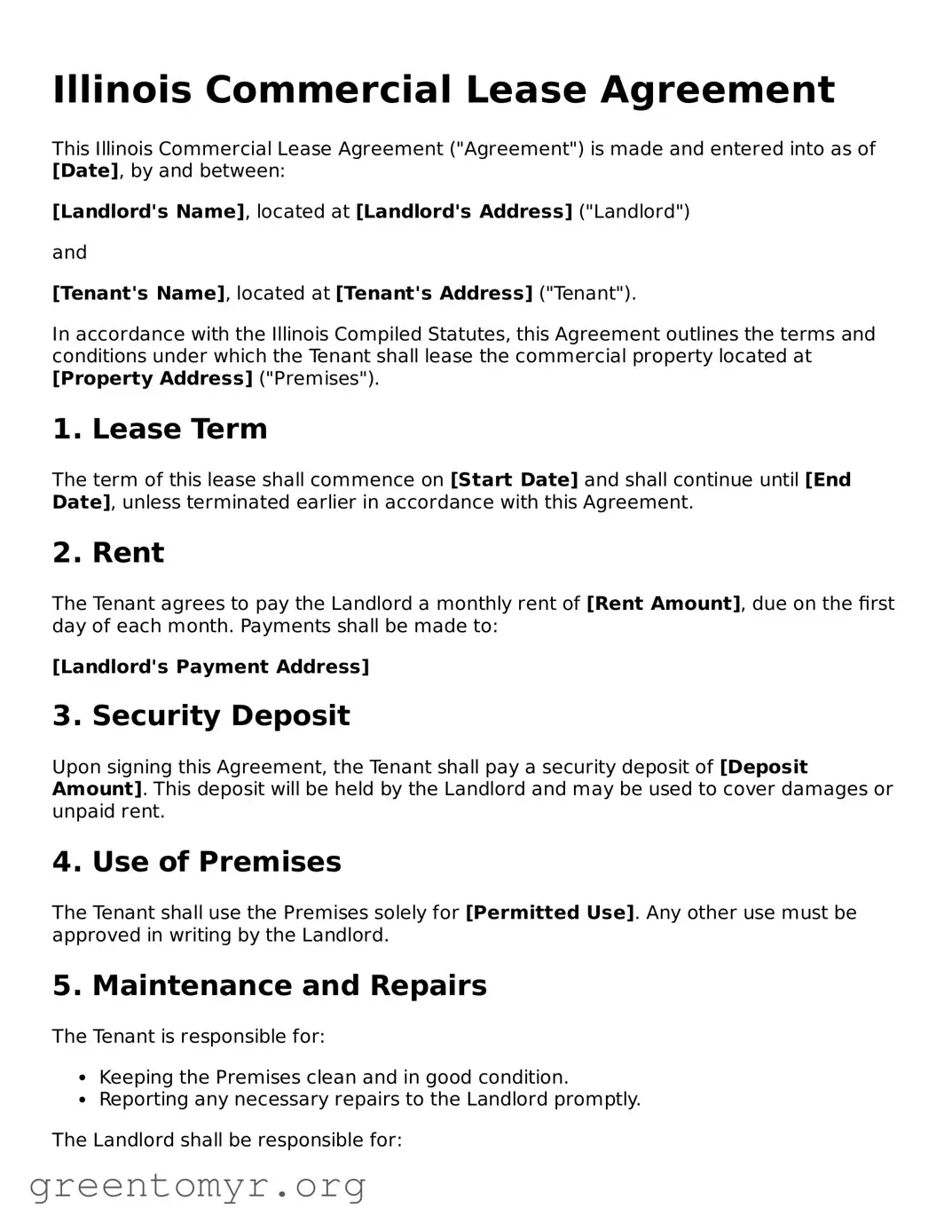
Illinois Commercial Lease Agreement
This Illinois Commercial Lease Agreement ("Agreement") is made and entered into as of [Date], by and between:
[Landlord's Name], located at [Landlord's Address] ("Landlord")
and
[Tenant's Name], located at [Tenant's Address] ("Tenant").
In accordance with the Illinois Compiled Statutes, this Agreement outlines the terms and conditions under which the Tenant shall lease the commercial property located at [Property Address] ("Premises").
1. Lease Term
The term of this lease shall commence on [Start Date] and shall continue until [End Date], unless terminated earlier in accordance with this Agreement.
2. Rent
The Tenant agrees to pay the Landlord a monthly rent of [Rent Amount], due on the first day of each month. Payments shall be made to:
[Landlord's Payment Address]
3. Security Deposit
Upon signing this Agreement, the Tenant shall pay a security deposit of [Deposit Amount]. This deposit will be held by the Landlord and may be used to cover damages or unpaid rent.
4. Use of Premises
The Tenant shall use the Premises solely for [Permitted Use]. Any other use must be approved in writing by the Landlord.
5. Maintenance and Repairs
The Tenant is responsible for:
The Landlord shall be responsible for:
6. Insurance
The Tenant shall maintain liability insurance covering the Premises with a minimum coverage of [Insurance Amount]. Proof of insurance must be provided to the Landlord.
7. Termination
This Agreement may be terminated by either party with a written notice of [Notice Period] days. Upon termination, the Tenant shall vacate the Premises and return all keys to the Landlord.
8. Governing Law
This Agreement shall be governed by the laws of the State of Illinois.
9. Additional Provisions
Any additional provisions or amendments to this Agreement must be made in writing and signed by both parties.
IN WITNESS WHEREOF, the parties hereto have executed this Illinois Commercial Lease Agreement as of the date first above written.
______________________________
Landlord's Signature
______________________________
Tenant's Signature
| Fact Name | Details |
|---|---|
| Governing Law | The Illinois Commercial Lease Agreement is governed by the laws of the State of Illinois. |
| Parties Involved | The agreement involves at least two parties: the landlord (lessor) and the tenant (lessee). |
| Lease Duration | The lease duration can vary, often ranging from one year to several years, depending on the agreement. |
| Rent Payment Terms | Details regarding the rent amount, due date, and payment method are specified in the lease. |
| Security Deposit | Typically, a security deposit is required, which may be equivalent to one or more months' rent. |
| Property Use | The lease outlines the permitted use of the property, which can include retail, office, or industrial purposes. |
Filling out the Illinois Commercial Lease Agreement form is a straightforward process. This document outlines the terms of the lease between the landlord and tenant. To ensure accuracy and clarity, follow the steps below carefully.
A Commercial Lease Agreement is a legally binding contract between a landlord and a business tenant. This document outlines the terms under which a tenant can occupy a commercial property, such as an office, retail space, or warehouse. Key elements include the duration of the lease, rental payments, maintenance responsibilities, and any specific conditions related to the property.
Several important components should be included in a Commercial Lease Agreement:
The duration of a commercial lease can vary widely based on the needs of the business and the landlord's preferences. Typical leases range from one to five years, but longer leases are not uncommon, especially for established businesses. Short-term leases may also be available for startups or temporary projects.
Yes, a Commercial Lease Agreement can be modified, but any changes must be documented in writing and signed by both parties. This ensures that all modifications are legally enforceable. It's important to discuss any desired changes with the landlord and reach a mutual agreement before making adjustments.
If a tenant fails to pay rent, the landlord has the right to take specific actions. Typically, the landlord may issue a notice to the tenant, providing a grace period to pay the overdue rent. If the payment is not made, the landlord may initiate eviction proceedings. Understanding the terms outlined in the lease regarding late payments and eviction is crucial for both parties.
No, a Commercial Lease Agreement does not need to be notarized in Illinois to be legally binding. However, having the agreement notarized can provide an extra layer of protection and authenticity, especially in disputes. It’s often a good practice to have legal documents notarized to ensure all parties are properly identified and to prevent future complications.
When entering into a Commercial Lease Agreement, consider avoiding these common pitfalls:
You can obtain a Commercial Lease Agreement form from various sources, including legal stationery stores, online legal services, or local real estate agents. It's essential to ensure that the form complies with Illinois laws and is tailored to your specific needs. Consulting with a legal professional can also provide guidance and ensure that the agreement is comprehensive and enforceable.
Filling out the Illinois Commercial Lease Agreement form can be a straightforward process, but several common mistakes can lead to complications. One frequent error is failing to clearly identify the parties involved. It's essential to include the full legal names of both the landlord and the tenant. Omitting this information can create confusion and lead to disputes down the line.
Another mistake often made is neglecting to specify the lease term. The start and end dates of the lease should be clearly stated. Without this information, both parties may have different interpretations of the agreement's duration, which can result in misunderstandings.
Many people overlook the importance of detailing the rental amount. The lease should explicitly state the monthly rent and any additional fees, such as maintenance costs or utilities. Failing to include this information can lead to disputes over payments.
Additionally, some individuals forget to clarify the purpose of the lease. The agreement should specify what type of business will operate in the leased space. This clarity helps ensure that the property is used appropriately and in accordance with zoning laws.
Another common error is not addressing maintenance responsibilities. Both parties should understand who is responsible for repairs and upkeep. If these responsibilities are not clearly defined, it can lead to disagreements and potential legal issues.
Many people also neglect to include provisions for renewal or termination of the lease. Clearly outlining the process for ending or renewing the lease can prevent confusion and protect both parties' interests.
It's also important to pay attention to the security deposit terms. The lease should specify the amount of the deposit, the conditions under which it may be withheld, and the timeline for its return. Inadequate information can lead to disputes when the lease ends.
Some individuals fail to review the entire document before signing. Skimming through the lease can result in missing critical clauses or terms. Taking the time to read the agreement thoroughly ensures that all parties understand their rights and obligations.
Finally, not seeking legal advice can be a significant oversight. Consulting with a legal professional can help identify potential issues and ensure that the lease complies with Illinois law. This step can save both parties from future complications.
When entering into a commercial lease agreement in Illinois, several additional documents may be necessary to ensure all parties are protected and informed. These documents help clarify terms, outline responsibilities, and provide legal protections. Below is a list of commonly used forms that accompany the Illinois Commercial Lease Agreement.
These documents play a crucial role in the leasing process, ensuring clarity and legal compliance. It is advisable to review each form carefully and consider consulting a legal professional for guidance.
When filling out the Illinois Commercial Lease Agreement form, it’s important to be thorough and careful. Here’s a list of things you should and shouldn't do to ensure the process goes smoothly.
By following these guidelines, you can help ensure that your experience with the Illinois Commercial Lease Agreement is positive and that you are well-prepared for your leasing journey.
Misconception 1: The Illinois Commercial Lease Agreement is a one-size-fits-all document.
This is not true. While there are standard elements in many lease agreements, each lease should be tailored to fit the specific needs of the parties involved. Factors such as the type of business, location, and length of the lease can all influence the terms.
Misconception 2: All lease agreements are legally binding immediately upon signing.
While signing a lease does create a legal obligation, certain conditions may affect its enforceability. For example, if one party has not fulfilled specific requirements, such as obtaining necessary permits, the lease might not be binding until those conditions are met.
Misconception 3: Commercial leases do not require negotiation.
This is a common misunderstanding. Many assume that commercial leases are set in stone, but negotiation is often a crucial part of the process. Both landlords and tenants should feel empowered to discuss terms and make adjustments that reflect their needs.
Misconception 4: Tenants have no rights in a commercial lease.
This is incorrect. Tenants have rights that are protected by law. These rights can include the right to a safe and habitable space, protection against unfair eviction, and the right to privacy. Understanding these rights is essential for any tenant entering into a commercial lease.
When filling out and using the Illinois Commercial Lease Agreement form, there are several important points to keep in mind: