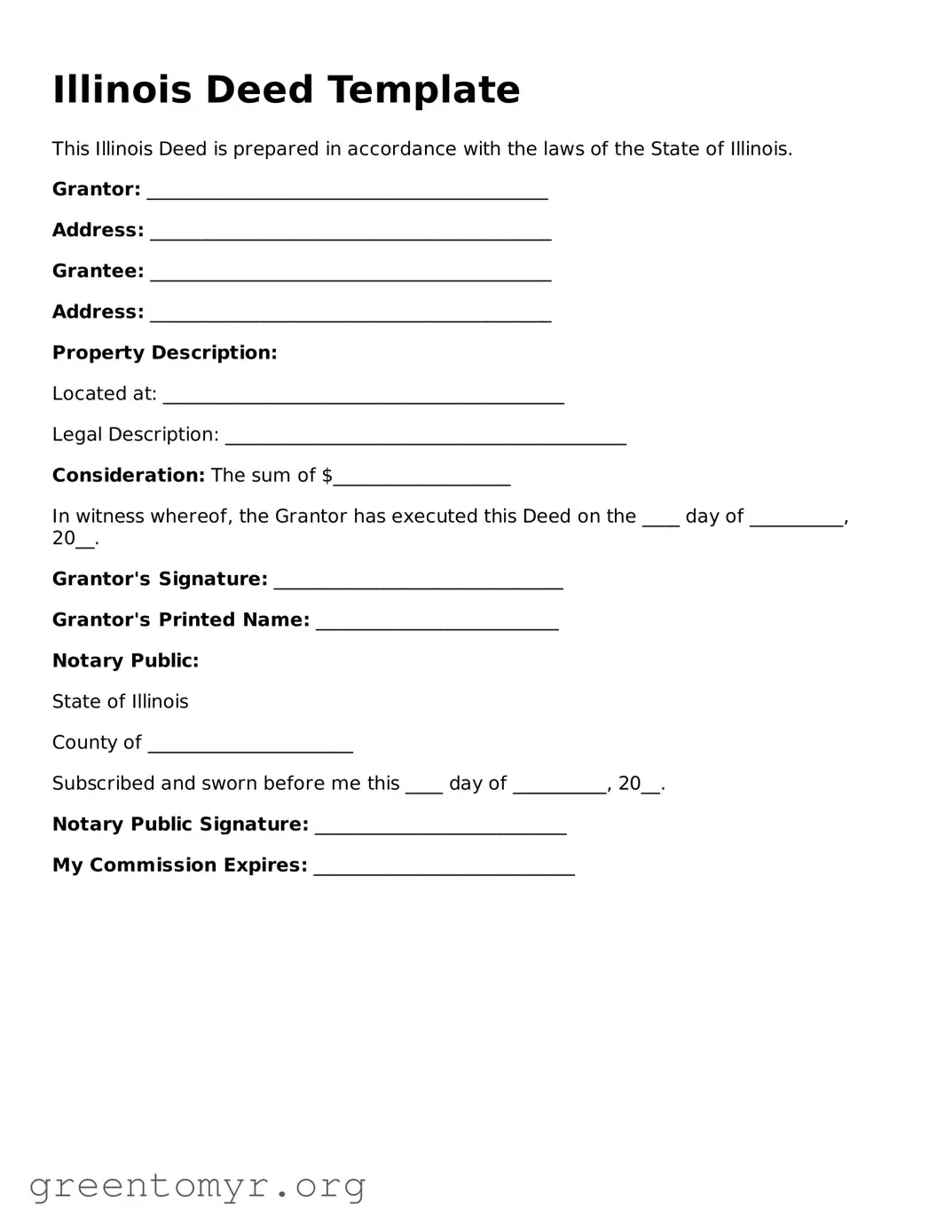
The Illinois Deed form serves as a vital document in the transfer of real estate ownership within the state. When a property owner wishes to sell or convey their property, this form outlines the necessary details to ensure a clear and legally binding transaction. Key aspects of the Illinois Deed include the identification of the grantor, or seller, and the grantee, or buyer, along with a precise description of the property being transferred. The form also requires the inclusion of the date of the transaction, which marks the official transfer of ownership. Additionally, signatures from both parties are essential, often necessitating the presence of a notary public to validate the transaction. Understanding these elements is crucial for anyone involved in real estate transactions in Illinois, as they help prevent disputes and ensure compliance with state laws.
Illinois Deed Template
This Illinois Deed is prepared in accordance with the laws of the State of Illinois.
Grantor: ___________________________________________
Address: ___________________________________________
Grantee: ___________________________________________
Address: ___________________________________________
Property Description:
Located at: ___________________________________________
Legal Description: ___________________________________________
Consideration: The sum of $___________________
In witness whereof, the Grantor has executed this Deed on the ____ day of __________, 20__.
Grantor's Signature: _______________________________
Grantor's Printed Name: __________________________
Notary Public:
State of Illinois
County of ______________________
Subscribed and sworn before me this ____ day of __________, 20__.
Notary Public Signature: ___________________________
My Commission Expires: ____________________________
| Fact Name | Description |
|---|---|
| Type of Deed | The Illinois Deed form can be used for various types of property transfers, including warranty deeds, quitclaim deeds, and special warranty deeds. |
| Governing Law | This form is governed by the Illinois Compiled Statutes, specifically under 765 ILCS 1005 for conveyances. |
| Signature Requirements | For the deed to be valid, it must be signed by the grantor and acknowledged before a notary public. |
| Recording | After execution, the deed should be recorded with the county recorder's office to provide public notice of the property transfer. |
Once you have the Illinois Deed form ready, you will need to complete it carefully to ensure all information is accurate. After filling out the form, it will need to be signed and notarized before being submitted to the appropriate county office for recording.
An Illinois Deed form is a legal document used to transfer ownership of real property from one party to another in the state of Illinois. This form serves as proof of the transaction and outlines the details of the transfer, including the names of the parties involved, a description of the property, and any conditions or covenants associated with the transfer. There are different types of deeds, such as warranty deeds and quitclaim deeds, each serving specific purposes and providing varying levels of protection for the buyer.
To complete an Illinois Deed form, you will need to provide several key pieces of information:
Filing an Illinois Deed form involves a few straightforward steps:
Using an Illinois Deed form provides several important benefits:
Filling out the Illinois Deed form can seem straightforward, yet many individuals make common mistakes that can lead to complications later. One frequent error is failing to include the correct legal description of the property. A vague or inaccurate description can create confusion and may even invalidate the deed. Always ensure that the property is described in detail, including boundaries and any relevant identifiers.
Another mistake involves the omission of signatures. All parties involved in the transaction must sign the deed. If even one signature is missing, the document may not be recognized as valid. It is essential to double-check that everyone required to sign has done so before submitting the form.
People often neglect to have the deed notarized. In Illinois, notarization is a crucial step that lends credibility to the document. Without a notary's seal, the deed may face challenges in proving its authenticity. Taking the time to have the deed properly notarized can save significant headaches in the future.
Additionally, some individuals fail to include the appropriate transfer tax declaration. This declaration is necessary for tax purposes and must accompany the deed. Neglecting this step can result in penalties or delays in the transfer process. Always verify that the correct forms are completed and submitted alongside the deed.
Finally, many overlook the importance of recording the deed with the county clerk's office. Even if the deed is filled out correctly, it must be recorded to provide public notice of the ownership transfer. Failing to record the deed can lead to disputes over property ownership down the line. Ensuring that the deed is recorded promptly is a critical step in safeguarding property rights.
When preparing to execute a property transfer in Illinois, several key documents often accompany the Illinois Deed form. Each of these documents serves a specific purpose in ensuring a smooth transaction and protecting the interests of all parties involved.
Understanding these documents is essential for a successful property transaction. Each serves to clarify responsibilities and protect your investment, ensuring that the process is as seamless as possible.
The Deed form shares similarities with several other legal documents. Each of these documents serves specific purposes in property and contractual transactions. Below is a list of nine documents that are similar to the Deed form:
When filling out the Illinois Deed form, it's essential to follow certain guidelines to ensure accuracy and compliance. Here are six important do's and don'ts to keep in mind:
By following these guidelines, you can help ensure that the deed is properly filled out and accepted without issues.
Many people have misunderstandings about the Illinois Deed form. Here are eight common misconceptions:
All deeds are the same. In Illinois, there are different types of deeds, such as warranty deeds and quitclaim deeds. Each serves a different purpose and offers varying levels of protection to the buyer.
A deed does not need to be recorded. While a deed can be valid without recording, failing to record it can create problems. Recording protects the buyer's interest and provides public notice of ownership.
Only lawyers can prepare a deed. While it is advisable to seek legal assistance, individuals can prepare their own deeds. However, they must ensure that all required information is included and that it meets state requirements.
Signing a deed is enough to transfer property. Simply signing a deed does not transfer ownership. The deed must be delivered to the grantee and accepted for the transfer to be effective.
All property transfers require a new deed. In some cases, property can be transferred without a new deed, such as through inheritance or when property is held in a trust. However, a new deed is often necessary for clarity.
Deeds are permanent and cannot be changed. While a deed is a legal document, it can be modified or revoked under certain circumstances. This typically requires a new deed to be executed.
Only property owners can execute a deed. While property owners usually execute deeds, authorized representatives, such as agents or executors, can also sign on behalf of the owner.
Illinois does not require a witness for a deed. In Illinois, a deed does not need to be witnessed to be valid. However, having a witness can add an extra layer of protection and credibility.
Filling out and using the Illinois Deed form is an important process for property owners. Here are some key takeaways to consider: