Content Navigation

In the realm of real estate transactions, particularly during times of financial distress, the Illinois Deed in Lieu of Foreclosure form serves as a significant legal instrument for homeowners facing foreclosure. This form allows property owners to voluntarily transfer the title of their property back to the lender, effectively relinquishing their ownership in exchange for relief from the burdens of mortgage debt. By opting for this route, homeowners can often avoid the lengthy and costly foreclosure process, thereby preserving their credit scores to some extent and minimizing the emotional toll associated with foreclosure proceedings. The form outlines essential details, including the names of the parties involved, the legal description of the property, and any existing liens or encumbrances. Importantly, it also stipulates the conditions under which the deed is executed, ensuring that both parties are clear about their rights and obligations. Understanding the nuances of this form is crucial for homeowners considering this option, as it can offer a pathway to a fresh start while also providing lenders with a more efficient means of recovering their investment.

Illinois Deed in Lieu of Foreclosure Example

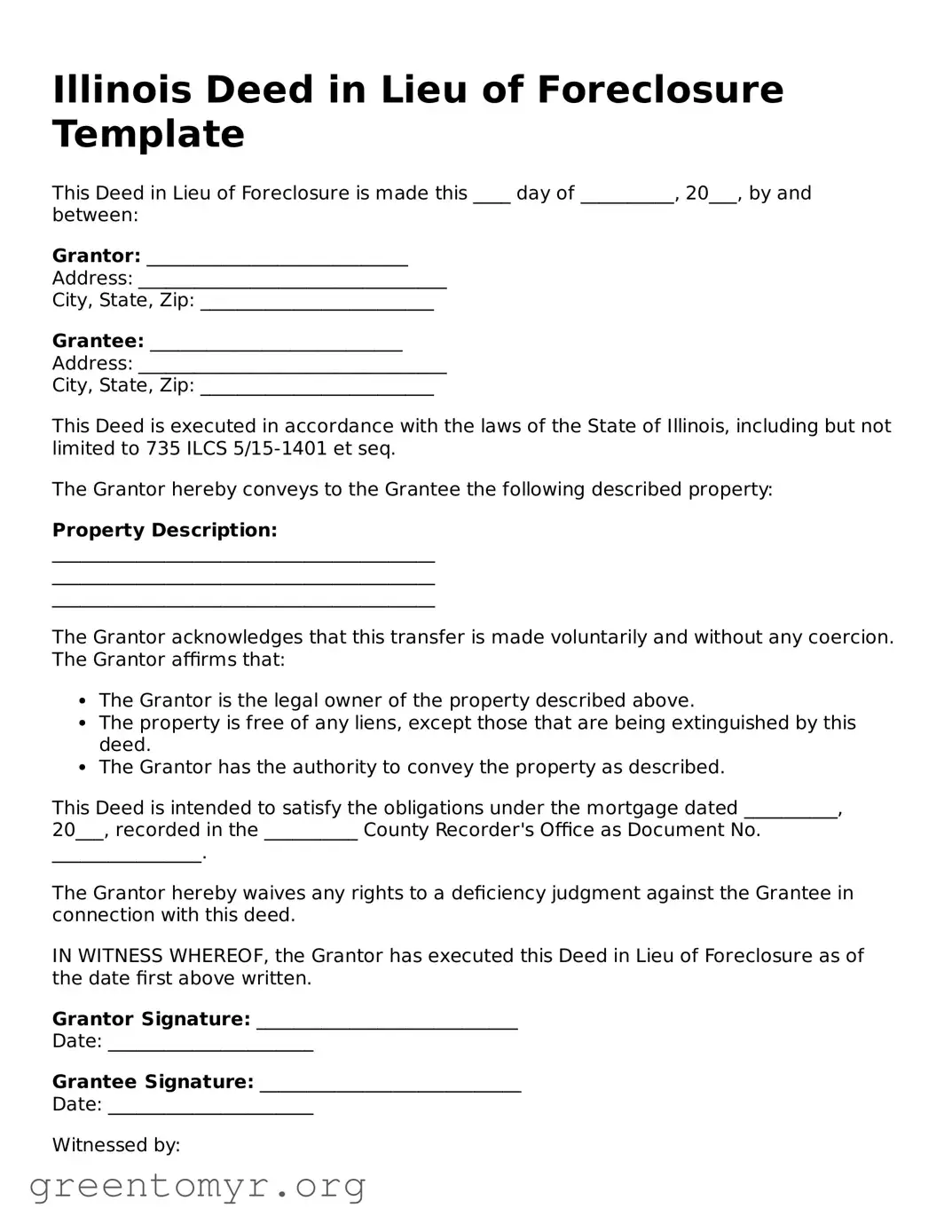
Illinois Deed in Lieu of Foreclosure Template

This Deed in Lieu of Foreclosure is made this ____ day of __________, 20___, by and between:

Grantor: ____________________________
Address: _________________________________
City, State, Zip: _________________________

Grantee: ___________________________
Address: _________________________________
City, State, Zip: _________________________

This Deed is executed in accordance with the laws of the State of Illinois, including but not limited to 735 ILCS 5/15-1401 et seq.

The Grantor hereby conveys to the Grantee the following described property:

Property Description:
_________________________________________
_________________________________________
_________________________________________

The Grantor acknowledges that this transfer is made voluntarily and without any coercion. The Grantor affirms that:

  • The Grantor is the legal owner of the property described above.
  • The property is free of any liens, except those that are being extinguished by this deed.
  • The Grantor has the authority to convey the property as described.

This Deed is intended to satisfy the obligations under the mortgage dated __________, 20___, recorded in the __________ County Recorder's Office as Document No. ________________.

The Grantor hereby waives any rights to a deficiency judgment against the Grantee in connection with this deed.

IN WITNESS WHEREOF, the Grantor has executed this Deed in Lieu of Foreclosure as of the date first above written.

Grantor Signature: ____________________________
Date: ______________________

Grantee Signature: ____________________________
Date: ______________________

Witnessed by:

Witness Signature: ____________________________
Date: ______________________

Witness Signature: ____________________________
Date: ______________________

PDF Form Features

Fact Name Description
Definition The Illinois Deed in Lieu of Foreclosure is a legal document allowing a borrower to transfer property ownership to the lender to avoid foreclosure.
Governing Law This form is governed by Illinois state law, specifically the Illinois Mortgage Foreclosure Law.
Eligibility Typically, borrowers who are unable to meet mortgage obligations may qualify for this option, provided they are in default.
Benefits One key advantage is that it can help borrowers avoid the lengthy foreclosure process and its negative impact on credit scores.
Process The process involves negotiation with the lender, completion of the deed, and acceptance by the lender to finalize the transfer.

Guide to Using Illinois Deed in Lieu of Foreclosure

After completing the Illinois Deed in Lieu of Foreclosure form, you will need to submit it to the appropriate parties involved in your situation. This may include your lender and possibly local government offices. Ensure that you keep copies for your records.

  1. Obtain the Illinois Deed in Lieu of Foreclosure form from a reliable source.
  2. Fill in the date at the top of the form.
  3. Provide the name of the property owner(s) in the designated space.
  4. Enter the address of the property that is subject to the deed.
  5. Include the legal description of the property. This can usually be found on your mortgage documents or property tax statements.
  6. Identify the lender's name and address as it appears on your mortgage documents.
  7. State the reason for the deed in lieu of foreclosure in the appropriate section.
  8. Sign the document in the presence of a notary public.
  9. Have the notary public complete their section, including their signature and seal.
  10. Make copies of the completed form for your records.
  11. Submit the original signed document to your lender.

Get Answers on Illinois Deed in Lieu of Foreclosure

What is a Deed in Lieu of Foreclosure?

A Deed in Lieu of Foreclosure is a legal document that allows a homeowner to transfer ownership of their property to the lender to avoid foreclosure. This option is typically pursued when the homeowner is unable to keep up with mortgage payments and wants to prevent the lengthy and costly foreclosure process. By agreeing to this arrangement, the lender accepts the property instead of going through foreclosure proceedings.

What are the benefits of choosing a Deed in Lieu of Foreclosure?

Opting for a Deed in Lieu of Foreclosure can offer several advantages:

  • Quicker Resolution: The process is generally faster than foreclosure, allowing homeowners to move on more quickly.
  • Less Impact on Credit: While it still affects credit scores, the impact may be less severe compared to a foreclosure.
  • Relief from Debt: Homeowners can eliminate their mortgage debt, which can provide financial relief.
  • Potential for Negotiation: Some lenders may negotiate terms that allow homeowners to stay in the property for a short period post-agreement.

What are the eligibility requirements for a Deed in Lieu of Foreclosure?

To qualify for a Deed in Lieu of Foreclosure, homeowners typically need to meet certain criteria, which may include:

  1. The property must be the homeowner's primary residence.
  2. The homeowner must demonstrate financial hardship, such as job loss or medical issues.
  3. The mortgage must be in default or nearing default.
  4. The homeowner must be willing to surrender the property voluntarily.

Each lender may have specific requirements, so it’s advisable to consult with them directly.

How does the process work?

The process of completing a Deed in Lieu of Foreclosure generally involves several steps:

  1. Contact the Lender: Homeowners should reach out to their lender to express interest in this option.
  2. Submit Documentation: Lenders may require financial documents to assess eligibility.
  3. Review Terms: Homeowners should carefully review the terms and conditions proposed by the lender.
  4. Sign the Deed: If approved, both parties will sign the Deed in Lieu of Foreclosure, transferring ownership.
  5. Property Transfer: The lender will then take possession of the property, and the homeowner will vacate.

Will I still owe money after a Deed in Lieu of Foreclosure?

In many cases, a Deed in Lieu of Foreclosure can relieve homeowners of their mortgage debt. However, it’s essential to confirm with the lender whether any deficiency balance will remain. A deficiency balance occurs when the property's value is less than the outstanding mortgage amount. Homeowners should seek clarification on this point to avoid unexpected financial obligations.

Common mistakes

Filling out the Illinois Deed in Lieu of Foreclosure form can be a complex process, and mistakes can lead to significant delays or complications. One common error occurs when individuals fail to provide accurate property descriptions. The legal description of the property must be precise and match the details on the original deed. Omitting critical details or using vague terms can create confusion and may invalidate the deed.

Another frequent mistake involves the signatures of the parties involved. All required parties must sign the document for it to be legally binding. Sometimes, individuals overlook the necessity of having all co-owners or spouses sign the deed. This oversight can lead to disputes later on, especially if one party claims they were not informed or did not consent to the deed.

Additionally, people often neglect to include necessary supporting documents. The Deed in Lieu of Foreclosure process typically requires various attachments, such as a letter of intent or a statement from the lender. Failing to include these documents can stall the process or lead to misunderstandings with the lender regarding the intent to transfer the property.

Misunderstanding the tax implications is another mistake that can have lasting consequences. Individuals may not realize that transferring property through a deed in lieu of foreclosure can have tax ramifications. Consulting with a tax professional before completing the form can provide clarity and help avoid unexpected financial burdens.

Finally, individuals sometimes submit the form without fully understanding the implications of a deed in lieu of foreclosure. This process can affect credit ratings and future borrowing capacity. It is crucial to comprehend the long-term effects of this decision and to explore all available options before proceeding.

Documents used along the form

A Deed in Lieu of Foreclosure is a legal document that allows a homeowner to transfer the title of their property to the lender in order to avoid foreclosure. Several other forms and documents are often used in conjunction with this process to ensure a smooth transaction and to clarify the terms involved. Below is a list of these documents.

  • Notice of Default: This document informs the borrower that they have defaulted on their mortgage payments. It outlines the amount owed and the steps that will be taken if the default is not resolved.
  • Loan Modification Agreement: This agreement modifies the original loan terms, such as interest rates or payment schedules, to make it more manageable for the borrower.
  • Release of Liability: This document releases the borrower from any further obligations related to the mortgage after the Deed in Lieu is executed.
  • Property Inspection Report: An inspection report assesses the condition of the property before the transfer of ownership, which can affect the lender's decision.
  • Title Search Report: A title search verifies the ownership of the property and checks for any liens or encumbrances that may affect the transfer.
  • Settlement Statement: This document outlines the financial details of the transaction, including any costs associated with the Deed in Lieu process.
  • Affidavit of Title: This sworn statement confirms that the seller has the right to transfer the property and that there are no undisclosed liens or claims against it.
  • Consent to Foreclosure: This document may be used to formally agree to the terms of the foreclosure process should the Deed in Lieu not be accepted.
  • Power of Attorney: This legal document allows one person to act on behalf of another in the transaction, which can be useful if the borrower is unable to be present.

Each of these documents plays a crucial role in the Deed in Lieu of Foreclosure process, providing clarity and legal protection for both the borrower and the lender. Understanding these forms can facilitate a smoother transition and help avoid potential complications.

Similar forms

The Deed in Lieu of Foreclosure form is similar to several other legal documents that deal with property and debt resolution. Here are four documents that share similarities:

  • Short Sale Agreement: This document allows a homeowner to sell their property for less than the amount owed on the mortgage. Like a deed in lieu, it aims to avoid foreclosure by settling the debt through a sale.
  • Loan Modification Agreement: This agreement alters the terms of an existing mortgage to make payments more manageable. Both documents seek to prevent foreclosure, but a loan modification keeps the homeowner in the property while adjusting the loan terms.
  • Foreclosure Notice: While this document initiates the foreclosure process, it serves as a formal warning to the homeowner. A deed in lieu acts as a solution to avoid reaching this stage, offering a way to transfer property ownership voluntarily.
  • Bankruptcy Filing: This legal process can help individuals reorganize or eliminate debts. Like a deed in lieu, it can provide relief from financial distress, but bankruptcy involves a court process and can impact credit for a longer duration.

Dos and Don'ts

When filling out the Illinois Deed in Lieu of Foreclosure form, it is essential to follow specific guidelines to ensure accuracy and compliance. Here is a list of things you should and shouldn't do:

  • Do verify that you have the correct form for your situation.
  • Do provide accurate property information, including the address and legal description.
  • Do ensure all parties involved sign the document.
  • Do consult with a legal or financial advisor if you have questions.
  • Do keep a copy of the completed form for your records.
  • Don't leave any sections blank unless instructed to do so.
  • Don't rush through the process; take your time to review each detail.
  • Don't sign the document without fully understanding its implications.
  • Don't forget to check for any additional requirements specific to your lender.

Misconceptions

Many homeowners facing financial difficulties may consider a deed in lieu of foreclosure as a potential solution. However, several misconceptions surround this option. Understanding these misconceptions can help individuals make informed decisions.

  • A deed in lieu of foreclosure eliminates all debt. This is not true. While it can relieve homeowners of their mortgage obligation, it does not automatically erase other debts. Homeowners may still owe money on second mortgages or other liens against the property.
  • It is a quick and easy process. The process can be lengthy and complicated. Lenders often require extensive documentation and may take time to evaluate the request. Homeowners should be prepared for a potentially drawn-out negotiation.
  • All lenders accept deeds in lieu of foreclosure. Not all lenders offer this option. Some may prefer to pursue foreclosure instead. Homeowners need to check with their specific lender to determine if a deed in lieu is an available option.
  • A deed in lieu of foreclosure does not affect credit scores. This is misleading. While it may be less damaging than a foreclosure, a deed in lieu can still negatively impact credit scores. Homeowners should understand the potential long-term effects on their credit history.
  • Homeowners can stay in the property after signing the deed. This is often not the case. Once the deed is signed and accepted, the lender typically takes ownership of the property. Homeowners may need to vacate the premises shortly thereafter.
  • It is a guaranteed solution to avoid foreclosure. A deed in lieu of foreclosure is not a guaranteed fix. Lenders may refuse the request if they believe it is not in their best interest. Homeowners should explore all options before making a decision.

By addressing these misconceptions, homeowners can better navigate their choices and understand the implications of a deed in lieu of foreclosure.

Key takeaways

Filling out and using the Illinois Deed in Lieu of Foreclosure form can be a critical step for homeowners facing foreclosure. Here are key takeaways to consider:

  • The Deed in Lieu of Foreclosure allows homeowners to transfer property ownership to the lender, avoiding the lengthy foreclosure process.
  • Both parties must agree to the terms of the deed; it is not a unilateral decision.
  • Homeowners should ensure all mortgage payments are up to date before initiating this process to facilitate smoother negotiations.
  • It is advisable to consult with a real estate attorney to understand the implications of signing the deed.
  • Review any potential tax consequences, as transferring property may have financial implications.
  • Obtain a written agreement from the lender confirming they will not pursue further action after the deed is executed.
  • Make sure to document the condition of the property before handing over the deed to avoid disputes later.
  • Once the deed is signed, it must be recorded with the county recorder's office to ensure legal validity.
  • Keep copies of all documents related to the deed for your records, including correspondence with the lender.

Understanding these key points can help homeowners navigate the Deed in Lieu of Foreclosure process more effectively.