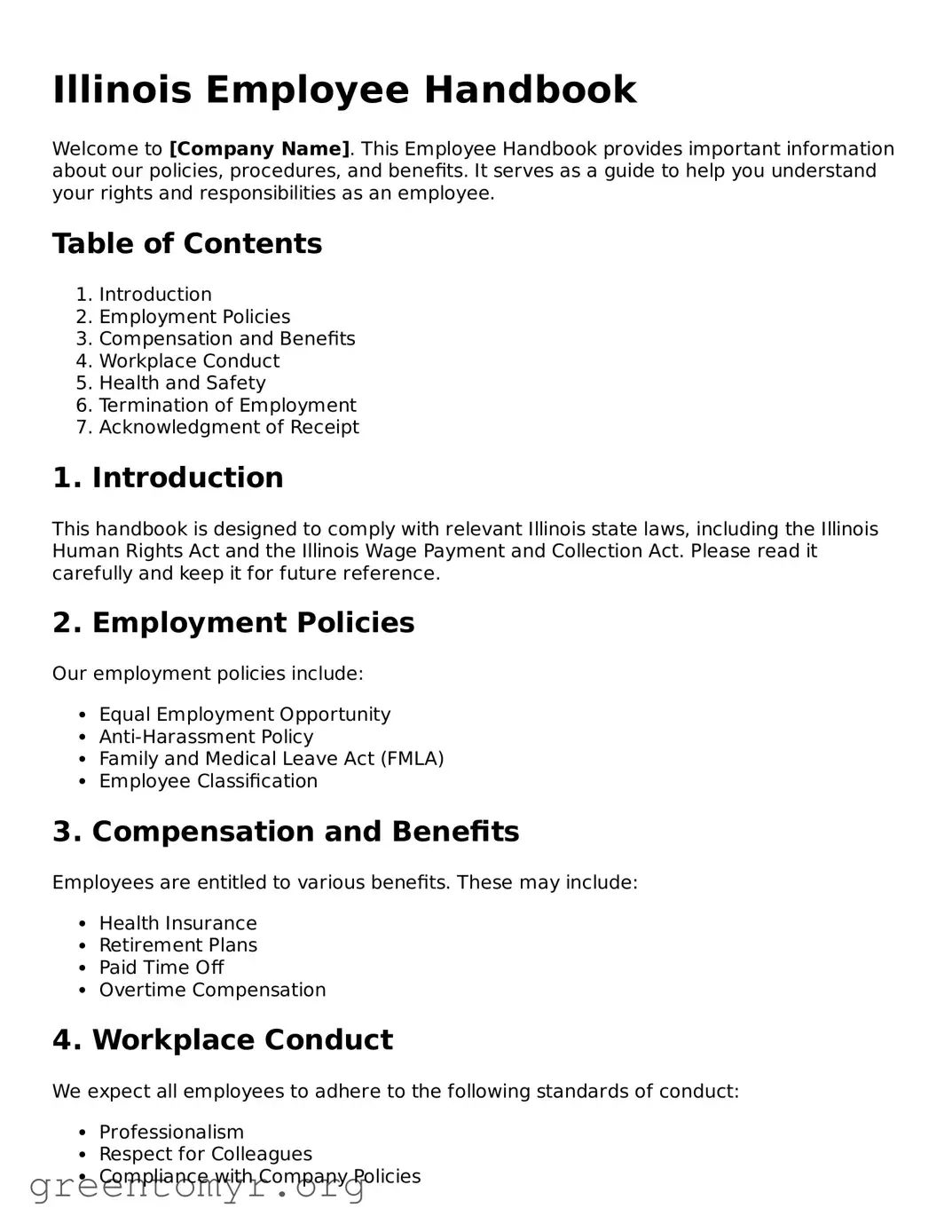
The Illinois Employee Handbook form serves as a crucial resource for employers and employees alike, outlining essential workplace policies and expectations. This document typically includes sections on company culture, employee rights, and responsibilities, as well as procedures for addressing grievances. Additionally, it often details benefits, workplace safety protocols, and guidelines for conduct, ensuring that both parties have a clear understanding of their roles within the organization. By providing a structured framework, the handbook helps foster a positive work environment and encourages compliance with state and federal regulations. Employers are advised to customize the form to reflect their unique operational needs while adhering to legal standards, thereby promoting transparency and accountability in the workplace.
Illinois Employee Handbook
Welcome to [Company Name]. This Employee Handbook provides important information about our policies, procedures, and benefits. It serves as a guide to help you understand your rights and responsibilities as an employee.
Table of Contents
1. Introduction
This handbook is designed to comply with relevant Illinois state laws, including the Illinois Human Rights Act and the Illinois Wage Payment and Collection Act. Please read it carefully and keep it for future reference.
2. Employment Policies
Our employment policies include:
3. Compensation and Benefits
Employees are entitled to various benefits. These may include:
4. Workplace Conduct
We expect all employees to adhere to the following standards of conduct:
5. Health and Safety
Employee safety is a priority. We are committed to maintaining a safe workplace by:
6. Termination of Employment
Termination may occur for various reasons, including:
7. Acknowledgment of Receipt
By signing below, you acknowledge that you have received and read the Employee Handbook.
Employee Name: [Employee Name]
Signature: [Signature]
Date: [Date]
For any questions regarding this handbook, please contact [HR Contact Name] at [HR Contact Information].
| Fact Name | Description |
|---|---|
| Purpose | The Illinois Employee Handbook form serves to outline company policies, procedures, and expectations for employees. |
| Legal Requirement | While not mandated by law, providing an employee handbook is considered a best practice for Illinois employers. |
| Content Recommendations | The handbook should include topics such as workplace conduct, anti-discrimination policies, and employee benefits. |
| Governing Laws | Relevant laws include the Illinois Human Rights Act and the Fair Labor Standards Act. |
| Distribution | Employers should distribute the handbook to all employees and obtain acknowledgment of receipt. |
| Updates | Regular updates are essential to ensure compliance with changing laws and company policies. |
Completing the Illinois Employee Handbook form is an important step for both employers and employees. This process ensures that everyone is aware of their rights and responsibilities within the workplace. Below are the steps to effectively fill out the form.
The Illinois Employee Handbook form is a document that outlines the policies, procedures, and expectations of employees within an organization. It serves as a guide for employees, ensuring they understand their rights and responsibilities in the workplace.
An Employee Handbook is crucial for several reasons:
While not all employers are legally required to have an Employee Handbook, it is highly recommended for all businesses, regardless of size. Having a handbook can help clarify policies and protect both employees and employers from misunderstandings and disputes.
Key components of an Employee Handbook may include:
It is advisable to review and update the Employee Handbook at least annually or whenever there are significant changes in company policies or applicable laws. Keeping the handbook current ensures that employees have the most accurate information and helps mitigate potential legal risks.
Employees should be provided with a copy of the Employee Handbook upon hiring. Additionally, a meeting or training session can be held to discuss key policies and answer any questions. Regular reminders about the handbook should be communicated, especially after updates.
If an employee has questions regarding the Employee Handbook, they should reach out to their supervisor or the Human Resources department. Open communication is encouraged to clarify any uncertainties and ensure everyone understands the policies in place.
Yes, an Employee Handbook can be used as evidence in legal disputes. If the policies outlined in the handbook are clear and consistently enforced, they can help protect the employer in cases of wrongful termination or discrimination claims. It is vital to ensure that the handbook is comprehensive and reflects actual practices.
While it is not mandatory, having a lawyer review the Employee Handbook is highly recommended. Legal professionals can ensure that the handbook complies with state and federal laws, minimizing the risk of potential legal issues in the future.
If an employee does not receive a copy of the Employee Handbook, they may not be fully aware of their rights and responsibilities. This can lead to misunderstandings and disputes. Employers should ensure that all employees receive and acknowledge receipt of the handbook to foster a transparent workplace environment.
Filling out the Illinois Employee Handbook form is an important task that requires attention to detail. Many individuals make common mistakes that can lead to confusion or issues down the line. One frequent error is not reading the instructions carefully. Each section of the form has specific requirements. Skipping over these can result in incomplete or incorrect submissions.
Another mistake is providing inaccurate personal information. This includes things like misspelling names or entering incorrect addresses. Such errors can complicate communication and may lead to delays in processing important documents. It’s crucial to double-check all entries for accuracy.
Some people overlook the importance of signatures. Failing to sign the form or forgetting to date it can render the document invalid. A signature confirms that you have read and understood the policies outlined in the handbook. Always ensure that you sign and date where required.
Additionally, individuals sometimes neglect to ask questions if they are unsure about certain sections. The handbook may contain policies that are new or unclear. Not seeking clarification can lead to misunderstandings about workplace expectations. It’s better to ask for help than to make assumptions.
Lastly, many fail to keep a copy of the completed form. This can create problems if there are discrepancies later on. Retaining a copy allows you to reference what you submitted and ensures you have a record of your acknowledgment of the handbook’s policies. Keeping organized records is always a wise practice.
When developing an Illinois Employee Handbook, several other forms and documents can complement it. These documents help ensure compliance with state and federal laws, clarify policies, and enhance communication between employers and employees. Here’s a list of commonly used forms and documents:
These documents, when used alongside the Illinois Employee Handbook, create a comprehensive framework for managing employee relations and ensuring compliance with legal requirements. Together, they support a positive workplace culture and protect both the employer and employees.
When filling out the Illinois Employee Handbook form, it’s important to approach the task with care. Here are some essential dos and don'ts to keep in mind:
Many people have misunderstandings about the Illinois Employee Handbook form. Here are four common misconceptions:
While it is not legally required for every employer to have an employee handbook, it is highly recommended. A well-crafted handbook can help clarify policies and protect both employees and employers.
Some believe that the handbook must be written in complex legal language. In reality, a clear and straightforward handbook is more effective. It should be easy for employees to understand.
This is not true. An employee handbook should be reviewed and updated regularly. Changes in laws, company policies, or workplace culture may necessitate revisions.
Every business is unique, and so should be its handbook. A one-size-fits-all approach may not address specific needs or regulations relevant to a particular industry or company.
Filling out and using the Illinois Employee Handbook form is a crucial process for both employers and employees. Here are key takeaways to consider: