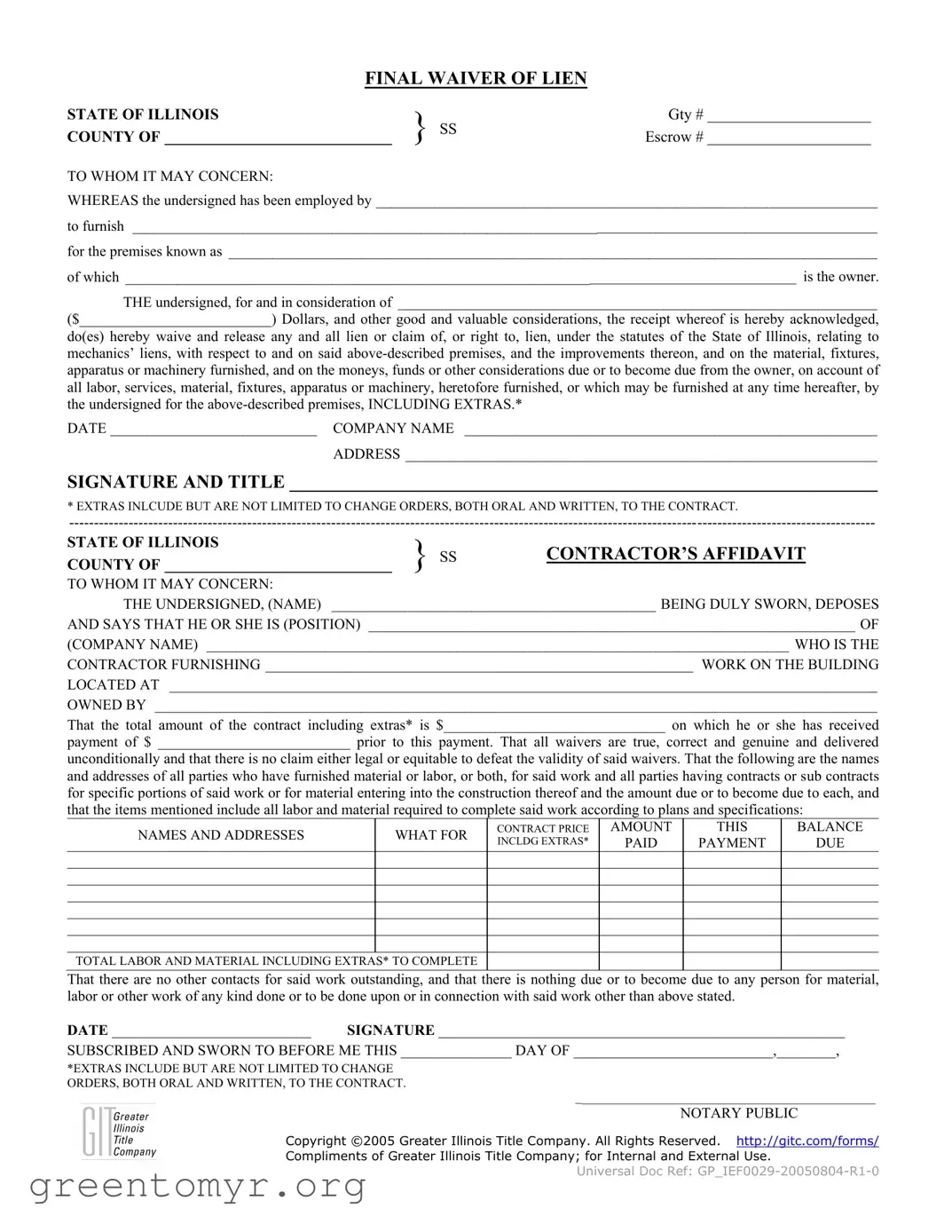
The Illinois Final Waiver of Lien form serves as a crucial document in the realm of construction and property transactions, ensuring that all parties involved have a clear understanding of their financial obligations and rights. This form is primarily utilized by contractors and subcontractors to formally relinquish their right to file a lien against a property once they have received payment for their services. It includes essential details such as the names of the parties involved, the specific work performed, and the total amount of the contract, including any extras or change orders that may have been agreed upon. By signing this waiver, the contractor acknowledges that they have received payment and confirms that no further claims will be made against the property in question. Additionally, the form requires a sworn affidavit from the contractor, affirming the accuracy of the information provided and declaring that all parties owed money for labor or materials have been accounted for. This dual structure not only protects property owners from potential lien claims but also provides contractors with a clear pathway to secure their payments while maintaining transparency in their dealings.
FINAL WAIVER OF LIEN
STATE OF ILLINOIS |
} SS |
Gty # _____________________ |
COUNTY OF _____________________________ |
Escrow # _____________________ |
TO WHOM IT MAY CONCERN:
WHEREAS the undersigned has been employed by ____________________________________________________________________
to furnish _____________________________________________________________________________________________________
for the premises known as ________________________________________________________________________________________
of which ___________________________________________________________________________________________ is the owner.
THE undersigned, for and in consideration of _________________________________________________________________
($__________________________) Dollars, and other good and valuable considerations, the receipt whereof is hereby acknowledged,
do(es) hereby waive and release any and all lien or claim of, or right to, lien, under the statutes of the State of Illinois, relating to mechanics’ liens, with respect to and on said
DATE ____________________________ COMPANY NAME ________________________________________________________
ADDRESS ________________________________________________________________
SIGNATURE AND TITLE _______________________________________________________________
* EXTRAS INLCUDE BUT ARE NOT LIMITED TO CHANGE ORDERS, BOTH ORAL AND WRITTEN, TO THE CONTRACT.
STATE OF ILLINOIS |
} SS |
CONTRACTOR’S AFFIDAVIT |
COUNTY OF _____________________________ |
||
TO WHOM IT MAY CONCERN: |
|
|
THE UNDERSIGNED, (NAME) ____________________________________________ BEING DULY SWORN, DEPOSES
AND SAYS THAT HE OR SHE IS (POSITION) __________________________________________________________________ OF
(COMPANY NAME) _______________________________________________________________________________ WHO IS THE
CONTRACTOR FURNISHING __________________________________________________________ WORK ON THE BUILDING
LOCATED AT ________________________________________________________________________________________________
OWNED BY __________________________________________________________________________________________________
That the total amount of the contract including extras* is $______________________________ on which he or she has received
payment of $ __________________________ prior to this payment. That all waivers are true, correct and genuine and delivered
unconditionally and that there is no claim either legal or equitable to defeat the validity of said waivers. That the following are the names and addresses of all parties who have furnished material or labor, or both, for said work and all parties having contracts or sub contracts for specific portions of said work or for material entering into the construction thereof and the amount due or to become due to each, and that the items mentioned include all labor and material required to complete said work according to plans and specifications:
NAMES AND ADDRESSES
WHAT FOR
CONTRACT PRICE INCLDG EXTRAS*
AMOUNT
PAID
THIS
PAYMENT
BALANCE
DUE
TOTAL LABOR AND MATERIAL INCLUDING EXTRAS* TO COMPLETE
That there are no other contacts for said work outstanding, and that there is nothing due or to become due to any person for material, labor or other work of any kind done or to be done upon or in connection with said work other than above stated.
DATE ___________________________ SIGNATURE _______________________________________________________
SUBSCRIBED AND SWORN TO BEFORE ME THIS _______________ DAY OF ___________________________,________,
*EXTRAS INCLUDE BUT ARE NOT LIMITED TO CHANGE
ORDERS, BOTH ORAL AND WRITTEN, TO THE CONTRACT.
________________________________________________
NOTARY PUBLIC
Copyright ©2005 Greater Illinois Title Company. All Rights Reserved. http://gitc.com/forms/
Compliments of Greater Illinois Title Company; for Internal and External Use.
Universal Doc Ref:
| Fact Name | Description |
|---|---|
| Purpose | The Illinois Final Waiver of Lien form is used to formally release any lien rights a contractor or subcontractor may have against a property after receiving payment for their services or materials. |
| Governing Law | This form is governed by the mechanics' lien statutes of the State of Illinois, which outline the rights and responsibilities related to lien claims in construction projects. |
| Consideration | In order to execute the waiver, the undersigned must acknowledge receipt of payment, which can be a specific dollar amount or other valuable consideration. |
| Extras Included | The waiver covers not only the original contract amount but also includes any extras, such as change orders, whether they are written or oral. |
Once you have gathered the necessary information, you can begin filling out the Illinois Final Waiver of Lien form. This form is essential for confirming that all payments have been made for work performed, and it serves to release any claims against the property. Following the steps below will help ensure that the form is completed accurately.
After completing the form, review it for accuracy and completeness before submitting it to the appropriate parties. Ensure that all necessary signatures and notary acknowledgments are present to avoid any potential issues in the future.
The Illinois Final Waiver of Lien form serves a crucial function in construction and contracting. It is used to release any claims or liens that a contractor, subcontractor, or supplier may have against a property once they have been paid for their work. By signing this document, the undersigned acknowledges receipt of payment and waives any future claims related to the work performed or materials supplied for the specified project. This ensures that the property owner can have peace of mind, knowing that they are free from any future financial claims related to the work completed.
Typically, the form needs to be signed by the contractor or subcontractor who has provided services or materials for the construction project. In some cases, suppliers of materials may also be required to sign. The individual signing must be in a position to legally bind the company, such as an owner or a designated officer. It is important that the person signing has the authority to confirm that all payments have been made and that no further claims will be pursued regarding the work performed.
To complete the Illinois Final Waiver of Lien form, several key pieces of information must be provided:
This information is essential to ensure that the waiver is valid and that all parties involved are aware of the terms and conditions related to the payment and the release of liens.
If the Final Waiver of Lien form is not signed, the property owner may still be liable for future claims related to the work performed. This could lead to potential legal disputes or financial liabilities if contractors or subcontractors assert their right to a lien on the property. Without this waiver, it is difficult for the owner to prove that they have fulfilled their payment obligations. Therefore, obtaining and properly executing this form is a vital step in protecting the interests of all parties involved in a construction project.
Filling out the Illinois Final Waiver of Lien form requires careful attention to detail. One common mistake is failing to provide complete information about the contractor or company. Ensure that the name of the company and the contractor’s position are clearly stated. Omitting this information can lead to confusion and potentially invalidate the waiver.
Another frequent error is neglecting to specify the amount received prior to signing the waiver. The form asks for the total contract amount and the payment received. If these figures are not accurately filled in, it may raise questions about the legitimacy of the waiver. Always double-check these amounts to avoid complications.
People often overlook the importance of listing all parties involved in the project. This includes anyone who has provided materials or labor. Failing to include all relevant names and addresses can create legal issues down the line. It is crucial to be thorough and ensure that no party is omitted from the documentation.
Additionally, individuals sometimes forget to sign and date the form. A signature is essential for the waiver to be considered valid. Without it, the waiver cannot be enforced, leaving the contractor vulnerable to potential liens. Make sure to sign and date the document before submitting it.
Another mistake is misunderstanding what constitutes "extras." The form specifies that extras include change orders, both oral and written. If these are not clearly identified, it could lead to disputes over what is covered under the waiver. Clarify any extras to avoid ambiguity.
Lastly, individuals may fail to have the waiver notarized. The notary's role is to verify the identity of the signer and the authenticity of the document. Without notarization, the waiver may not hold up in court. Always ensure that a notary public witnesses the signing of the waiver to protect against future claims.
The Illinois Final Waiver of Lien form is a crucial document in the construction industry, providing assurance that a contractor or supplier has received payment and waives their right to file a lien against the property. However, this form often accompanies several other documents that help clarify the financial and legal relationships between parties involved in a construction project. Below is a list of these important forms and documents.
In summary, these forms and documents work together to create a clear and transparent financial framework for construction projects in Illinois. They protect the rights of all parties involved and help ensure that payments are made timely and accurately, minimizing the risk of disputes and legal issues.
The Illinois Final Waiver of Lien form serves a specific purpose in the context of construction and property law. Several other documents share similarities with this waiver. Below are four such documents, each explained in terms of its relation to the Final Waiver of Lien.
When filling out the Illinois Final Waiver of Lien form, it is essential to follow certain guidelines to ensure accuracy and compliance. Below are nine things you should and shouldn't do.
Misconceptions about the Illinois Final Waiver of Lien form can lead to confusion among contractors, subcontractors, and property owners. Understanding these misconceptions is crucial for ensuring that all parties are on the same page. Here are nine common misconceptions:
Understanding these misconceptions helps all parties navigate the complexities of construction contracts and lien rights in Illinois.
Filling out and using the Illinois Final Waiver of Lien form is an important step in ensuring that all parties involved in a construction project are protected. Here are some key takeaways to consider:
By following these guidelines, you can effectively utilize the Illinois Final Waiver of Lien form to protect your rights and interests in construction projects.