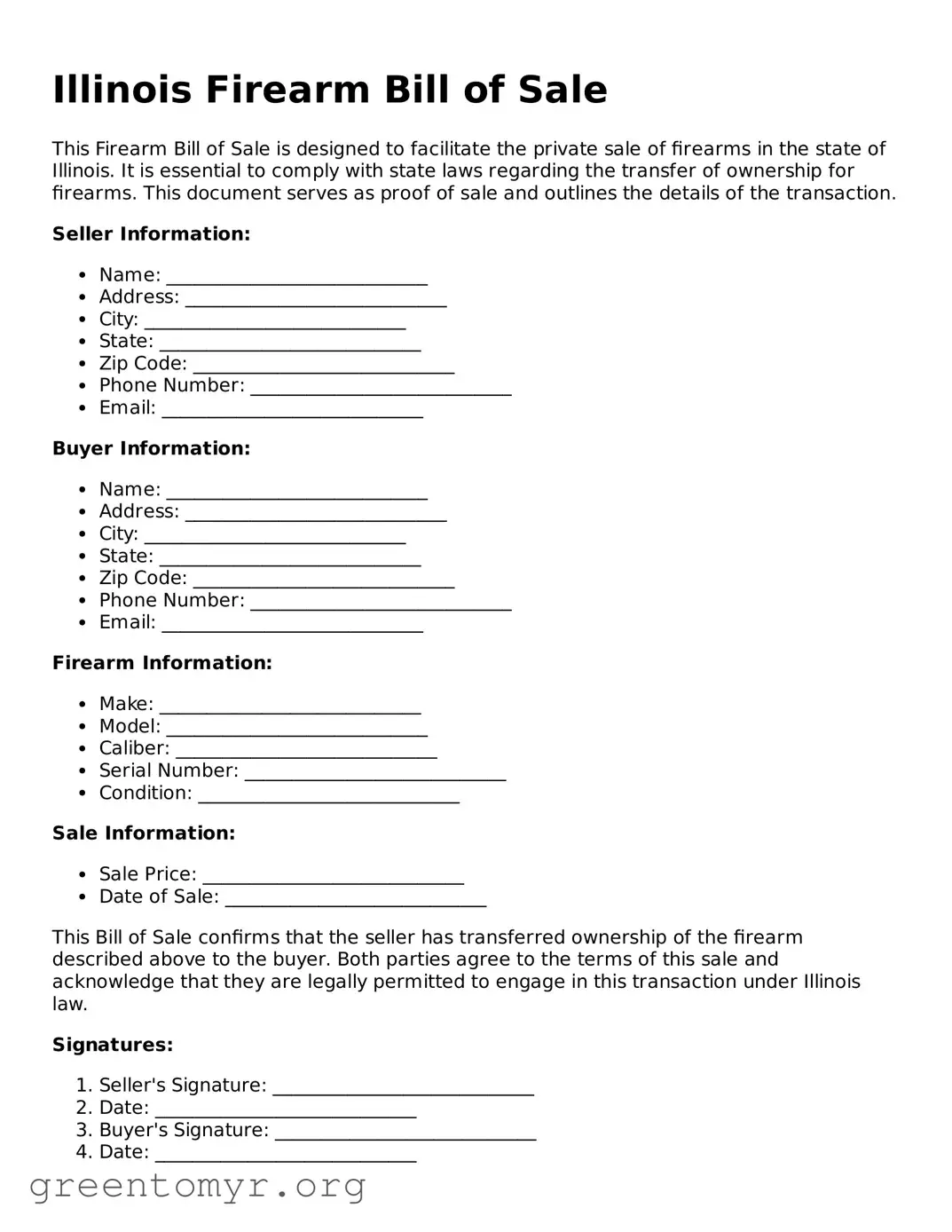
The Illinois Firearm Bill of Sale form is an essential document for individuals engaging in the private sale or transfer of firearms within the state. This form serves as a legal record, capturing crucial details about the transaction, including the buyer's and seller's information, the firearm's description, and the sale date. It is important for both parties to accurately complete the form to ensure compliance with state laws and to protect their rights. The document may also include sections for signatures, which validate the agreement and confirm that both parties understand the terms of the sale. By using this form, individuals can help prevent future disputes and provide proof of ownership, which can be beneficial for legal and personal reasons. Understanding the components of the Illinois Firearm Bill of Sale form is vital for anyone involved in firearm transactions in the state.
Illinois Firearm Bill of Sale
This Firearm Bill of Sale is designed to facilitate the private sale of firearms in the state of Illinois. It is essential to comply with state laws regarding the transfer of ownership for firearms. This document serves as proof of sale and outlines the details of the transaction.
Seller Information:
Buyer Information:
Firearm Information:
Sale Information:
This Bill of Sale confirms that the seller has transferred ownership of the firearm described above to the buyer. Both parties agree to the terms of this sale and acknowledge that they are legally permitted to engage in this transaction under Illinois law.
Signatures:
By signing this document, both parties affirm that the information provided is accurate and complete to the best of their knowledge. It is recommended that both parties retain a copy of this Bill of Sale for their records.
| Fact Name | Details |
|---|---|
| Purpose | The Illinois Firearm Bill of Sale form serves as a legal document to record the transfer of ownership of a firearm between a seller and a buyer. |
| Governing Law | This form is governed by the Illinois Compiled Statutes, specifically 430 ILCS 65/2, which outlines the requirements for firearm transfers. |
| Information Required | The form must include the names, addresses, and signatures of both the buyer and the seller, along with the firearm's make, model, and serial number. |
| Proof of Eligibility | Buyers must provide proof of eligibility to own a firearm, typically through a valid Firearm Owner's Identification (FOID) card. |
| Notarization | While notarization is not required, having the document notarized can provide additional legal protection for both parties. |
| Record Keeping | Both the buyer and seller should keep a copy of the completed Bill of Sale for their records, as it may be required for future reference. |
| Legal Consequences | Failure to properly complete the Bill of Sale can result in legal issues, including penalties for unlawful firearm transfer. |
| State-Specific | This form is specific to Illinois and may differ from firearm bill of sale forms in other states, reflecting local laws and regulations. |
Filling out the Illinois Firearm Bill of Sale form is an important step in the process of legally transferring ownership of a firearm. This document serves as proof of the transaction between the seller and buyer. To ensure a smooth experience, follow the steps outlined below carefully.
The Illinois Firearm Bill of Sale form is a legal document that records the sale or transfer of a firearm between two parties. It serves as proof of the transaction and includes essential details about the firearm, the buyer, and the seller.
While the Firearm Bill of Sale is not legally required in Illinois for private sales, it is highly recommended. This document can protect both the buyer and seller by providing a record of the transaction, which may be useful in case of future disputes or legal issues.
The form should include the following information:
While a generic Bill of Sale may suffice, using a specific Firearm Bill of Sale is advisable. This ensures that all relevant details about the firearm and the transaction are clearly documented, reducing the risk of misunderstandings.
No, notarization is not required for the Firearm Bill of Sale in Illinois. However, having it notarized can add an extra layer of authenticity and may be beneficial if any disputes arise in the future.
When selling a firearm to someone from another state, both federal and state laws must be followed. It is crucial to ensure that the buyer is legally allowed to possess firearms in their state. Additionally, using a Bill of Sale can help document the transaction.
If you lose your Firearm Bill of Sale, it is advisable to create a new document reflecting the transaction details. Both parties should sign this new document to maintain a record of the sale. Keeping a copy for future reference is important.
Once the transaction is complete, both the buyer and seller should retain copies of the Firearm Bill of Sale. If one party loses their copy, they may request a duplicate from the other party, provided that both parties agree to it.
The Illinois Firearm Bill of Sale form can be obtained from various online legal resources, local gun shops, or firearm associations. It is important to ensure that the form used complies with state laws and includes all necessary information.
When filling out the Illinois Firearm Bill of Sale form, many people make common mistakes that can lead to complications. One frequent error is not providing complete information. Buyers and sellers must ensure that all fields are filled out accurately. Missing details can delay the process or even invalidate the sale.
Another mistake involves incorrect identification. It's crucial to include the correct names and addresses of both parties. If there are typos or mismatches, this can create issues down the line. Always double-check that the information matches the identification documents.
Some individuals forget to include the firearm details. The make, model, and serial number of the firearm must be clearly stated. Omitting this information can lead to confusion and potential legal problems. Ensure that these details are accurate and complete.
Additionally, failing to sign the document is a common oversight. Both the buyer and seller must sign the form for it to be valid. Without signatures, the document holds no legal weight. It’s essential to remember this step before completing the transaction.
Lastly, many people do not keep a copy of the Bill of Sale. After completing the form, it’s important to retain a copy for personal records. This documentation can be vital for future reference or if any disputes arise. Make sure to store it in a safe place.
When buying or selling a firearm in Illinois, it's important to have the right documentation in place. The Illinois Firearm Bill of Sale form is a key document, but several other forms and documents are often used alongside it to ensure a smooth transaction. Here’s a brief overview of these additional documents.
Having these documents ready can help ensure compliance with Illinois laws and provide peace of mind for both buyers and sellers. Proper documentation is essential for a safe and legal firearm transaction.
Vehicle Bill of Sale: This document serves as proof of the transfer of ownership for a vehicle. Similar to the Firearm Bill of Sale, it includes details about the buyer, seller, and the vehicle itself, ensuring that both parties have a record of the transaction.
Boat Bill of Sale: Like the Firearm Bill of Sale, this form documents the sale of a boat. It includes information about the boat, the seller, and the buyer, providing legal protection and clarity for both parties involved in the transaction.
Personal Property Bill of Sale: This document is used for the sale of personal items, such as electronics or furniture. It outlines the terms of the sale and includes details about the item and the parties involved, similar to how a Firearm Bill of Sale functions.
Real Estate Purchase Agreement: While more complex, this agreement formalizes the sale of real property. It includes the buyer and seller's information, property details, and terms of sale, paralleling the structure and purpose of a Firearm Bill of Sale.
Lease Agreement: This document outlines the terms under which one party agrees to rent property from another. It includes details about the property, the parties involved, and the rental terms, resembling the clarity and formal nature of a Firearm Bill of Sale.
When filling out the Illinois Firearm Bill of Sale form, it is important to approach the process with care. Here are some guidelines to help ensure that you complete the form correctly.
By following these guidelines, you can help ensure that the transaction is smooth and compliant with Illinois law.
Understanding the Illinois Firearm Bill of Sale form is crucial for both buyers and sellers. However, several misconceptions can lead to confusion. Here are seven common misunderstandings:
Addressing these misconceptions can help ensure that firearm transactions are conducted smoothly and legally in Illinois.
When filling out and using the Illinois Firearm Bill of Sale form, it is essential to keep several key points in mind. This document serves as a legal record of the sale or transfer of a firearm. Here are ten important takeaways:
By following these guidelines, you can ensure that your firearm transaction in Illinois is conducted legally and smoothly.