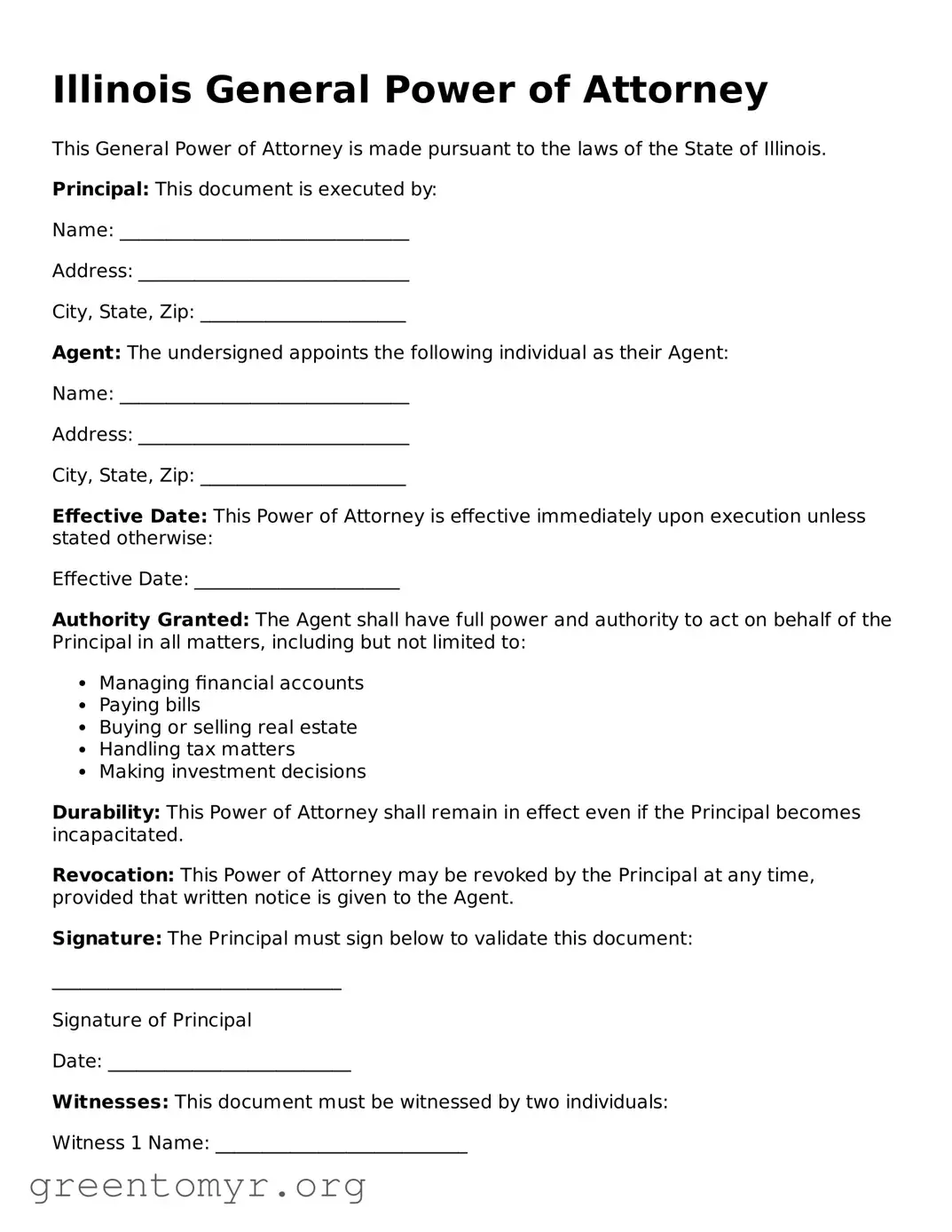
In Illinois, the General Power of Attorney form serves as a crucial legal document that empowers an individual, known as the "agent" or "attorney-in-fact," to act on behalf of another person, referred to as the "principal." This form is particularly important for individuals who wish to delegate authority for financial and legal matters, ensuring that their affairs can be managed effectively in their absence or if they become unable to make decisions for themselves. The document allows the agent to perform a variety of tasks, such as managing bank accounts, signing contracts, and handling real estate transactions. Importantly, the General Power of Attorney can be tailored to fit specific needs; it can be broad or limited in scope, depending on the principal's preferences. Additionally, the form must be signed and dated by the principal in the presence of a witness or a notary public to ensure its validity. Understanding the implications of this document is essential, as it grants significant authority to the agent, making it vital for individuals to choose someone they trust implicitly. By preparing this form, individuals can have peace of mind knowing that their financial and legal matters will be taken care of according to their wishes, even if they are not in a position to manage them themselves.
Illinois General Power of Attorney
This General Power of Attorney is made pursuant to the laws of the State of Illinois.
Principal: This document is executed by:
Name: _______________________________
Address: _____________________________
City, State, Zip: ______________________
Agent: The undersigned appoints the following individual as their Agent:
Name: _______________________________
Address: _____________________________
City, State, Zip: ______________________
Effective Date: This Power of Attorney is effective immediately upon execution unless stated otherwise:
Effective Date: ______________________
Authority Granted: The Agent shall have full power and authority to act on behalf of the Principal in all matters, including but not limited to:
Durability: This Power of Attorney shall remain in effect even if the Principal becomes incapacitated.
Revocation: This Power of Attorney may be revoked by the Principal at any time, provided that written notice is given to the Agent.
Signature: The Principal must sign below to validate this document:
_______________________________
Signature of Principal
Date: __________________________
Witnesses: This document must be witnessed by two individuals:
Witness 1 Name: ___________________________
Witness 1 Signature: ________________________
Date: __________________________
Witness 2 Name: ___________________________
Witness 2 Signature: ________________________
Date: __________________________
Notarization: This document must be notarized:
State of Illinois
County of _______________________
Subscribed and sworn to before me this _____ day of __________, 20__.
_______________________________
Notary Public Signature
My commission expires: ________________
| Fact Name | Details |
|---|---|
| Definition | The Illinois General Power of Attorney form allows an individual (the principal) to appoint someone else (the agent) to make decisions on their behalf regarding financial and legal matters. |
| Governing Law | This form is governed by the Illinois Power of Attorney Act, specifically 755 ILCS 45/2-1 et seq. |
| Durability | The power of attorney can be made durable, meaning it remains effective even if the principal becomes incapacitated, unless stated otherwise in the document. |
| Revocation | The principal can revoke the General Power of Attorney at any time, as long as they are mentally competent to do so. |
| Signature Requirements | The form must be signed by the principal and witnessed by at least one person or notarized to be legally valid. |
After obtaining the Illinois General Power of Attorney form, you'll need to fill it out carefully to ensure it meets all requirements. Once completed, the form will need to be signed and possibly notarized, depending on your specific situation.
A General Power of Attorney (POA) in Illinois is a legal document that allows one person, known as the "principal," to grant another person, called the "agent" or "attorney-in-fact," the authority to act on their behalf. This authority can cover a wide range of financial and legal matters, making it a versatile tool for managing affairs when the principal is unable to do so themselves.
The powers granted under a General Power of Attorney can include, but are not limited to:
It is important to note that the specific powers can be tailored to meet the principal's needs and preferences.
In Illinois, any adult who is of sound mind can create a General Power of Attorney. This means that the individual must understand the implications of the document and be capable of making informed decisions. It is crucial that the principal is not under duress or undue influence when signing the document.
To execute a General Power of Attorney in Illinois, the following steps must be taken:
It is advisable to keep copies of the signed document for both the principal and the agent.
Yes, a General Power of Attorney can be revoked at any time by the principal, as long as they are still of sound mind. To revoke the document, the principal should create a written revocation notice and notify the agent and any relevant third parties. It is a good practice to destroy any copies of the original POA to prevent confusion.
If the principal becomes incapacitated, the General Power of Attorney remains effective unless it is specifically stated to terminate upon incapacity. This means the agent can continue to act on behalf of the principal, managing their affairs as needed. However, if the principal wishes to have a different arrangement, they may consider establishing a Durable Power of Attorney, which remains in effect even if the principal becomes incapacitated.
No, a General Power of Attorney and a Healthcare Power of Attorney are not the same. A General Power of Attorney primarily focuses on financial and legal matters, while a Healthcare Power of Attorney specifically grants authority to make medical decisions on behalf of the principal. It is possible to have both documents, allowing for comprehensive management of both financial and healthcare decisions.
Yes, there can be limitations. The principal can specify which powers the agent does or does not have. Additionally, certain actions, such as making a will or changing beneficiaries, are generally not allowed under a General Power of Attorney. It's important for the principal to clearly outline their wishes in the document to avoid any misunderstandings.
General Power of Attorney forms can be obtained from various sources, including:
When selecting a form, ensure that it complies with Illinois state law and meets your specific needs.
Filling out the Illinois General Power of Attorney form can be a crucial step in ensuring that your financial and medical decisions are managed according to your wishes. However, many individuals make common mistakes that can lead to complications down the road. Awareness of these pitfalls can help you navigate the process more smoothly.
One frequent error is failing to specify the powers granted. The form allows you to choose specific powers for your agent, such as handling financial transactions or making healthcare decisions. If you leave these sections vague or unchecked, your agent may not have the authority to act on your behalf in critical situations. Clearly outlining the powers you wish to grant can prevent confusion and ensure your needs are met.
Another common mistake is neglecting to sign and date the form correctly. The Illinois General Power of Attorney requires your signature, and it must be dated. If you forget to sign or fail to date the document, it may not be considered valid. Double-checking your signature and date can save you from potential disputes or challenges in the future.
Additionally, many people overlook the importance of choosing a reliable agent. Selecting someone who is trustworthy and capable of managing your affairs is vital. A hasty decision can lead to issues later on, especially if your agent does not fully understand your wishes or lacks the necessary skills to handle complex situations. Take your time to choose someone who aligns with your values and can act in your best interest.
Another mistake often made is not having the form witnessed or notarized, when required. In Illinois, while it is not mandatory for all General Power of Attorney forms, having a witness or notary can add an extra layer of protection. This step can help verify the authenticity of your signature and your mental capacity at the time of signing, which can be crucial if the document is ever challenged.
Finally, failing to communicate your wishes with your agent can lead to misunderstandings. It’s essential to have an open dialogue about your expectations and preferences. Discussing your goals and concerns ensures that your agent is prepared to make decisions that align with your values. By fostering this communication, you can provide peace of mind for both yourself and your loved ones.
The Illinois General Power of Attorney form is a crucial document that allows individuals to designate someone to make decisions on their behalf. However, several other forms and documents can complement this power of attorney, enhancing its effectiveness and ensuring comprehensive legal coverage. Below is a list of commonly used documents that often accompany the General Power of Attorney in Illinois.
Incorporating these documents alongside the Illinois General Power of Attorney can create a robust framework for managing both health and financial decisions. Each document serves a unique purpose, ensuring that an individual's wishes are respected and upheld in various circumstances.
A General Power of Attorney (GPA) is a powerful legal document that grants someone the authority to act on your behalf in various matters. However, it is not the only document that serves a similar purpose. Here are five other documents that share similarities with the General Power of Attorney:
Understanding these documents can help individuals make informed decisions about their legal and financial matters. Each serves a unique purpose but ultimately revolves around the delegation of authority and decision-making.
When filling out the Illinois General Power of Attorney form, it's important to approach the process with care. Here are some guidelines to help you navigate this task effectively.
When it comes to the Illinois General Power of Attorney form, several misconceptions can lead to confusion. Understanding the facts can help individuals make informed decisions. Here are six common misconceptions:
Many people believe that a General Power of Attorney is limited to financial matters. In reality, it can cover a wide range of decisions, including healthcare and property management, depending on how it is drafted.
Some assume that a General Power of Attorney continues to be effective after the principal's death. This is incorrect. The authority granted by the document ends when the principal passes away.
While it is true that you can choose anyone to be your agent, it is crucial to select someone trustworthy and capable. Not everyone is suited for the responsibilities that come with this role.
This is a common misunderstanding. A General Power of Attorney can be revoked at any time, as long as the principal is mentally competent. A written revocation notice is typically required.
While notarization is highly recommended for a General Power of Attorney to ensure its acceptance, it is not strictly required. However, witnesses are needed for the document to be valid.
Many believe that a standard form will suffice for everyone. In truth, a General Power of Attorney should be tailored to meet individual needs and circumstances to be truly effective.
By addressing these misconceptions, individuals can better understand the implications and uses of the Illinois General Power of Attorney form.
Filling out and using the Illinois General Power of Attorney form is an important step for anyone looking to designate someone to make decisions on their behalf. Here are some key takeaways to consider:
Being informed about the Illinois General Power of Attorney form can help you make better decisions regarding your personal and financial affairs.